A proposed U.S. federal recycled-content rule targeting plastic components in light vehicles, including interior trim and panels, is advancing toward finalization, placing automakers and Tier-1 polymer suppliers under mounting pressure to restructure material sourcing and supply chains. Developed under the EPA's Comprehensive Procurement Guideline (CPG) program, the rule would establish the first federal mandate specifically addressing recycled polymer content in vehicle components - a measure that industry analysts say could reshape resin procurement and cost structures across the domestic automotive supply chain.
Background
The EPA's CPG program, authorized under Section 6002 of the Resource Conservation and Recovery Act (RCRA), requires federal agencies to prioritize products made with recovered materials. EPA designated vehicular products under the CPG program to promote the use of materials recovered from municipal solid waste, with recycled-content recommendations listed for each item. However, the program's existing vehicular designations have historically been confined to ancillary products. Current CPG categories for vehicular products cover engine coolants, rebuilt vehicular parts, re-refined lubricating oils, and retread tires - leaving interior polymer components outside any mandatory federal framework.
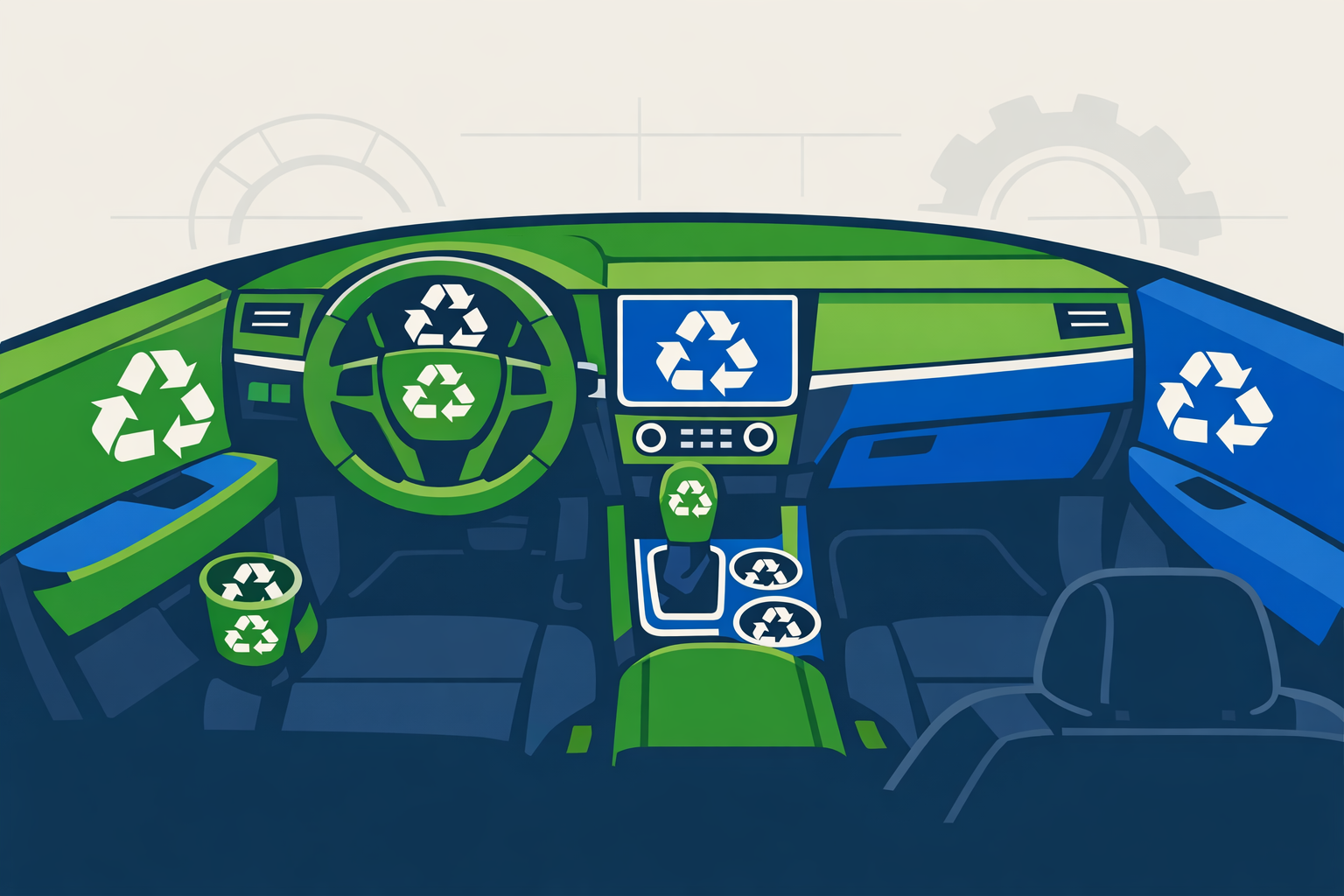
The proposed expansion would change that by introducing minimum post-consumer recycled (PCR) content thresholds for light-vehicle interior plastics such as dashboard substrates, door panel skins, and center console housings. These components predominantly employ ABS, PC/ABS blends, and modified polyolefins - material families that present distinct challenges for post-consumer recovery and automotive-grade requalification.
The move follows growing international precedent. In December 2025, EU co-legislators reached a provisional agreement on a new End-of-Life Vehicles (ELV) Regulation. Under that agreement, the plastic used in each new vehicle type must contain a minimum of 15% recycled plastic within six years of the rules' entry into force and 25% within ten years. Additionally, 20% of these targets must be achieved by including plastics recycled from end-of-life vehicles or from parts and components removed from vehicles during the use phase - a closed-loop requirement.
In the United States, state-level PCR legislation has accumulated rapidly. As of 2025, five states have enacted laws requiring certain containers and packages to meet minimum recycled-content standards. By late 2025, California, Colorado, Maine, Maryland, Minnesota, Oregon, and Washington had rolled out extended producer responsibility (EPR) programs for packaging. The proposed federal vehicle rule would represent a significant escalation - extending mandatory PCR requirements beyond packaging into durable goods manufacturing.
Details
The proposed rule is expected to introduce a tiered credit structure for recycled content, distinguishing between post-consumer and post-industrial recovered materials, with higher credits assigned to content sourced from end-of-life vehicle plastics. This structure mirrors the closed-loop preference embedded in the EU's ELV Regulation and is designed to incentivize domestic investment in automotive-grade recycling infrastructure rather than reliance on cheaper imported recyclate. Imported recycled plastic has become less expensive over the past year, prompting some companies to favor it over domestically recycled plastics - a trend the federal rule aims to counteract through domestic content preferences.
OEMs and Tier-1 suppliers face material qualification challenges that extend beyond procurement. Plastics comprise roughly 20% of a modern vehicle's weight and appear in interior, exterior, and structural parts; interior components like dashboards, door panels, center consoles, and seat bases often use ABS, PC/ABS blends, and modified polyolefins. Validating recycled-content variants of these polymers against crash, flammability, and aesthetic specifications requires significant engineering effort and capital outlay.
Some automakers and suppliers are already making progress. Nissan and BMW have incorporated recycled content into vehicle interiors and structural components, while Stellantis and Renault are expanding closed-loop plastic recovery programs in partnership with recyclers and dismantlers. Stellantis has announced a target of 40% recycled content in vehicle plastics by 2030, according to reporting by Plastics Engineering. Leading material suppliers such as BASF and Covestro are investing in next-generation sustainable polymers to support growing demand for high-performance recycled and bio-based materials.
Supply-side constraints remain a central concern. Among the most immediate challenges is the availability of automotive-grade recycled plastics; most scrapped plastics today are either incinerated or downcycled due to the lack of standardized collection and processing systems. An analysis by the EU's Joint Research Centre found that roughly 3% of plastics that go into car manufacturing end up in the recyclates market.
Cost impact is another key variable. Under a tiered credit structure, suppliers sourcing lower-tier post-industrial material may face narrower price advantages over virgin resin, while those investing in certified post-consumer automotive recyclate - a higher-credit category - face significant upfront qualification costs. Procurement specialists and R&D engineers will need to assess total cost of compliance across resin families, not simply the spot price differential between virgin and recycled grades.
Outlook
The rule is subject to public comment and interagency review before final adoption, with a phased rollout anticipated to give OEMs and Tier-1 suppliers several model years to transition. The ability of automakers to comply will depend on supply chain collaboration, investment in recycling technologies, and regulatory flexibility in the coming years, according to IDTechEx. IDTechEx's latest market forecast projects that sustainable plastics content in vehicles will reach 18% by 2035, with recycled plastics accounting for 15% and bio-based plastics making up the remaining 3%. Suppliers that accelerate domestic PCR qualification programs and closed-loop partnerships ahead of finalization stand to gain a compliance and commercial advantage as the rule takes effect.