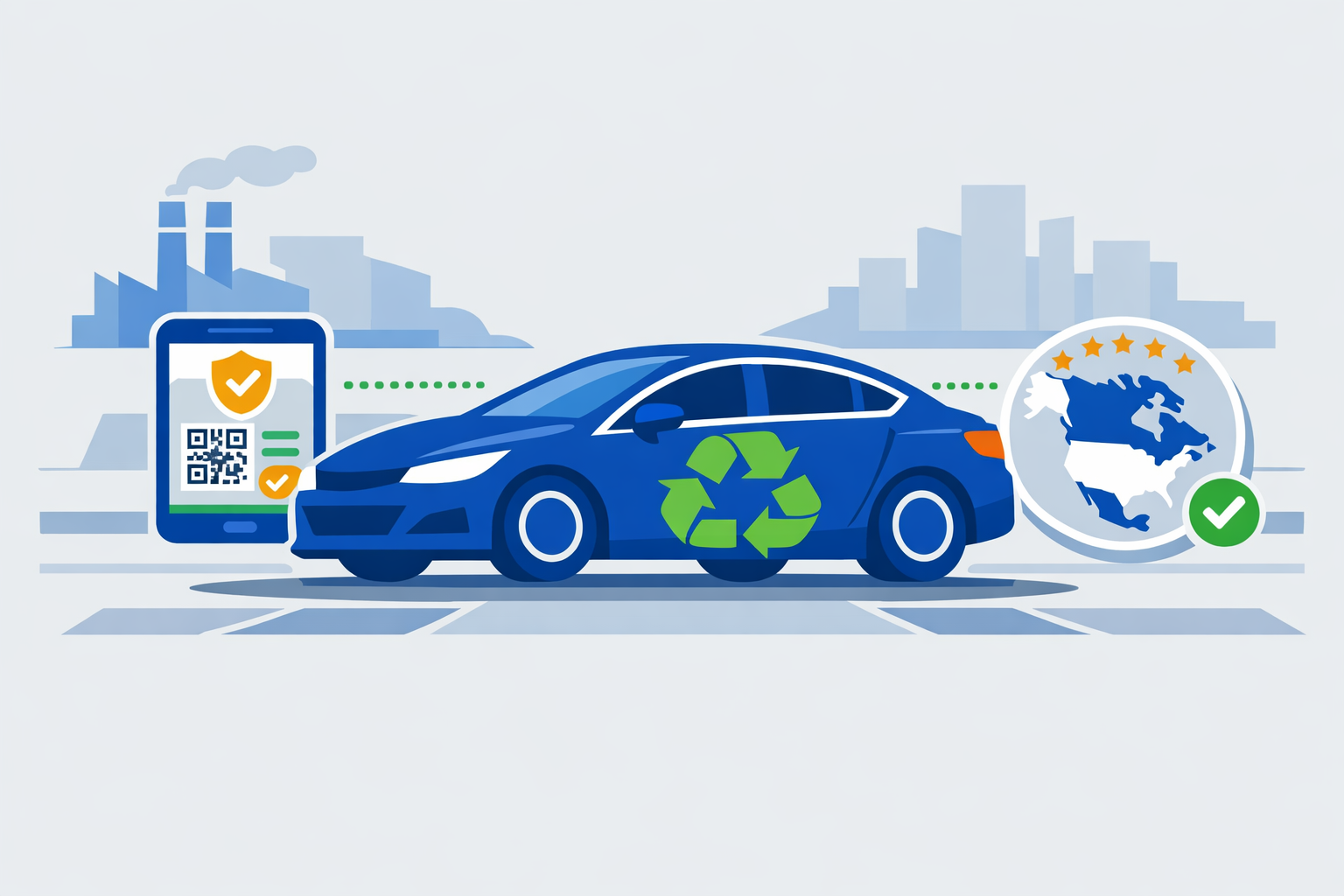
The modern vehicle interior-comprising dashboards, door trims, headliners, and seating components-represents one of the most plastic-intensive environments in any manufactured product. Now, that interior is at the center of a federal regulatory reckoning. A U.S. rule governing minimum post-consumer recycled (PCR) content in automotive interior plastics is approaching finalization, and its implications for OEMs, Tier-1 suppliers, and the recycled-polymer supply chain are substantial.
The global post-consumer recycled plastics in automotive market was estimated at $11.92 billion in 2024 and is projected to grow at a compound annual growth rate of 11.1% through 2030. That trajectory is no longer driven solely by voluntary corporate sustainability pledges. Regulatory architecture is hardening-and the interior plastics rule is its most targeted expression yet in the U.S. automotive context.
What the Rule Would Establish
The proposed federal rule would codify minimum PCR content thresholds for specified interior part categories and introduce verification and traceability protocols binding on OEMs and their supply chains. Unlike previous voluntary guidelines under the EPA's Comprehensive Procurement Guidelines, the forthcoming rule is designed to be prescriptive: specific percentage targets by component type, a defined cadence for meeting them, and restrictions on which certified recycled materials qualify for durable automotive applications.
Key structural elements under active discussion include:
- PCR content minimums by part category (instrument panels, door trims, headliners, and center consoles are primary targets)
- Verification and chain-of-custody certification requirements, including third-party audit triggers
- Material data sheet and labeling standards to substantiate recycled content claims at the component level
- Permissible recycled material definitions-a critical question given feedstock variability across post-consumer waste streams
Regulators have emphasized lifecycle transparency throughout the rulemaking process, with accountability required end-to-end: from waste collection and sortation through resin formulation, compounding, and final component certification.
The Global Context: EU Precedents and International Alignment
The U.S. rule does not emerge in isolation. The European Union has set a globally significant benchmark, having mandated that new vehicles incorporate at least 15% recycled plastic within six years and 25% within ten years, with a minimum of 20% of that content sourced via closed-loop recycling from end-of-life vehicles. Multiple analyses have covered the EU's evolving automotive composites framework, which provides a regulatory model U.S. rulemakers are examining closely.
The U.S. rule is expected to align-at least directionally-with European verification standards, potentially harmonizing some international trade and certification processes. For multinational OEMs operating across both markets, convergence would reduce compliance duplication; for domestic-only suppliers, it raises the bar significantly.
On the polymer side, the composition of demand is already shifting. PCR-PP and PCR-ABS collectively represent nearly 55% of the automotive interior PCR material market, driven by their balance of strength, impact resistance, thermal stability, and aesthetic versatility. PCR-PP dominates structural and semi-structural interior components, while PCR-ABS is increasingly specified for decorative trims and visible surfaces where texture and color consistency are critical.
OEM Pilot Programs and Material Performance
Automakers are not waiting for final rulemaking. PCR pilot programs are already running across multiple interior subsystems-instrument panels, door trims, and headliners-with OEMs testing performance, safety, and aesthetics against virgin-resin benchmarks.
Major North American automakers including Ford have pledged to use at least 20% recycled content across their vehicle lineup by 2025, while GM has targeted 50% sustainable materials in all vehicles by 2030. These commitments are pulling supplier investment forward, creating de facto validation timelines ahead of federal finalization.
The technical case for PCR integration is strengthening. Advancements in polymer blending and additive technology now allow recycled polypropylene and polyethylene to meet the safety and performance standards required by automotive OEMs. Suppliers such as Borealis have demonstrated this in production applications: Borealis introduced Borcycle GD3600SY, a glass fiber-reinforced polypropylene compound with 65% post-consumer recycled polymer content, which was applied in the center console structure of the Peugeot 3008.
Challenges persist, however. Feedstock variability, surface finish consistency, and the molding behavior of recycled grades under complex geometries remain active areas of material development. Consistent compounding and thermal processing control are prerequisites for achieving predictable mechanical behavior in crash, thermal, and flammability testing-all mandatory for automotive approval.
The Traceability Imperative
Perhaps the most operationally demanding aspect of the anticipated rule is its traceability framework. The proposed regime would require end-to-end supply-chain accountability-documentation tracing recycled content from its waste-stream origin through processing, resin formulation, and final component manufacturing.
For polymer suppliers and compounders, this means investing in:
- Chain-of-custody certification aligned with third-party PCR verification programs (analogous to California and Oregon's existing requirements for packaging)
- Updated material data sheets that quantify and certify PCR content percentages per lot or batch
- Digital audit trails capable of supporting OEM supplier qualification processes and regulatory inspections
Third-party certification for post-consumer recycled content provides transparency and assurance, and is increasingly embedded in legal requirements across jurisdictions. In the automotive context, where component failure carries safety and liability consequences, the documentation bar is materially higher than in packaging.
OEMs are expected to push verification burdens downstream, requiring validated recycled-content and sustainability data across their Tier-1 and Tier-2 supplier networks.
PCR vs. Virgin Resin: The Compliance Calculus
The rule's finalization will force a structured reassessment of material sourcing decisions across the automotive interior supply chain. The table below summarizes the key dimensions of that calculus:
| Factor | Virgin Resin | PCR Automotive Grade |
|---|---|---|
| Feedstock origin | Petrochemical (crude oil/naphtha) | Post-consumer waste streams |
| Regulatory trajectory | Increasing scrutiny; surcharges likely | Preferred under PCR mandates |
| Performance parity | Baseline benchmark | Achievable via advanced compounding |
| Cost outlook (2025-2030) | Subject to crude oil volatility | Premium narrowing as supply scales |
| Traceability requirement | Limited documentation | Chain-of-custody certification required |
| Key interior polymers | PP, ABS, PC, TPE | PCR-PP, PCR-ABS (~55% of PCR demand) |
| OEM sustainability scoring | Negative contribution | Positive toward 2026/2030 targets |
PCR requirements strengthen market demand but do not by themselves generate additional supply. Demand-side mandates must be paired with supply-side policies-such as extended producer responsibility (EPR) programs, deposit return systems, and landfill bans-that directly incentivize households and businesses to recycle more. This supply-demand dynamic is central to the rule's viability and is expected to drive federal and state-level coordination on collection infrastructure.
Strategic Outlook: What Industry Stakeholders Should Monitor
Analysts caution that the final rule's scope will directly influence supplier contract structures, capital expenditure decisions on sortation and quality-control facilities, and the pace at which brands can meet 2026 and 2030 sustainability targets.
The global automotive interior trim components market using PCR materials is projected to reach $2.2 billion in 2026 and expand to $5.9 billion by 2036, registering a CAGR of 10.4% over the forecast period-propelled by the automotive industry's accelerating transition toward low-carbon manufacturing and compliance with tightening environmental regulations.
For R&D engineers, procurement specialists, and sustainability officers, the near-term priorities are clear:
- Monitor supplier qualification timelines-third-party PCR certification pipelines are not instantaneous, and qualification lead times may constrain model launch schedules
- Audit current PCR content libraries against anticipated thresholds by interior part category, identifying compliance gaps now
- Engage polymer suppliers on traceability readiness-not all compounders have chain-of-custody infrastructure in place
- Plan capital expenditure on sortation and QC with the rule's verification demands factored into facility upgrade timelines
- Track harmonization developments with EU ELV regulation, which could affect certification mutual recognition and trade flows
Note: The final rule's content thresholds, compliance cadence, and permissible material definitions remain subject to change pending public comment and interagency review. Stakeholders should monitor Federal Register publications and engage in the comment process to ensure industry perspectives are reflected in the final text.
The anticipated finalization marks a structural shift-not merely a reporting requirement, but a mandate that will reshape material selection, supplier qualification, and capital planning across the U.S. automotive interior supply chain for the decade ahead.