Advances in sulfur polymer chemistry are positioning a new class of antimicrobial materials for automotive interiors, prompting regulators, OEMs, and material scientists to assess environmental fate, antimicrobial resistance (AMR) risks, and end-of-life recyclability before commercial deployment scales.
The push reflects accelerating demand for hygienic cabin surfaces. Research cited by the National Center for Biotechnology Information has identified over 700 distinct bacterial strains on soft and hard surfaces within a typical vehicle, with the steering wheel, cupholders, and seat belts showing the highest concentrations of Colony Forming Units (CFUs). Since the COVID-19 pandemic, antibacterial treatments have drawn increased interest for their potential to reduce microbial contamination in vehicle cabins.
Background
The material class attracting the most scientific attention is produced via inverse vulcanization - a process that converts elemental sulfur, an industrial by-product, into functional polymers. Inverse vulcanization is a bulk polymerization method for synthesizing high-sulfur-content polymers from elemental sulfur with vinylic comonomers. More than 60 million tons of sulfur are produced as a by-product of the petrochemical industry annually, and the inverse vulcanization process transforms this surplus into functional polymers through stabilization with organic cross-linkers.
Interest in polysulfides as antimicrobials traces back to the bioactivity of natural organosulfur compounds. Polysulfides found in garlic and onions exhibit well-documented antimicrobial activity, driving exploration of synthetic analogues. Researchers at the University of Liverpool demonstrated that inverse vulcanized polymers - specifically sulfur-co-diisopropenylbenzene (S-DIB) and sulfur dicyclopentadiene (S-DCPD) - prevented the growth of Escherichia coli and Staphylococcus aureus, reporting the highest bacteria log reduction (>log 4.3) of adhered S. aureus cells to an inverse vulcanized sulfur polymer to date.
More recently, researchers reported a distinct approach: synthesizing a linear poly(trisulfide) via photochemical ring-opening polymerization of a cyclic trisulfide monomer bearing a carboxylic acid, where deprotonation renders the polymer fully water-soluble via S-S bond cleavage. The resulting poly(trisulfide) oligomers exhibited potent antifungal activity against Candida albicans (MIC < 8 µg/mL) and stronger inhibition of Staphylococcus aureus (MIC = 16 µg/mL) compared to Escherichia coli (MIC > 512 µg/mL).
The automotive sector is not the only industry responding to these developments. With tuneable properties, recyclability, and adaptable synthesis routes, inverse vulcanized polymers have been identified for applications including batteries, water purification, and advanced optical components. Several companies - including ThioTech, Outside the Box Materials, Uberbinder, and Clean Earth Technology - have achieved early commercial uptake, suggesting these polymers possess properties suitable for mainstream applications.
Details
The central technical advantage of non-leaching sulfur polymer surfaces lies in their potential relationship to AMR risk. Because the most likely mechanism of action in cross-linked inverse vulcanized sulfur polymers is homolytic bond cleavage rather than leaching of sulfur-containing compounds, their high material stability is considered desirable for long-term antibacterial surfaces - leaching-type surfaces can create concentration gradients that raise antimicrobial resistance concerns over time.
However, the water-soluble poly(trisulfide) prodrug approach presents a different profile. Antimicrobial resistance poses a growing threat to human health and agriculture. Regulators in Europe are already navigating analogous questions for conventional antimicrobial technologies: according to the European Chemicals Agency (ECHA), conventional antimicrobial silver technologies face challenges meeting Biocidal Products Regulation (BPR) requirements due to concerns over potential harm to human, animal, and ecological health, with many set for phase-out in the years ahead.
The automotive standardization landscape remains immature for novel polymer-based antimicrobials. Performance standards such as ISO 20743, AATCC 100, ISO 22196, and the ECHA Biocidal Products Regulation establish baseline compliance requirements, but smart textile integration lacks mature standardization as of 2025, creating both regulatory risk and market opportunity. OEM internal specifications are establishing de facto standards pending formal ISO development, enabling early adopters to influence industry standards alignment.
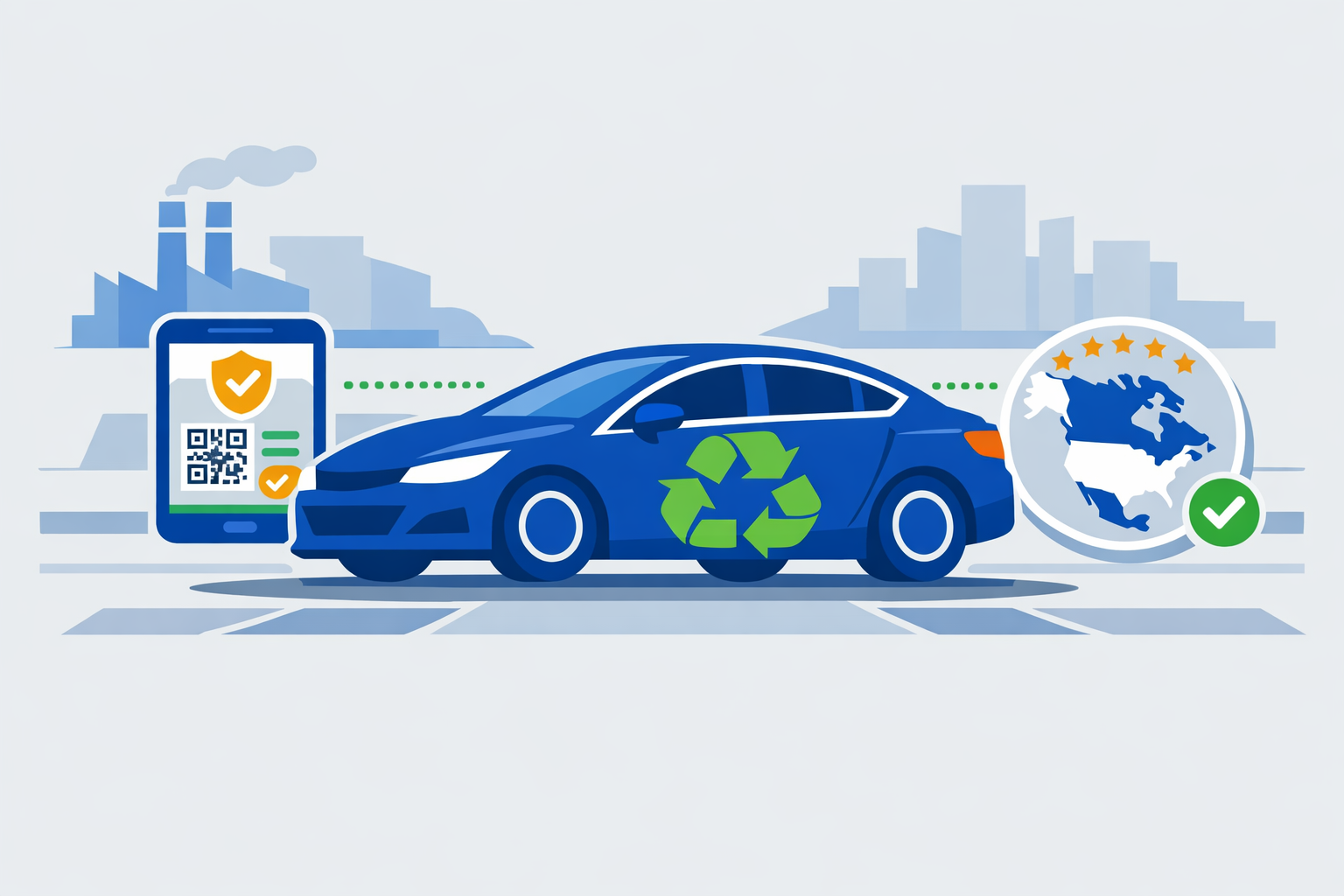
End-of-life recyclability presents an additional engineering challenge. Starting in mid-2025, EU manufacturers must embed detailed material data into components through mandatory digital product passports listing polymer types, additives, fillers, joining methods, and end-of-life handling instructions. Under the new EU End-of-Life Vehicles Regulation - on which the European Parliament and Council reached provisional agreement in December 2025 - new vehicles must contain a minimum of 15% recycled plastic within six years and 25% within ten years. The high sulfur content and heterogeneous cross-linked architecture that underpin these polymers' antimicrobial function may complicate compatibility with conventional mechanical recycling streams - a tension material engineers and procurement specialists will need to resolve. This dovetails with the broader redesign pressures explored in our report on EU Tightens Circularity Rules for Automotive Composites.
The market context is substantial. The global antimicrobial textile market reached USD 13.77-15.34 billion in 2025 and is projected to reach USD 16.55-25.51 billion by 2030-2032, expanding at a 3.75-7.4% CAGR. Within automotive specifically, antimicrobial surfaces currently represent approximately 3-5% of total antimicrobial textile consumption, or roughly USD 1.12 billion, but demonstrate the highest growth trajectory among all application segments.
Outlook
Regulatory agencies in the EU and the U.S. have yet to issue specific guidance for sulfur-polymer antimicrobial surfaces in automotive applications, meaning near-term commercial deployment will proceed primarily under existing BPR, REACH, and ISO frameworks. Environmental concerns associated with petroleum-based polymers and sulfur flammability continue to challenge broader adoption of polysulfide materials. Research groups and early-stage commercial entities are advancing bio-based comonomer strategies - such as resveratrol and vegetable oil derivatives - to address these concerns, though lifecycle assessments and ecotoxicological data for automotive-grade formulations remain limited. As the evidence base matures, regulatory bodies overseeing healthcare and agricultural applications are expected to generate precedent-setting assessments of polysulfide environmental fate and AMR contribution that will directly inform the pathway for automotive adoption.