The European Union has reached a provisional agreement to tighten circularity requirements in automotive design, mandating that new vehicles contain 15% recycled plastic within six years and 25% within ten years, with 20% sourced from closed-loop recycling. The rules, issued under the Circular Economy Action Plan, extend to heavy-duty vehicles, motorcycles, and vans, and are intended to improve end-of-life vehicle (ELV) management across the EU. Manufacturers and suppliers must adapt vehicle interior composites to meet enhanced recyclability, recycled content, and transparency requirements. The phased implementation provides a 24- to 36-month adaptation period.
Background
The agreement between the European Parliament and Council represents a substantial update to ELV regulations and replaces previous directives within the European Green Deal framework. The new regulation enforces greater recoverability and recyclability in vehicle design, introduces extended producer responsibility, and requires stricter ELV traceability to deter illegal exports and support materials retention within the EU economy.{{cite:}}{{cite:}}
Automotive interiors are a focal point, as plastics represent millions of tonnes of vehicle materials annually. The push for recycled content, particularly from ELVs, marks a significant shift, given that only about 19% of ELV plastics are currently recycled.{{cite:}}
Details
Under the agreement, new vehicles must contain 15% recycled plastic within six years, rising to 25% within ten years. Of this, 20% is required to come from closed-loop recycling, using materials recovered specifically from end-of-life vehicles. The European Commission is tasked with conducting feasibility studies within two years of the regulation's introduction to consider recycled content targets for steel, aluminum, and other critical raw materials.{{cite:}}{{cite:}}
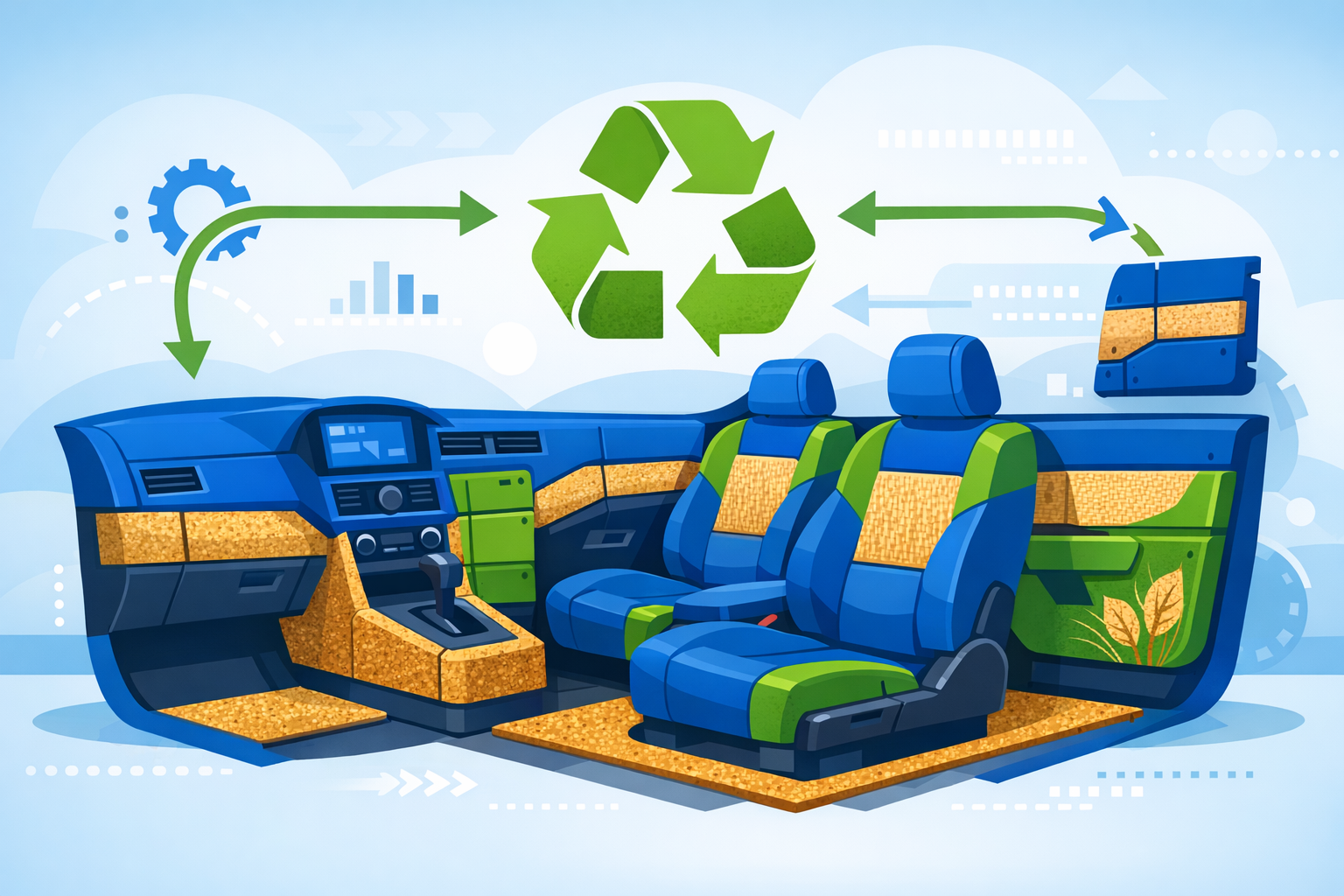
Industry sources note that the new requirements will accelerate redesign cycles for components such as dashboard panels, door trims, and seating. Suppliers are investigating natural-fiber composites such as flax combined with thermoplastic matrices to increase recyclability and facilitate disassembly. SGL Carbon and BMW jointly won the 2026 JEC Innovation Award for developing a flax-based natural fiber composite prepreg system, demonstrating approximately a 40% reduction in CO₂-equivalent emissions compared with traditional carbon fiber alternatives while achieving compliance with automotive durability standards.{{cite:}}{{cite:}}
At JEC World 2026, multiple projects presented flax and hemp composite applications for automotive interiors, including a hypercar rear wing demonstrator and lightweight bio-composite vehicle seating, illustrating growing industry interest in bio-based, recyclable materials.{{cite:}}
Outlook
The adoption of stricter circularity rules will require OEMs and suppliers to implement design-for-disassembly, modular geometry, and natural-fiber thermoplastic composites in manufacturing. Procurement strategies are anticipated to prioritize end-of-life performance, recyclability, and regulatory compliance alongside traditional criteria such as weight and cost. The scheduled 24- to 36-month transition period provides stakeholders with the opportunity to validate tooling, processes, and materials while preparing for compliance with lifecycle-focused regulations.