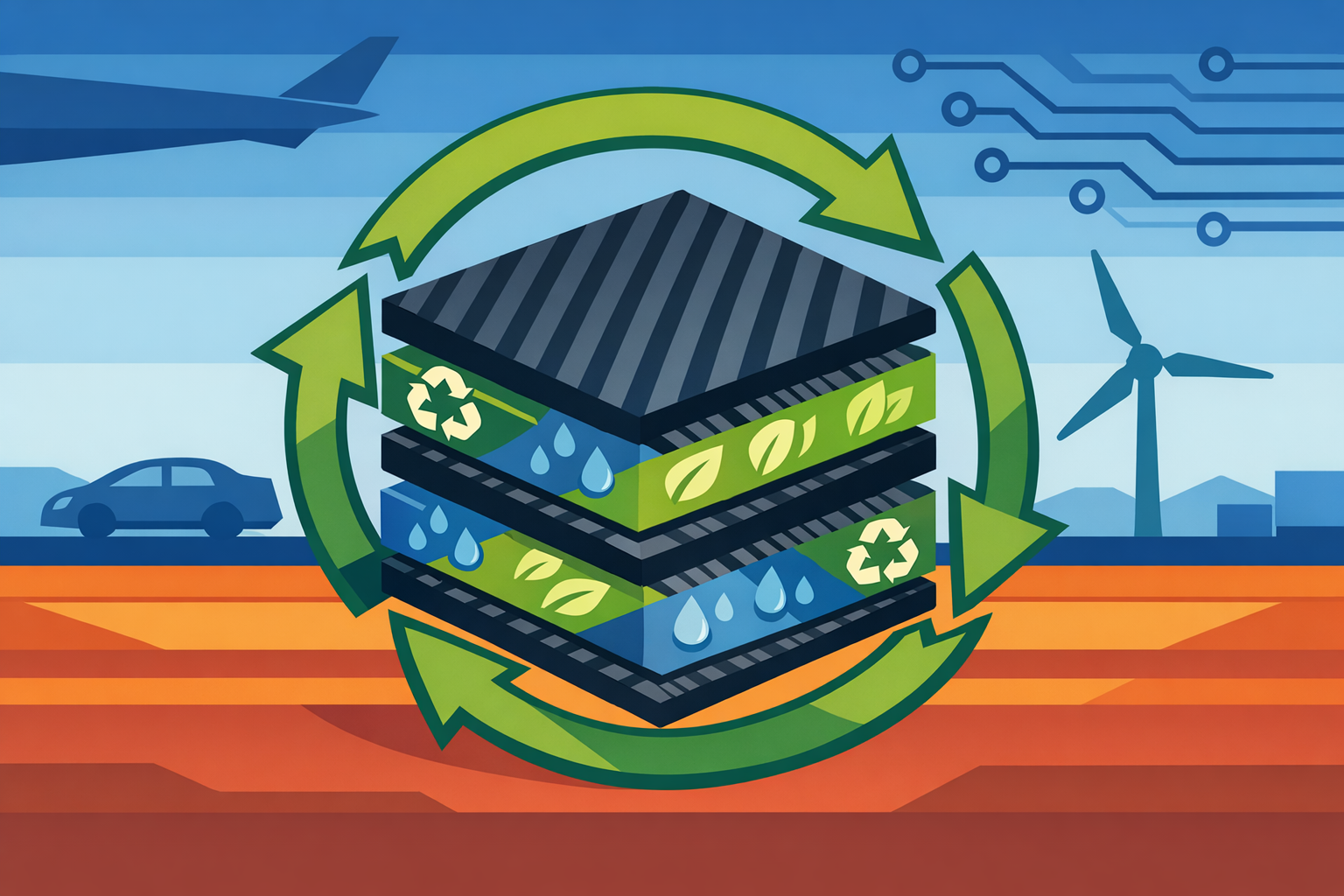
Advanced polymer composites originally developed for aerospace applications are gaining adoption in automotive, wind energy, and electronics industries. This trend is accelerating demand for materials that combine lightweight, high-temperature performance with end-of-life recyclability. Lightweight, continuous fiber-reinforced composites are being implemented in electric vehicle (EV) structures, battery enclosures, and thermal management components. Concurrently, circularity initiatives are motivating suppliers to develop recyclable materials and foster collaboration with OEMs, Tier-1 integrators, and recyclers.
Background
This shift is driven by increasing regulatory and sustainability requirements. Recent EU regulations require automotive manufacturers to use recycled and recyclable plastics and polymers and to achieve high end-of-life recycling rates[1]. The European Union's End-of-Life Vehicle Directive sets a vehicle recycling target of 95 wt %[2]. Despite these mandates, only about 15% of composite waste is recycled globally, with most being incinerated or landfilled[3].
Details
Recent research underscores the technical and economic viability of circular composite processes. A March 2026 study demonstrated the effective recycling of automotive bumpers and carbon fiber prepreg waste into new composite materials using recycled polypropylene and recycled carbon fiber (rCF), with reduced energy consumption and environmental impact[4]. The LIFE-EU CIRCE project explored cost-effective reuse of carbon fiber prepreg scraps in automotive components through compression molding[5]. GAIKER, working within Horizon-funded projects, is advancing solvolysis-based recycling and reversible cross-linking composites to support the end-of-life recovery of fiber-reinforced polymer components for wind energy systems[6].
Strategic partnerships are emerging across the industry. Composite Recycling and Owens Corning announced a mid-2025 collaboration to incorporate reclaimed glass fibers into new industrial products, aiming to scale recycling technologies for automotive, construction, and aerospace sectors[7]. In Germany, the BMBF-funded "CirProTech" project includes Volkswagen, TU Braunschweig, and Fraunhofer CCEM, among others, to develop closed-loop recycling processes for plastics and CFRP components over five years, backed by €10 million beginning March 2025[8].
Automotive materials innovation continues: Covestro launched a pilot in April 2024 to chemically recycle polycarbonate from end-of-life headlamps into OEM-grade post-consumer recycled (PCR) polycarbonate for EV trim and lighting, with validation underway by brands such as Volkswagen and NIO[9].
Recycled CFRP is used in automotive, aerospace, and energy sectors, although its mechanical properties remain lower than those of virgin fibers. Nevertheless, companies such as Tesla, BMW, and Toyota utilize rCF in EV battery enclosures and structural elements to reduce weight and enhance sustainability[3].
Outlook
Regulatory mandates and industry collaboration are converging toward scalable, recyclable composite solutions. As Horizon and industrial projects report pilot outcomes, OEMs and suppliers are anticipated to integrate reuse-ready resins, recycled fiber feedstocks, and circular design into production. Continued research and consortium-led initiatives will help define the next generation of sustainable, high-performance composite materials for mobility and related sectors.