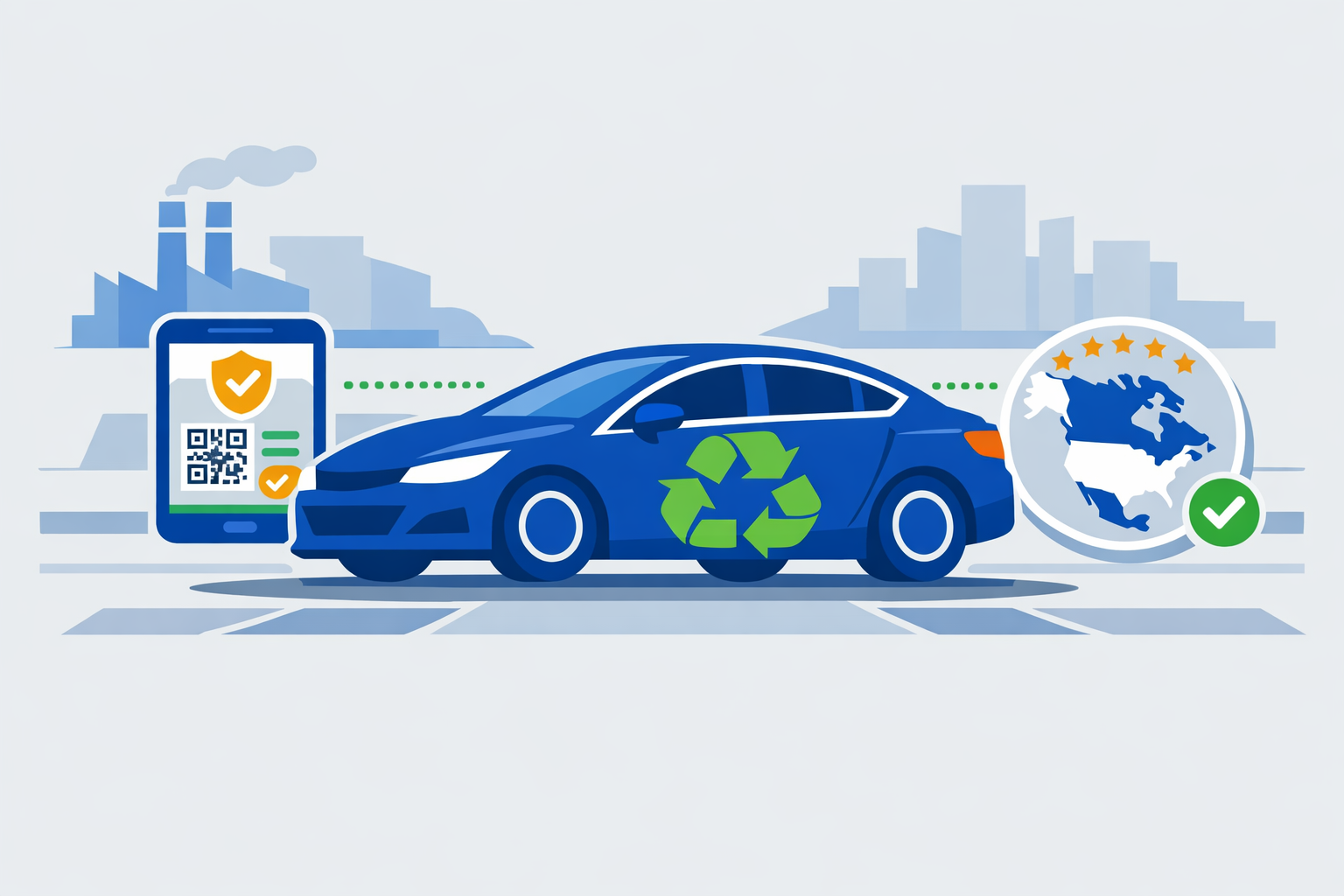
The European Union has advanced its most comprehensive framework for verified recycled plastic content in new vehicles. A provisional political agreement reached in December 2025 and a compromise text published in February 2026 set firm verification deadlines and phased content targets now reshaping material strategy across the global automotive supply chain.
On 12 December 2025, the European Commission, Council, and Parliament reached a provisional agreement on circularity requirements for vehicle design and end-of-life vehicle management. In February 2026, the compromise text was published, marking a key step toward adoption of the new ELV Regulation. Simultaneously, third-party certification for post-consumer recycled (PCR) content is increasingly being embedded in legal requirements across North America, intensifying pressure on OEMs and Tier 1 suppliers to validate polymer sourcing throughout their supply chains.
Background
The automotive industry is among the largest consumers of primary raw materials such as steel, aluminium, copper, and plastics, yet makes little use of recycled materials. Although recycling rates for end-of-life vehicle materials are generally high, the scrap metals produced are low quality and only small amounts of plastic are recycled. The EU's earlier ELV Directive, in force since 2000, set reuse and recovery targets but did not mandate minimum recycled plastic content for new vehicles. The European Commission proposed a revision in 2023 to address these gaps and align the framework with broader circular economy objectives.
In North America, the regulatory picture remains more fragmented. As of August 2025, five U.S. states have passed laws requiring post-consumer recycled content in plastic packaging. Automotive-specific mandates remain absent at the federal level, though the Association of Plastic Recyclers (APR) has pushed for broader adoption of certified PCR requirements. APR President and CEO Steve Alexander said the APR PCR Certification Program "provides stronger accountability and transparency to prepare companies for requirements on recycled plastic resin that are emerging in laws across North America and globally, particularly in minimum content mandates and EPR for packaging laws."
Details
The EU agreement introduces a phased structure for recycled content mandates covering passenger cars, light commercial vans, motorcycles, and regular heavy-duty vehicles. Co-legislators agreed that plastic used in each new vehicle type should contain a minimum of 15% recycled plastic within six years of the rules' entry into force and 25% within ten years. Of these targets, 20% would have to be achieved by incorporating plastics recycled from end-of-life vehicles or from parts and components removed during use - so-called "closed loop" sourcing.
Critically for near-term industry planning, rules for recycled plastic content are to be calculated and verified by end of 2026, followed by a feasibility study for setting the recycled content target in 2027 and a declaration of material formats in 2030, according to Ascend Materials.
Lawmakers reduced recycled plastic content targets from an originally proposed 25% to 15% six years after entry into force, postponing the 25% requirement until a decade after the regulation takes effect. Environmental groups criticized the revision. Fynn Hauschke, Senior Policy Officer for Circular Economy and Waste at the European Environmental Bureau, called the deal "a textbook case of political backsliding under industry pressure," adding that "by weakening key circularity requirements and scaling back ambition on recycled plastics, they've missed a crucial opportunity to put the automotive sector on a truly circular path."
The regulation also introduces a digital circularity vehicle passport to enhance transparency and traceability of materials throughout a vehicle's lifecycle. Manufacturers would be obligated to maintain a circularity strategy and a digital vehicle passport containing information about composition and traceability. However, the required level of detail - whether it should apply at the brand, type, or individual vehicle level, and the specific data it must include - still needs to be defined.
On the demand side, the regulation's polymer implications are already being quantified. ICIS Plastic Recycling Analyst Mia McLachlan noted that "recycled content mandates are expected to be met primarily through recycled polyolefins, supported by the wider availability of suitable waste feedstocks compared with other polymers used in the automotive sector." ICIS previously estimated 0.5 to 0.6 million tonnes of recycled polyolefins would be required by 2040, with the majority supplied by recycled polypropylene, as polypropylene is a key polymer used in automotive components.
In North America, third-party verification frameworks are advancing independently of direct automotive mandates. Since its launch in 2021, APR PCR Certification has been awarded to more than 35 plastic recyclers, covering an estimated 30% or more of the postconsumer PET, PP, HDPE, LDPE, and LLDPE produced in North America. APR developed its certification scheme based on ISO chain-of-custody and traceability standards, written in coordination with the EU RecyClass Audit Scheme for Recycled Plastics Traceability to support global harmonization and more efficient processing for multinational companies.
The provisional EU agreement also allows the European Commission to delay or temporarily revise down plastic content targets "in case the lack of availability or excessive prices of specific recycled plastics make compliance with the minimum percentages of recycled content excessively difficult."
Outlook
The provisional agreement must be formally endorsed by both the Parliament and the Council before entering into force, with the new rules expected to apply two years after adoption. Vehicle platforms launching from the late 2020s onward will need to incorporate recycling, material recovery, and traceability from the design stage. Competition for high-quality recycled materials is expected to intensify, making early action on sourcing and partnerships critical. A broader ICIS and CPCIF study projects that EU producers will require approximately 5.4 million tonnes per year of rPE, rPP, and rPET by 2030 to meet mandated minimum recycled content targets across sectors, with demand expected to more than double to 11.5 million tonnes per year by 2040.