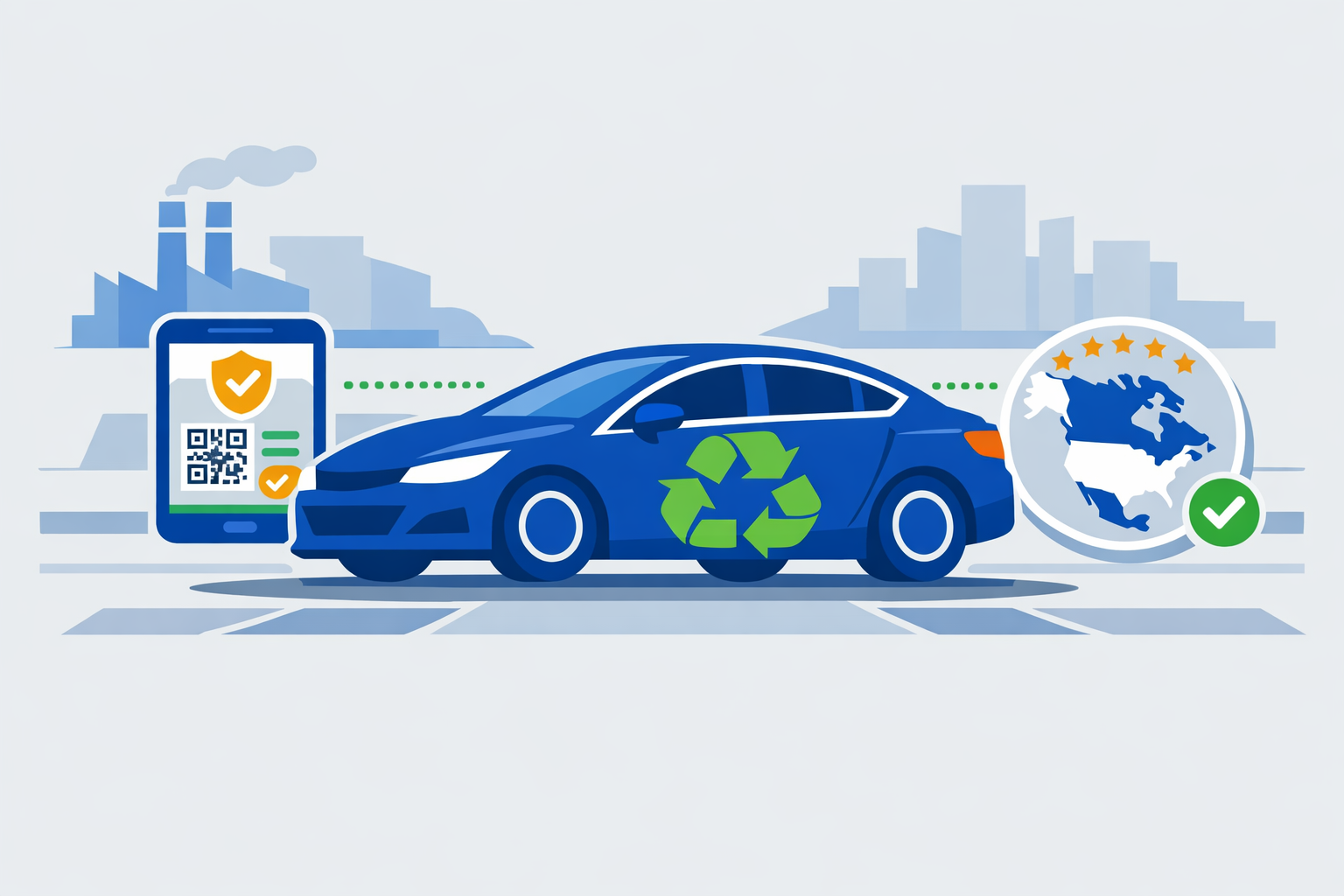
The European Union's new recycled-content rules for vehicle plastics are transforming the automotive composites market. Binding targets for recycled materials and stricter end-of-life (EoL) requirements are driving investment in recycled and bio-based fiber solutions, while exposing significant gaps in traceability, processing compatibility, and EoL separation that must be addressed before 2030.
Executive Summary
The recast End-of-Life Vehicle Regulation (ELVR) enforces mandatory recycled plastic content in new vehicles, linking circularity metrics to type approval and a digital circularity vehicle passport. This elevates requirements for thermoplastic and thermoset composites in interiors, exterior bodywork, and semi-structural components.
While recycled and bio-based fiber composites are entering series production, industrialization is limited by shortages in recycled plastic supply, variability in recycled feedstock properties, insufficient composite recycling capacity, and gaps in life-cycle data. Automakers and suppliers are responding with material standardization, design-for-disassembly, supplier diversification, and pilot programs that phase in recycled content while validating performance and warranty risks.
Regulatory Turning Point: From ELV Directive to Full Vehicle Circularity
From Directive to Regulation
The EU is replacing the 2000 End-of-Life Vehicles (ELV) Directive with a regulation that imposes circularity requirements on vehicle design and EoL management. The new framework:
- Expands scope beyond passenger cars and light commercial vehicles to include heavy-duty trucks, buses, trailers, motorcycles, and quadricycles.
- Ties circularity requirements to type approval, making recyclability and recycled content part of compliance.
- Introduces a Circularity Vehicle Passport, a digital document detailing material composition, recycled content, recyclability indicators, and dismantling instructions.
These measures shift circularity considerations to the design, procurement, and manufacturing phases.
Binding Recycled Plastic Content Targets
The central policy driver is the mandatory recycled plastic content in new vehicles. Positions developed through the legislative process:
- The Council's June 2025 approach proposed minimum recycled plastic content of 15%, 20%, and 25% of vehicle plastics at 6, 8, and 10 years after entry into force, respectively.
- The European Parliament's September 2025 position called for a minimum 20% recycled content within six years and at least 25% within ten years, conditional on sufficient supply at reasonable prices.
- A March 2026 agreement would phase in a 15% recycled plastic content requirement after six years and 25% after ten years, with at least 20% sourced from end-of-life vehicles (3% and 5% of total vehicle plastics, respectively).
Only post-consumer material qualifies toward these quotas. Chemical recycling is recognized through mass-balance accounting. Bio-based plastics and tire elastomers may be considered after a future Commission review.
As of April 2026, the text awaits ratification by the European Parliament and Council. Binding thresholds are expected beginning in the early-to-mid 2030s.
Scope and Exemptions
The regulation applies to passenger cars, light commercial vehicles, heavy-duty vehicles, motorcycles, and most special-purpose vehicles. Exemptions or delayed compliance are foreseen for:
- Low-volume manufacturers of certain heavy-duty special-purpose vehicles.
- Vehicles for armed forces, civil defense, fire, and medical services.
- Historic or culturally significant vehicles.
Mainstream automotive programs should expect full application of recycled content obligations.
Scale of the Plastics and Composites Challenge in EU Vehicles
Plastics Demand in the Automotive Sector
Automotive is a major plastics consumer in Europe.
- Council analysis notes the automotive sector accounts for roughly 10% of EU plastics consumption, or about 6 million tonnes per year.
- Commission research estimates that vehicles placed on the EU market use over 2.2 million tonnes of plastics annually, or about 208 kg per passenger car and light commercial vehicle.
Thermoplastics such as polypropylene (PP), polyurethane (PUR), polyamides (PA), polyethylene (PE), ABS/SAN, and PET comprise over 80% of automotive plastics use. These are often used in fiber-reinforced composites like glass-fiber-reinforced PP for interiors and exterior panels.
A 25% recycled-plastics target translates to roughly 550,000 tonnes of recycled plastics needed annually for vehicles sold in the EU.
Current Gap Between Targets and Recycled Supply
Available post-consumer recycled (PCR) plastics for automotive remain insufficient:
- A supply-chain analysis for DG Environment suggests OEMs use around 5.2 million tonnes of plastics per year in Europe, yet only about 109,000 tonnes of PCR plastics currently return to automotive applications.
To achieve the ~0.5 Mt/year demand implied by a 25% target, the sector must invest in:
- Collection, sorting, and upgrading of automotive-grade recyclate.
- Qualifying recyclers and compounders for automotive specifications.
- Long-term offtake contracts to support plant investments.
Composites: Small Share, High Complexity
Although composites account for less total mass than other plastics, they bring significant complexity:
- Fiber-reinforced composites are found in bumpers, front-end modules, dashboards, seat structures, cross-members, battery enclosures, and under-body shields.
- Thermoplastic composites (e.g., GF-PP, CF-PA, CF-PPS) can be remelted and reprocessed, but multi-material designs hinder separation.
- Thermoset composites (e.g., glass-fiber epoxy, polyester SMC/BMC) require energy-intensive chemical or thermal recycling.
EuCIA reports that 40-70% of thermoset composite waste in Europe is still landfilled or incinerated without energy recovery.
Including composites within vehicle plastics targets significantly impacts recycling infrastructure and design strategies.
Impact of the Recycled Content Mandate on Automotive Composites
Composites Within the Plastics Target
Both thermoplastics and thermosets count toward vehicle plastics mass. Composite industry groups warn that excluding thermosets would undermine incentives to recycle composite parts. Glass Fibre Europe and EuCIA support including composites in plastic recycling targets.
This requires OEMs and Tier 1 suppliers to include both composite types when tracking total and recycled plastics, with material choices affecting compliance feasibility.
Industrial Hurdles: From Design to EoL
Key technical and operational challenges include:
1. Verification of Recycled Content in Composites
- Mass-balance accounting for chemically recycled feedstock must align with ISO chain-of-custody standards and satisfy type-approval authorities.
- Composites often include multiple polymers, fillers, and fibers, requiring robust data to allocate recycled content.
- Batch variability in recyclate properties complicates consistent formulation.
2. Processing Compatibility
- Recycled matrices may show decreased molecular weight and altered rheology, affecting molding processes.
- Processing parameters require adjustment to maintain properties.
- Recycled fibers differ in length distribution and sizing from virgin fibers, affecting mechanical performance.
3. Joining and Mixed-Material Assemblies
- Some joining methods impede disassembly and material separation.
- Permanent fasteners and foamed-in systems complicate component removal, as specified in the ELVR.
4. End-of-Life Separation of Composites
- Few European car shredding facilities have advanced post-shredder plastic sorting.
- Composite parts may enter mixed fractions, reducing quality and yield of recovered materials.
Meeting vehicle recycled content targets therefore demands redesigning composite structures, joining techniques, and dismantling processes.
Bio-Based and Recycled Fibers in Automotive Supply Chains
Natural Fiber Composites Enter Mass Production
Natural fibers such as flax and hemp are now used in mainstream automotive programs:
- The Bio-Materials Village at JEC World 2026 expanded by 30%, focusing on automotive and other markets.
- Automotive OEMs have moved flax composites from motorsport trials to series production in performance vehicles.
- The Volvo EX30 features flax-composite interior panels, showing integration into electric platforms.
Flax-based powerRibs panels achieve up to 50% weight reduction and 70% plastic reduction versus conventional reinforcements, while hemp-PP grades like NAFILean utilize about 20% natural fibers in recyclable interior composites.
These address weight reduction, CO₂ footprint, and compatibility with existing compression-molding lines.
However, natural fibers alone do not fulfill recycled plastic quotas unless the matrix is also recycled or bio-based plastic is accepted toward the target-an open issue at the EU level.
Recycled Carbon and Glass Fibers
Recycled carbon (rCF) and glass fiber (rGF) composites are increasingly used in semi-structural parts, especially where stiffness matters.
- Thermal and chemical recycling (pyrolysis, solvolysis) recover fibers from scrap and EoL parts.
- Recycled fibers are used as non-woven mats, compounds, or hybrid laminates in components like battery enclosures and under-body shields.
- Several European initiatives are advancing rCF production at scales around 10,000 tonnes/year, offering lower energy and CO₂ footprints than virgin fiber.
For plastics targets, only the polymer matrix counts. Recycled fibers support circularity and emissions reduction, but not mandates unless the matrix is recycled.
Bio-Based Plastics in Vehicles: Policy Outlook
A 2024 European Commission study analyzed integrating bio-based plastics into vehicle targets.
- Vehicles placed on the EU market use about 2,200 kilotonnes of plastics annually, roughly 4% of EU consumption.
- The study assessed scenarios combining recycled and bio-based plastics, with limits on bio-based shares.
Current focus is on post-consumer recycled plastics. The Commission must review the role of bio-based plastics and elastomers within 72 months of entry into force. Bio-based content remains an option for future compliance, but is not counted toward quotas today.
Traceability, Data, and Life-Cycle Metrics: Making Circularity Quantifiable
Digital Vehicle Passport and Product Passports
The ELVR requires a Circularity Vehicle Passport, consistent with EU Digital Product Passport initiatives in the Ecodesign for Sustainable Products Regulation.
The passport will record:
- Component-level material composition.
- Recycled content percentages and origin, including EoL sources.
- Reusability, recyclability, and recoverability indicators.
- Life-cycle environmental data (e.g., CO₂ footprint).
- Dismantling instructions for key components.
This places new demands on suppliers to provide standardized, audit-ready data on content, mass-balance accounting, provenance, and life-cycle inventory.
Tools such as the Alliance for European Flax-Linen & Hemp's LCA platform, developed to align with EU Product Environmental Footprint methods, help supply these datasets for OEM reporting and regulatory compliance.
Life-Cycle Assessment as Procurement Criteria
EU policy is increasingly tying "circularity" to quantified life-cycle impacts rather than recyclability alone. Implications for composites include:
- LCA results become essential for sourcing decisions.
- Recycled feedstock variability requires rigorous statistical assessment.
- Lack of harmonized LCA rules risks inconsistencies across suppliers.
Suppliers unable to provide robust, standardized LCA data aligned with OEM requirements and digital passports may be excluded, regardless of technical performance.
Strategic Responses: Automotive Industry Adjustments
OEMs, Tier 1s, and suppliers are deploying multiple strategies to comply with new requirements.
1. Standardizing Material Data and Testing
- Harmonization of data sheets for recycled and bio-based composites, covering minimum data on content, properties, and LCA.
- Testing recycled composites to OEM standards to streamline qualification.
- Developing sector-wide rules for recycled content counting and mass-balance.
Standardization reduces costs and accelerates material approval.
2. Design for Disassembly and Modular Components
- Segmenting assemblies to enable intact removal.
- Replacing permanent adhesive with reversible joins.
- Minimizing incompatible material blends, except where justified.
Such designs support higher recovery rates and recyclability.
3. Phased Pilot Programs for Recycled Content
- Initial 10-15% recycled content in non-critical components to validate processing.
- Testing virgin and recycled composites under identical conditions to benchmark performance.
- Linking pilot results to supply agreements with recyclers.
This approach manages risks while building operational data for future models.
4. Supplier Diversification and Localization
- Qualifying multiple recyclers for key polymers and fibers.
- Developing local supply chains for natural fibers, reducing logistics risks.
- Exploring partnerships and long-term contracts with recycling technology providers.
This shift builds resilience and material security.
5. Investments in Composite Recycling Technologies
- Expanding mechanical recycling for thermoplastics.
- Scaling thermal and chemical processes for thermosets.
- Integrating dismantling, shredding, and sorting for cleaner recyclate streams.
Combining composite wastes from automotive and other sectors supports economic scale.
Comparing Material Pathways Under EU Circularity Rules
| Material route | Typical fiber/matrix | Current automotive uses | Recycled plastic target alignment | Processing compatibility | Key circularity considerations |
|---|---|---|---|---|---|
| Virgin glass-fiber/PP or PA thermoplastics | GFRP with PP or PA matrix | Bumpers, front-end carriers, instrument panel beams, under-body shields | Counts toward total plastics mass but provides no recycled content; may require substitution | Fully compatible with existing lines | High performance and mature supply, but increases virgin plastics demand and pressure on recycling targets |
| Virgin glass-fiber/SMC thermosets | GFRP with polyester/vinyl ester | Exterior panels, structural inserts, battery enclosures | Included in plastics mass if in scope; zero recycled content | Compatible with SMC/BMC lines; difficult to change tooling | EoL recycling requires advanced processes; inclusion in plastics targets incentivizes recycling |
| Recycled-content thermoplastic composites | GFRP or rGF/rCF with recycled PP, PA, PET | Interior panels, brackets, semi-structural parts | Direct contributor to recycled plastic quota | May require process adjustments for consistency | Enables plastics loop closure; recyclate quality is critical |
| Natural-fiber/PP or bio-based composites | Flax/hemp with PP, PP-recyclate, or bio-based resins | Door panels, seat backs, trunk linings, exterior trims | Fiber excluded from recycled plastic targets; recycled matrix counts; bio-based matrix subject to future rules | Compatible with existing compression equipment | Provides lightweighting and CO₂ reduction; feedstock traceability and LCA data essential |
| Hybrid bio-based + recycled composites | Natural fiber with recycled PP or PET | Emerging in interiors and non-critical parts | Potential contributor to recycled content if rules allow | More complex control and qualification | High leverage for circularity if regulation recognizes combined content; long-term data needed |
Conclusions and Near-Term Priorities (2026-2030)
Policy Direction: Clear Trajectory, Evolving Details
The ELVR marks a systemic shift from voluntary to binding recycled content and circularity obligations. Vehicles entering the EU market will be required to:
- Incorporate substantial post-consumer recycled plastics over the next decade.
- Demonstrate EoL recyclability and recoverability at the design stage.
- Provide auditable, digital proof of material composition, recycled content, and life-cycle metrics.
Composites are central to these directions.
Industrial Readiness: Challenges and Opportunities
Key gaps:
- Insufficient supply of automotive-grade PCR plastics.
- Limited composite recycling infrastructure and low recovery rates.
- Underdeveloped data systems for tracking recycled content and life-cycle performance.
Opportunities include:
- Scaling recycled-matrix composites and natural-fiber solutions compatible with current processes.
- Embedding design-for-disassembly principles.
- Using digital product passports and harmonized LCA data to enable material selection based on verified performance.
Next Steps for Industry Stakeholders
Immediate priorities for R&D, materials, sustainability, and regulatory teams:
- Map plastics and composites use per platform against future content thresholds.
- Identify suitable early-use cases and define pilot programs with measurable KPIs.
- Upgrade data infrastructure for passport-ready reporting at grade and component levels.
- Engage in standardization on test and data formats for recycled and bio-based composites.
- Monitor regulatory developments on bio-based plastics and design flexible material roadmaps.
The effectiveness of these actions between 2026 and 2030 will determine whether the recycled-content mandate accelerates automotive circularity or exposes persistent bottlenecks.
Frequently Asked Questions
When will the EU's recycled plastic content mandate for vehicles apply?
Requirements are anchored to the entry into force of the ELVR. Under the March 2026 agreement, a 15% recycled plastic content at vehicle level applies six years after entry, rising to 25% after ten years. Timing depends on final ratification, but mainstream vehicles launched in the early 2030s are expected to be included.
Are composites covered by the recycled content targets?
Yes. The regulation defines plastics to include composite plastics-both thermoplastics and thermosets. Proposals from the Commission, Council, and Parliament all reflect this. Industry bodies support inclusion to maintain recycling incentives. Thermoplastic and thermoset composites used in major components are counted in total and recycled plastic shares.
How is recycled content in composite components verified?
Verification uses chain-of-custody standards, mass-balance accounting, and digital data transfer. For mechanical recycling, suppliers must document post-consumer origins and shares by batch. Chemical recycling relies on mass-balance allocation per standards. The Circularity Vehicle Passport holds component-level declarations, underpinned by audits and third-party verification when necessary.
Can bio-based fibers or resins meet recycled plastic content targets?
Currently, only post-consumer recycled plastics count toward mandatory quotas. Bio-based fibers and resins help reduce life-cycle impacts but do not count toward recycled plastic requirements at this stage. The Commission will review bio-based plastics' role within 72 months of ELVR entry into force. Until further rulemaking, bio-based content is regarded as complementary, not a substitute for recycled plastic.
What should composite material suppliers prioritize in 2026?
Suppliers should focus on:
- Developing and qualifying recycled-matrix grades for automotive standards.
- Generating comprehensive material, durability, and LCA data for OEM databases and passports.
- Ensuring processing compatibility with existing equipment.
- Establishing transparent supply chains for recycled and bio-based inputs, with certification where applicable.
Early engagement with OEMs and Tier 1s on pilot applications and data requirements will be critical for future positioning in circular vehicle platforms.