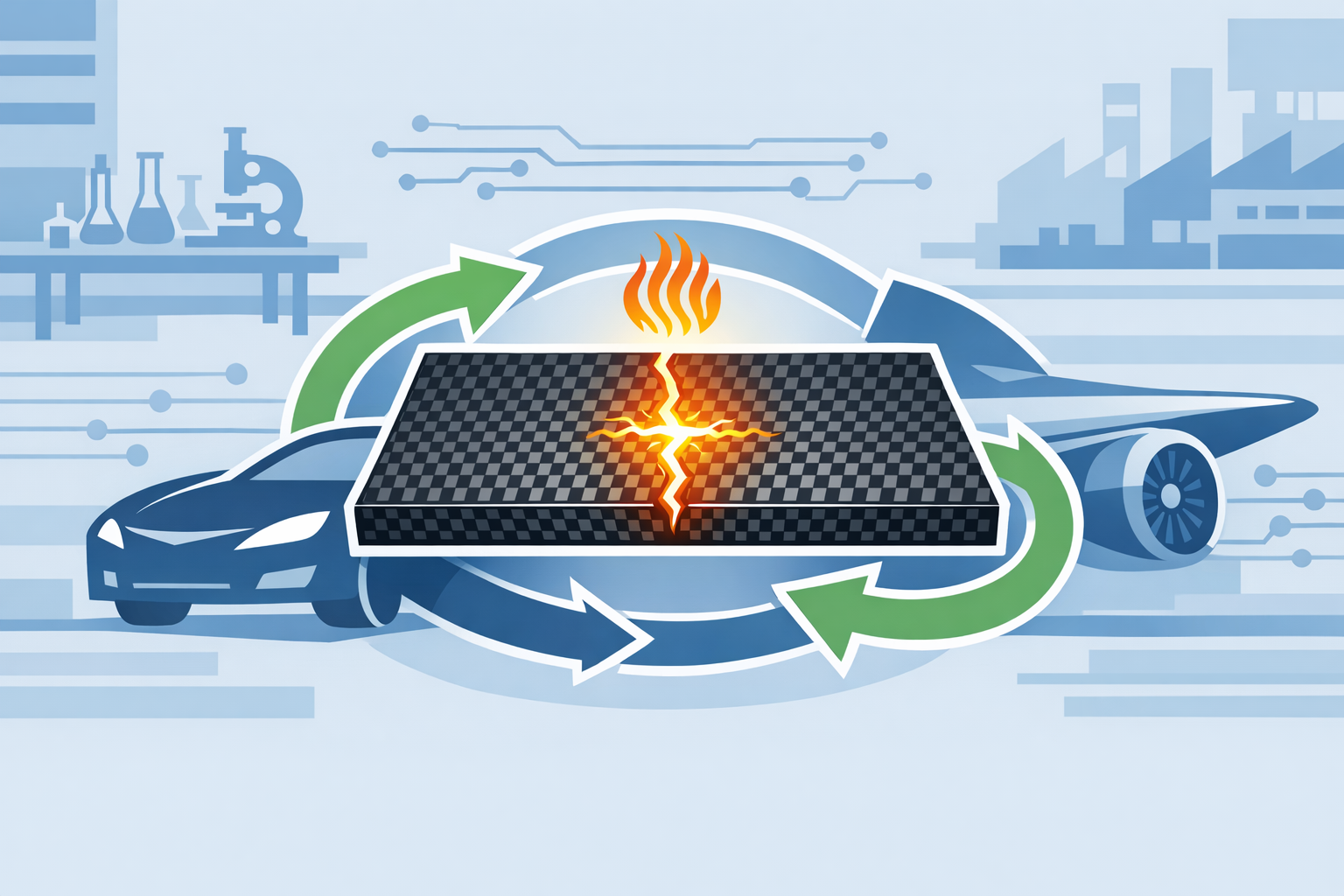
Texas A&M University researchers have developed a carbon-fiber-reinforced vitrimer composite, Aromatic Thermosetting Copolyester (ATSP), that offers steel-comparable strength, shape-memory, self-healing, and complete recyclability. Developed under the direction of Dr. Mohammad Naraghi at Texas A&M's Nanostructured Materials Lab, the research has been published in peer-reviewed journals including Macromolecules and the Journal of Composite Materials. The work received funding from the U.S. Air Force Office of Scientific Research and involved collaboration with ATSP Innovations. ATSP's ability to heal on demand, reshape under heat, and maintain durable performance indicates strong potential for adoption in high-performance mobility sectors such as automotive and aerospace from 2025 onward.[1]
Background
ATSP is part of the vitrimer family-covalent adaptable networks that allow polymer bonds to reconfigure when exposed to heat. The material is designed to merge the processing flexibility of thermoplastics with the mechanical stability of thermosets. When reinforced with discontinuous carbon fibers, ATSP composites demonstrate strengths that surpass steel while remaining lighter than aluminum.[1] This development addresses the industry's growing need for materials that combine high structural performance, recyclability, and adaptability throughout the lifecycle, particularly in automotive and aerospace sectors.
Details
Naraghi's team conducted cyclical creep and bending fatigue tests, heating the composite to roughly 160 °C to activate self-healing and shape recovery. X-ray imaging confirmed that following damage and thermal healing, the material nearly restored its original configuration and strength. In fact, durability improved over multiple cycles due to bond-exchange mechanisms within the ATSP matrix.[1]
During tests involving repeated damage and healing cycles, the composite was reheated to approximately 280 °C. After two cycles, it returned to near-original strength. By the fifth cycle, healing efficiency dropped to around 80 percent, attributed to mechanical fatigue, although the chemical and structural integrity was retained.[1] Naraghi noted that vitrimer chemistry supports repeated reshaping and recycling while maintaining performance.[1]
Outlook
If production is scaled and ATSP is integrated into automotive and aerospace manufacturing, these composites could offer an alternative to conventional thermosets, improving sustainability by enabling recyclability and in-service repair. Next steps include scaling up manufacturing, confirming performance in operational conditions, and meeting regulatory requirements for lightweight structural applications.
Word count: ~355