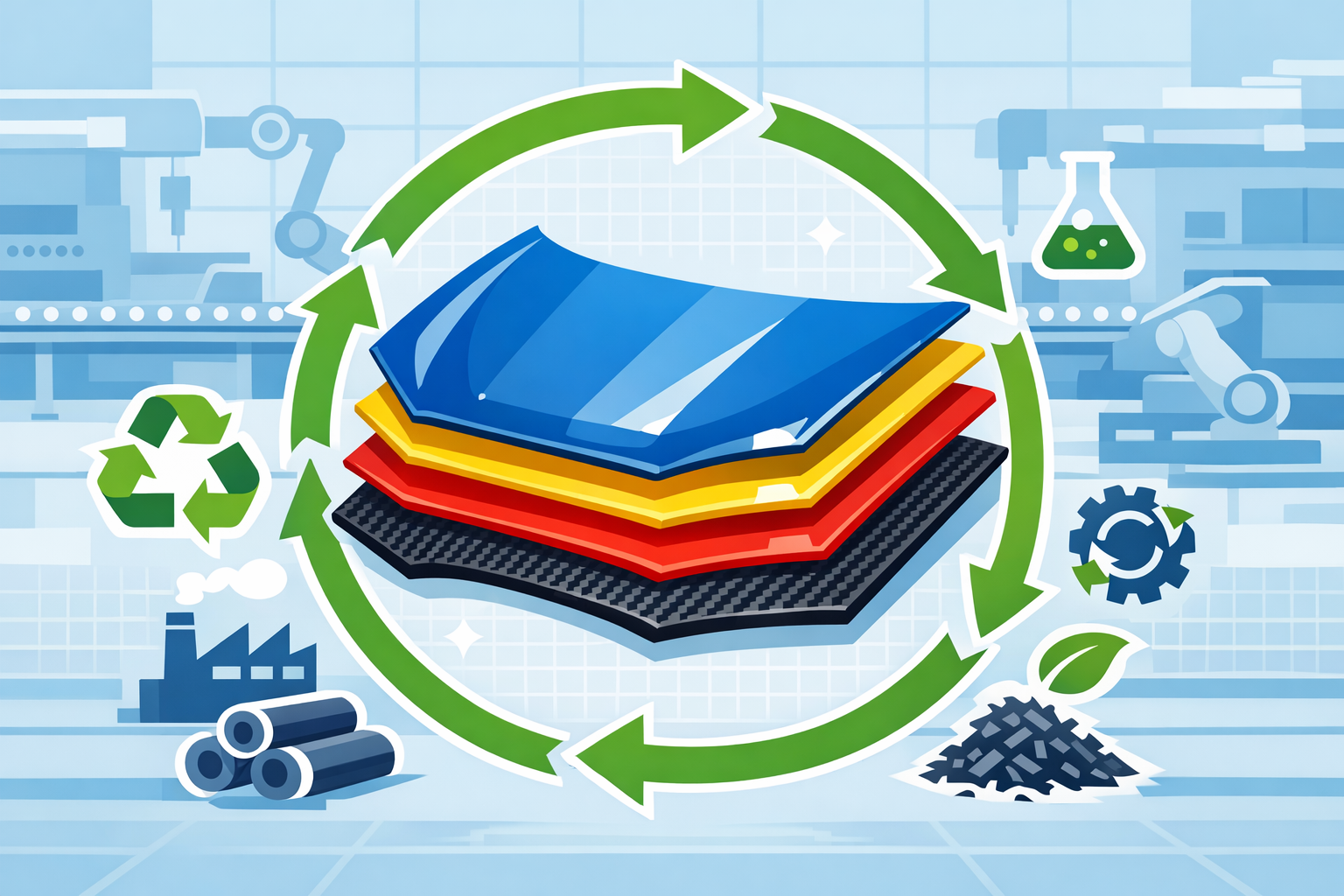
Automotive manufacturers and material suppliers have initiated pilot production of recyclable carbon-fiber prepregs and integrated in-plant recycling loops. OEMs and composite suppliers in Europe and North America have recently announced partnerships to deploy recyclable prepregs, alongside onsite reprocessing and take-back systems, to comply with increasingly stringent circularity mandates.
Background
EU regulations are increasing pressure on the composites sector. The revised EU Waste Framework Directive of 2024 requires a 30% recycling rate for carbon-fiber composites by 2030 and levies approximately EUR 120 per ton on non-compliant products under Germany's VerpackG scheme [1]. Extended Producer Responsibility initiatives are advancing closed-loop supply chains; long-term scrap-supply contracts have grown by 40% since Q4 2025 [1].
Germany and France have emerged as leaders in recycling innovation. Germany accounts for 43% of Europe's demand for recycled carbon fiber, supported by a €1.2 billion federal investment in composite recycling hubs such as the Carbon Circle Alliance in Leipzig, which processes about 8,500 metric tons of aerospace scrap per year [2]. France's AGEC law, enacted in 2024, penalizes the use of virgin carbon fiber in non-critical applications, prompting a shift toward recycled feedstocks in procurement strategies [2].
Details
Hexcel will present a portfolio of recycled-carbon-fiber (rCF) prepregs at JEC World 2026, featuring automotive bonnet components with rCF backing plies, virgin carbon-fiber surfaces, and Class A finishes [3]. In Germany's Ruhr Valley, Arkema and automotive OEMs have established regional closed-loop ecosystems for thermoplastic carbon-fiber prepregs, reducing scrap rates to 4% in 2023, down from the industry average of 18% [4].
The CIDER research project has introduced a demonstrator that incorporates recycled carbon fibers from hydrogen tanks into nonwovens and combines them with a recyclable resin (Elium). With a 25% fiber volume content, the composite demonstrates tensile strength of 360 MPa and stiffness of 31 GPa, while reducing CO₂ emissions by up to 90% [5].
Angeloni Group, with Sparco, Herambiente, and Carbon Task, has established a closed-loop industrial process that transforms expired prepregs and offcuts into regenerated semi-finished products using energy-efficient pyro-gasification, needle-punching, and impregnation. According to project representatives, the final output matches the performance of virgin carbon fiber [6].
Outlook
Pilot deployments of recyclable prepregs and onsite processing systems are anticipated to scale through 2026, with OEMs integrating these technologies into electric vehicle production lines to achieve Scope 3 emissions targets. Increasing regulatory requirements and internal circularity mandates indicate broader adoption in aerospace and industrial sectors, although cost competitiveness relative to traditional materials remains a decisive factor.