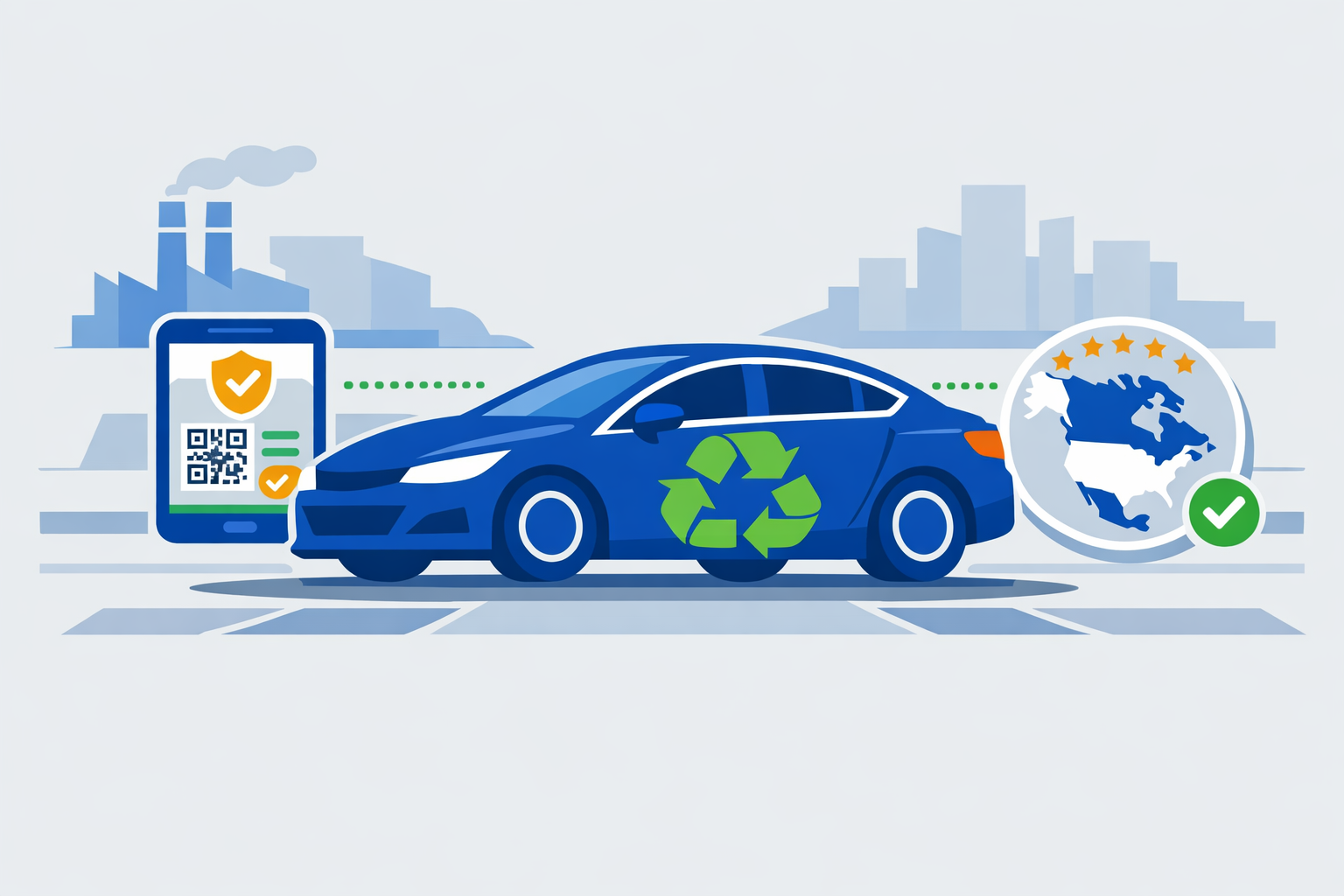
Only an average of 3% of the plastic in new vehicles today is made from recycled content, according to a 2025 supply chain analysis[1] published by the European Commission's Joint Research Centre - a figure that stands in stark contrast to the sustainability commitments now being issued by major North American automakers. As investor scrutiny intensifies and regulatory frameworks evolve at both federal and state levels, that gap is coming under increasing pressure, particularly for high-profile components such as EV battery housings.
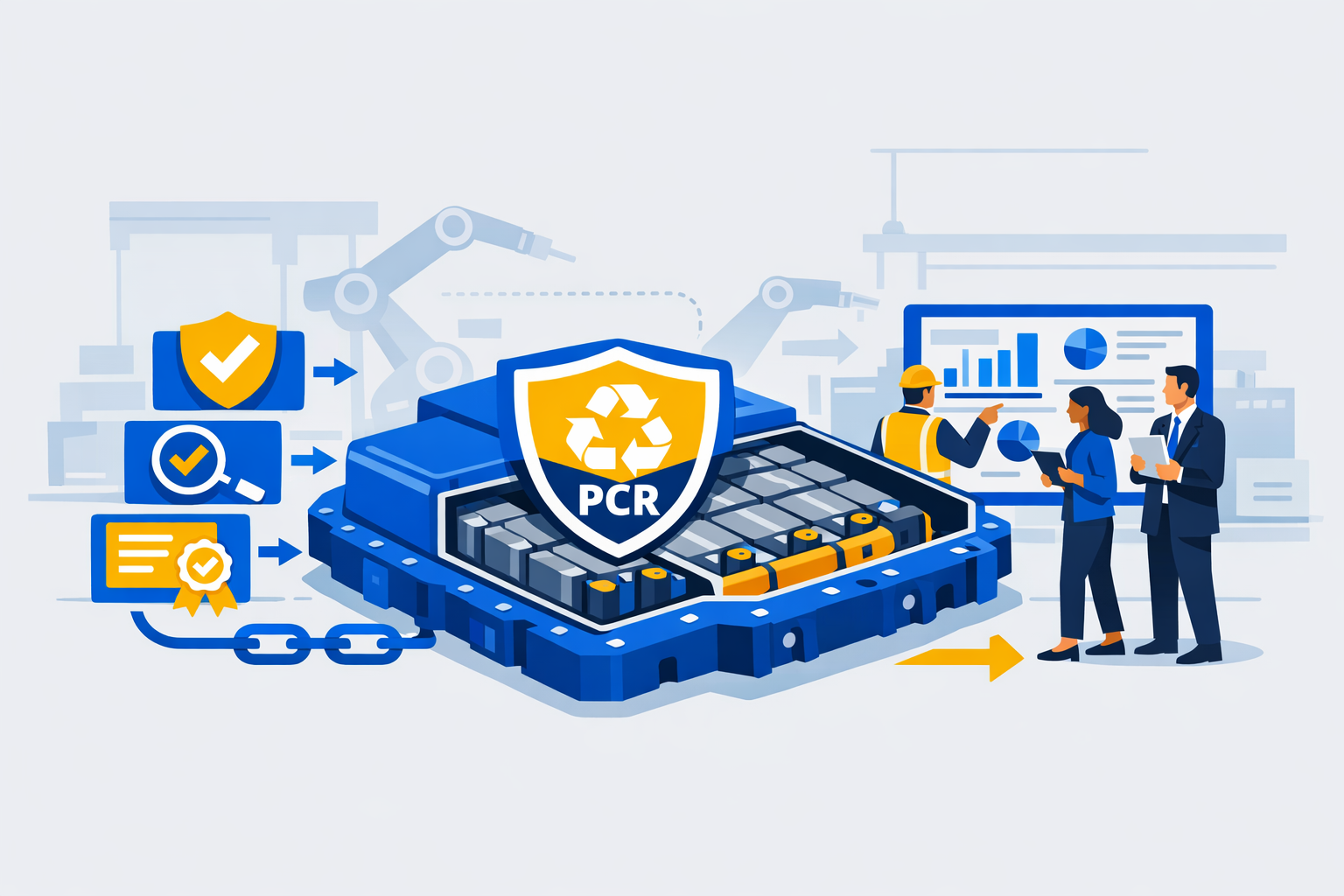
The result: a growing number of OEMs are moving beyond self-declared sustainability claims and mandating independent, third-party certification of post-consumer recycled (PCR) content in battery enclosures. For suppliers - from chemical recyclers to compounders and molded-part manufacturers - understanding what these certifications require, and what they demand of a supply chain, is becoming a prerequisite for participation in next-generation EV programs.
The Regulatory and Market Pressure Driving Certification
North America's push for verified PCR content in EV battery components is shaped by forces on multiple fronts.
At the federal level, a proposed U.S. rule - covered in detail in our earlier analysis of the US Federal Recycled Content Rule for Auto Plastics - would introduce the first federal mandate specifically addressing recycled polymer content in vehicle components, including battery housings. The rule is expected to align with international precedents: the European Union has mandated that new vehicles incorporate at least 15% recycled plastic within six years, rising to 25% within ten years, with a minimum of 20% from closed-loop recycling of end-of-life vehicles.
At the state level, California and several other jurisdictions are advancing reporting requirements and potential eco-labeling schemes that could expose OEMs to reputational and legal risk if PCR claims lack third-party backing. The U.S. Plastics Pact has established a set of principles for effective PCR certification that specifically requires third-party certification and supply chain transparency, as documented in its PCR Toolkit[2].
Meanwhile, major North American automakers including Ford and GM have made public commitments to recycled content, with Ford pledging at least 20% recycled content across its vehicle lineup and GM targeting 50% sustainable materials across all vehicles by 2030. Substantiating such claims for high-risk components like battery housings - where performance and safety specifications are most demanding - increasingly requires external verification.
The Certification Landscape: Which Bodies and Standards Apply
The ecosystem of third-party PCR certification relevant to EV battery housings is fragmented but converging around a core set of programs.
The Association of Plastic Recyclers (APR) PCR Certification is a full chain-of-custody, third-party program that verifies recycled content comes from post-consumer sources and was developed in coordination with EU RecyClass, establishing a transatlantic baseline. Reclaimers seeking new certification after April 2025 must certify to the updated APR standard[3], with the long-term goal of extending certification through converters and finished-goods producers.
TÜV SÜD's Recycled Content Certification[4] is particularly relevant for automotive-grade applications: it covers compounds and components explicitly, with onsite audits required to validate actual production practices and certification validity of either one year (batch) or three years depending on supply chain data quality.
UL Solutions offers a program under UL 746C that allows mechanically recycled plastic to carry the same safety ratings as virgin resin - a critical pathway for battery housing materials that must also meet electrical equipment standards. The certification process includes initial qualification, a quality assurance program, and follow-up inspection visits.
For broader supply chain traceability, the Global Recycled Standard (GRS) - which applies to products with at least 20% recycled content - requires every link in the supply chain, from recycler to brand owner, to hold certification, with both Scope Certificates and Transaction Certificates issued per shipment.
The table below summarizes the programs most relevant to automotive PCR claims:
{{component:pcr-cert-table}}
The Technical Barrier: Fire Safety and PCR Content in Battery Housings
Battery enclosures occupy one of the most technically demanding positions in the vehicle. They must simultaneously address structural integrity under crash loading, thermal runaway containment, electromagnetic shielding, and recyclability - and now, verifiable PCR content.
EV battery housing polymers[5] must meet key fire-safety benchmarks including UL 94 (flammability of plastic materials) and FMVSS 302 (interior flammability), with battery-specific performance evaluated against UL 2596 (thermal and mechanical requirements for battery enclosures). UL 1487, published as a binational U.S.-Canada standard in February 2025, establishes the first dedicated Standard for Battery Containment Enclosures, adding another benchmark for suppliers.
The central technical challenge: achieving UL 94 V-0 flame-retardancy with PCR content above 30% remains technically demanding, due to limited availability of high-purity, consistent PCR streams suitable for engineering applications, and the sensitivity of flame-retardant additive systems to contamination.
{{component:fr-pcr-callout}}
Advances in polymer compounding are narrowing this gap. Innovations in halogen-free flame retardants, intumescent systems, and improved dispersion technologies[6] are enabling recycled polycarbonate and polypropylene grades to perform reliably under high-temperature and high-voltage conditions. Stabilization packages and chain-extension technologies are also being deployed to restore mechanical properties degraded by thermal cycling during the recycling process.
Supplier Implications: What Vendors Must Demonstrate
For compounders, Tier-1 molders, and recycled-resin suppliers seeking to qualify for OEM programs requiring third-party PCR certification, the bar is rising on several dimensions simultaneously:
- Chain-of-custody documentation tracing PCR material from collection through sorting, compounding, and molding, with mass-balance accounting at each step
- Batch-level PCR content verification, including declaration of the specific post-consumer waste stream feeding the compound
- Fire-safety test data confirming UL 94, FMVSS 302, and UL 2596 performance at the specified wall thickness and PCR loading level
- OEM material qualification data - tensile, impact, heat deflection, and long-term aging performance versus a virgin-resin baseline
- Lifecycle assessment (LCA) data supporting carbon-footprint claims, increasingly required by OEM sustainability and procurement teams
- ISO 14021 compliance for recycled content declarations, providing a recognized international baseline for environmental claims
OEM material qualification cycles for new PCR compounds can be lengthy and costly, representing a structural barrier to rapid scale-up, particularly for suppliers who have not previously navigated automotive-grade certification programs.
Use the interactive tool below to assess your organization's readiness for third-party PCR certification:
{{widget:pcr-readiness-checker}}
Infrastructure and Market Implications
Certification mandates for battery housings will not operate in isolation - they will reverberate upstream through the recycling and compounding supply chain. Currently, about 80% of recycled plastic used in new vehicles is generated during industrial processes rather than from post-consumer sources, meaning the shift to verified PCR content represents a structural change in how and where material is sourced.
Demand for certified PCR resin is expected to drive investment in U.S. recycling infrastructure[7], advanced sorting technologies, and closed-loop collection programs capable of delivering the material consistency that engineering-grade battery housing compounds demand. The global post-consumer recycled plastics in automotive market was estimated at $11.92 billion in 2024 and is forecast to grow at a CAGR of 11.1% through 2030.
Chemical recyclers, currently excluded from the APR PCR standard (which focuses on mechanical recycling), are watching closely: APR has signaled it will release an addendum addressing circumstances where chemical recycling may qualify for certification - a development that would significantly expand the pool of certifiable PCR feedstocks for high-performance applications such as battery enclosures.
Key Takeaways for Industry Stakeholders
- OEMs are increasingly mandating third-party PCR certification as a vendor qualification criterion for EV battery housing programs, driven by investor ESG expectations, emerging federal and state reporting requirements, and greenwashing exposure risk.
- Compounders and Tier-1 suppliers must build certified PCR supply chains now - before OEM RFQs require it - including chain-of-custody documentation, batch-level tracking, and fire-safety validation at the target PCR loading.
- Certification bodies including TÜV SÜD, UL Solutions, and APR-approved auditors are positioning to serve the automotive sector, but audit capacity and automotive-specific expertise remain constraints as demand scales.
- Chemical recyclers should engage proactively with APR and standard-setting bodies, as the forthcoming addendum to the APR standard could determine whether chemically recycled feedstocks gain access to the certified PCR market for battery housings.
- Infrastructure investors in sorting and processing should note that certified PCR demand from the automotive sector ranks among the most technically demanding but commercially significant signals the North American recycling industry has received in years.
The window for early positioning is narrow. OEMs piloting third-party PCR certification in battery housing programs today are laying the groundwork for what is expected to become a baseline procurement requirement across major EV platforms within the next three to five years.