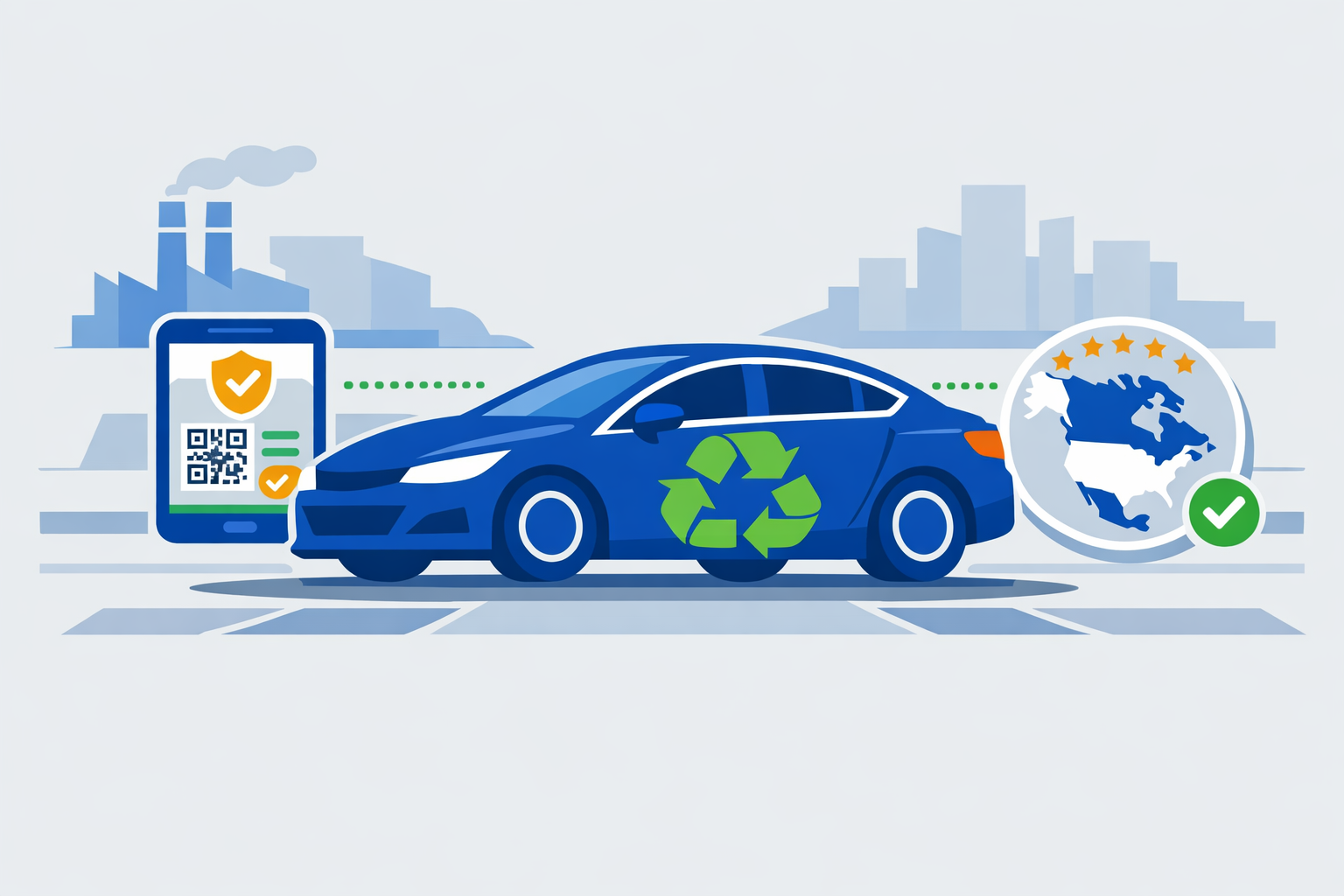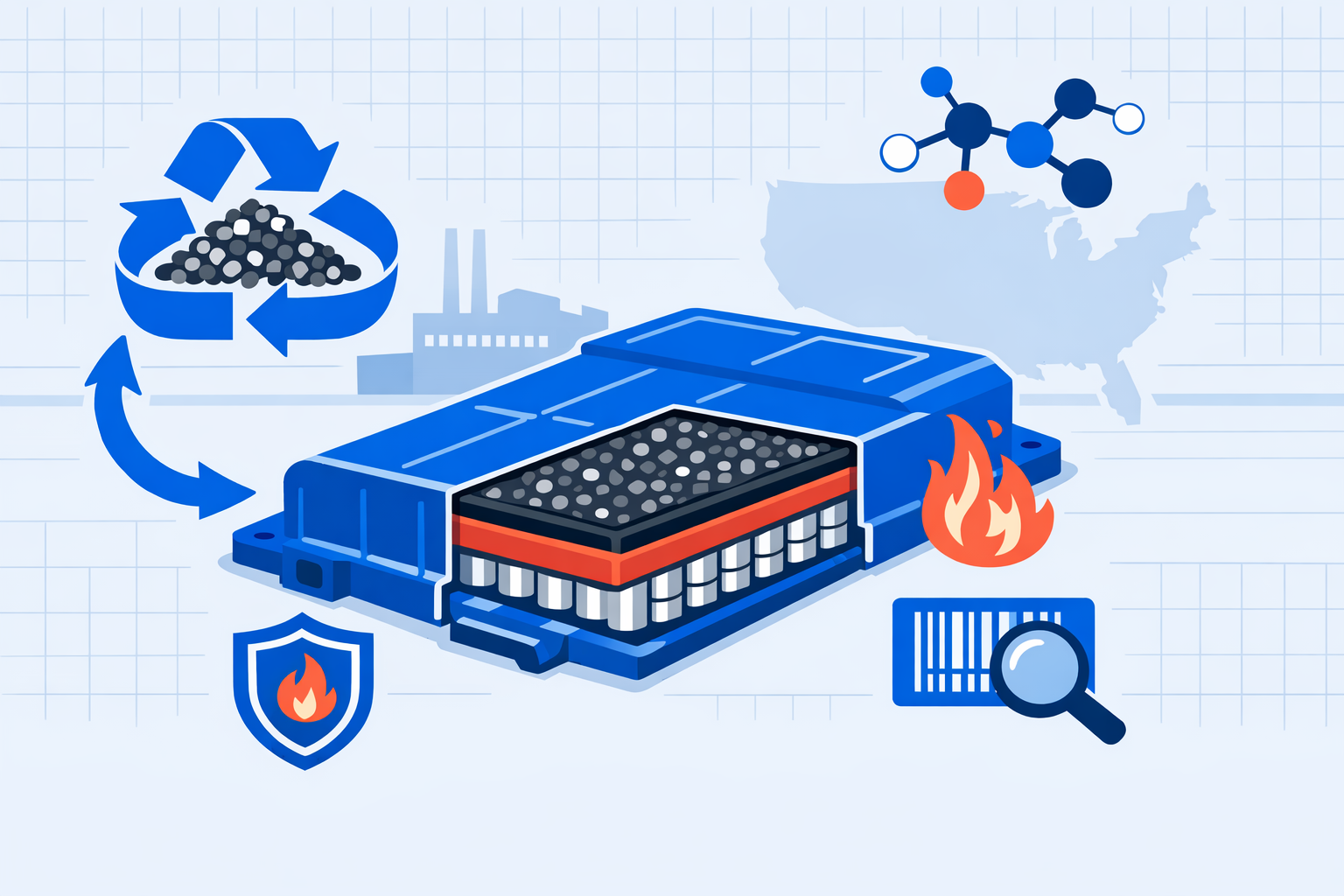
Battery housings represent one of the most demanding polymer applications in an electric vehicle - and they are fast becoming the front line of the North American automotive industry's recycled-content ambitions. While post-consumer recycled (PCR) plastics have gained steady traction in interior trim and under-hood brackets, deploying them in structural battery enclosures requires clearing a much higher bar: thermal runaway resilience, UL94 V-0 flame retardancy, crash-load resistance, and electrolyte chemical compatibility - all with documented, lot-traceable recycled feedstocks.
The commercial pressure to clear that bar is intensifying. The global post-consumer recycled plastics in automotive market was estimated at USD 11.92 billion in 2024 and is projected to grow at a compound annual growth rate of 11.1% through 2030, according to Grand View Research[1]. Meanwhile, North America's EV plastics market is estimated at approximately USD 395 million in 2025, growing at roughly 20% CAGR through 2034, with recyclable materials and polymer compounds at the center of regional supply-chain investment, per 360 Research Reports[2].
The convergence of OEM sustainability mandates, emerging U.S. federal recycled-content rulemaking, and supplier-side innovation is redefining how battery enclosures are specified, qualified, and sourced.
The Regulatory and OEM Mandate Landscape
The policy backdrop driving PCR adoption in battery housings is multilayered. As covered previously on Plastics Insider, the U.S. federal government has proposed a rule requiring minimum recycled plastic content in light-vehicle components, including battery enclosures. The proposal, aimed at 2026 implementation, would be the first federal mandate explicitly targeting recycled polymer content in automotive parts - broadening the scope well beyond existing EPA Comprehensive Procurement Guidelines.
That domestic rulemaking draws on international precedent. The European Union's End-of-Life Vehicles Directive mandates that new vehicles incorporate at least 15% recycled plastic within six years and 25% within ten years, with a minimum share sourced via closed-loop recycling of end-of-life vehicle (ELV) plastics, according to Grand View Research[1].
On the corporate side, commitments from major North American OEMs are concrete. Ford has pledged to use at least 20% recycled content across its vehicle lineup by 2025, while GM is targeting 50% sustainable materials in all vehicles by 2030, per Grand View Research[1]. Stellantis, through its SUSTAINera circular economy unit, is embedding recycled material loops into its North American supply chain and has committed to carbon neutrality by 2038, applying a "Design for Circular Economy" approach from the earliest design stages[3].
For battery housing suppliers, the implication is clear: recycled content is transitioning from a marketing differentiator to a contractual specification.
Why Battery Housings Amplify Every Material Challenge
An EV battery housing is not a passive enclosure. It must simultaneously provide structural stiffness to resist pack deformation in a crash, thermal insulation and management capability, electrical insulation with high dielectric strength, chemical resistance to lithium-ion electrolytes, and - critically - suppression of flame propagation if thermal runaway occurs.
A lithium-ion cell entering thermal runaway can reach temperatures of 700-900°C within seconds, releasing flammable electrolyte gases, as documented by ZetarMold engineering resources[4]. This sets the flame retardancy threshold: without a UL94 V-0 or V-1 rating at the specified wall thickness, no major OEM or safety agency will approve a polymer housing for use in lithium-ion battery packs.
Achieving that rating with virgin engineering polymers is challenging enough. Achieving it with a PCR-content compound introduces additional complexity. Recycled feedstocks carry variable molecular weight distributions, potential contaminants from prior use, and residual colorants or processing aids that interact unpredictably with flame-retardant additive systems. Halogen-free flame retardant systems eliminate toxic combustion gases but typically reduce impact strength by 10-25%, making load-bearing calculations more conservative for recycled grades, per ZetarMold[4].
A further engineering subtlety often underestimated in early-stage material selection: UL94 ratings are thickness-specific. A resin with a V-0 datasheet rating at 3.2 mm does not guarantee V-0 performance at 1.5 mm, as reduced wall thickness decreases the polymer mass available to form a protective char layer, according to ZetarMold[4]. Every thin-wall section of a housing design requires independent flammability validation - a discipline that must be applied with equal rigor to PCR-content compounds.
Key Polymer Candidates and Their PCR Trade-Offs
Several polymer families are being actively evaluated and deployed in PCR-content EV battery housing programs across North America:
| Polymer / Blend | Typical PCR Source | Thermal Resistance (filled) | Max UL94 Achievable (halogen-free) | Key PCR Challenge |
|---|---|---|---|---|
| Recycled PP (rPP) | Post-consumer packaging, auto scraps | HDT ~100-130°C | V-0 | MW degradation; FR loading variability |
| Recycled PA6/PA66 (rPA) | Fishing nets, automotive components | HDT ~180-200°C | V-0 (phosphorus-based) | Moisture absorption; reduced post-reprocess impact |
| Recycled PC/ABS (rPC/ABS) | E-waste, automotive trim | HDT ~100-110°C | V-0 at 0.75 mm | Color inconsistency; Vicat softening variation |
| Recycled PBT (rPBT) | Post-industrial engineering resin | HDT ~200°C (GF) | V-0 (phosphorus-N systems) | Hydrolytic stability; limited supply volume |
| Recycled PPE/HIPS blend | Post-industrial engineering resin | HDT ~110-130°C | V-0 at 0.75-0.8 mm | Blending consistency; electrolyte resistance verification |
Polypropylene holds the largest share of the PCR automotive market at 43.78% of global revenue in 2024, driven by its cost-effectiveness and processing versatility, according to Grand View Research[1]. However, for the most thermally demanding battery housing sub-components - cell module covers, inter-cell retainers, and bus-bar enclosures - glass-fiber-reinforced recycled polyamide and PPE-based blends are generating stronger technical interest.
SABIC, which accounts for approximately 12% of global EV plastic market share[2], highlighted its NORYL™ PPE-based grades and non-halogenated flame-retardant LNP™ compounds at The Battery Show North America in October 2024, specifically citing their suitability for EV battery components and charging infrastructure. LANXESS and Mitsubishi Chemical are competing with reinforced PCR polyamides and polycarbonate blends[5], emphasizing dimensional stability under thermal cycling and vibration - an important qualification for pack assemblies subject to repetitive charge-discharge thermal cycles in real-world EV operation.
Specialist compounders such as Avient Corporation and Teknor Apex are positioning around application-specific formulation flexibility, rapidly adjusting PCR content and FR systems to meet evolving OEM enclosure specifications for new battery formats and localized production sites.
The competitive dynamic is shifting: across the market, PCR plastics for battery enclosures are increasingly positioned as engineered materials rather than recycled substitutes[5] - a framing that aligns with OEM procurement expectations for validated, specification-compliant compounds.
The Certification and Qualification Gauntlet
Getting a PCR-content polymer approved for a battery housing program involves a multi-stage process substantially more rigorous than swapping a virgin resin for a recycled-content grade. The following pathway reflects current industry practice:
1. PCR Resin Qualification and Traceability Establishing documented chain-of-custody for recycled feedstock - verifying post-consumer content percentage, contamination levels, and molecular weight distribution relative to virgin benchmarks. ISO 14021 and ASTM D7209 provide reference frameworks for recycled content claims.
2. Compounding and Additive Optimization Reformulating flame-retardant (FR) additive systems - typically phosphorus-nitrogen or metal hydroxide-based - to compensate for variability in PCR matrix properties. Phosphorus- and nitrogen-based retardants have achieved solutions capable of passing stringent UL94 V-0 ratings with a reduced environmental footprint[6]. Halogenated systems, while effective, face tightening REACH and EPA restrictions and complicate end-of-life recycling, since halogenated additives are difficult to separate during mechanical recycling and may release toxic compounds if incinerated[7].
3. Mechanical and Thermal Characterization Full mechanical property profiling - tensile, flexural, Charpy impact, HDT - on PCR compound lots, referenced against OEM-specified minimums. Thermal runaway exposure testing per UN ECE R100 and FMVSS 305 must also be completed.
4. UL94 Flammability Certification at Design Wall Thickness Obtaining V-0 listings at the actual minimum wall thickness of the housing design - not nominal. Reducing wall thickness by 50% often shifts the UL94 rating by one to two levels[4], as less polymer mass is available to form a protective char. For thin-wall EV housing designs - increasingly driven below 2.0 mm to save weight - this represents a non-trivial certification burden.
5. OEM Automotive PPAP Completion of the automotive Production Part Approval Process (PPAP), including dimensional reports, material certificates, capability studies, and retained samples. PCR-content updates to an already-approved material require re-submission at the appropriate PPAP level.
6. Lifecycle and Carbon Accounting Documenting lifecycle carbon reduction versus a virgin resin baseline. OEMs increasingly demand supplier-level Scope 3 emissions data alongside PCR content certificates[6] - a requirement reshaping supplier qualification forms and data-sharing agreements across the Tier 1/Tier 2 supply chain.
Supply Chain Dynamics: Circularity and the North American Build-Out
The infrastructure for supplying automotive-grade PCR resins at the volumes needed for EV battery housing programs is still maturing in North America. Investment in advanced sorting and processing technologies has significantly improved the quality and consistency of PCR plastics[1], but supply reliability and lot-to-lot consistency remain critical concerns for procurement teams specifying materials for safety-critical enclosures.
OEM-level supply chain investments are beginning to close the loop. Ford invested $50 million in Redwood Materials[8] to build a closed-loop battery recycling supply chain. GM's Ultium Cells operation feeds production scrap back through Redwood's recovery process, providing recycled cathode and anode materials for new battery manufacturing. While these closed loops currently focus on cell chemistry materials rather than polymer housings, the infrastructure and traceability frameworks under development are directly applicable to polymer content tracking.
Sirmax Group announced an expansion of its recycled plastics production capacity at its North American facility in Q2 2025[9], specifically targeting the EV market - a development signaling growing commercial confidence in North American PCR supply chains for automotive-grade compounds.
Additionally, advances in polymer blending and additive technology now allow recycled polypropylene and polyethylene to meet the safety and performance standards required by automotive OEMs[1]. As these formulation improvements become accessible to more compounders, the cost premium associated with qualified PCR grades for demanding applications should narrow.
Competitive Implications for Material Selection
The shift toward PCR-content battery housings is not uniform across OEM platforms. Early adopters - primarily programs targeting regulatory compliance in European markets and sustainability reporting milestones - are focusing PCR content in lower-risk housing sub-components: covers, spacers, and secondary structural brackets. Primary load-bearing structures and thermal management interfaces remain in virgin or post-industrial recycled grades until validation data for post-consumer grades matures.
Competitive dynamics are sharpening at several levels:
- Resin producers with established PCR compounding capabilities (SABIC, LANXESS, Mitsubishi Chemical, LG Chem) are investing in application-specific EV grades with documented recycled content and FR performance, positioning early-stage OEM collaboration as a key differentiator.
- Specialist compounders (Avient, Teknor Apex) are competing on formulation agility - the ability to rapidly tune PCR content and FR chemistry for new battery formats and localized production needs.
- OEM procurement teams are beginning to treat recycled content traceability as a supply qualification criterion, not merely a sustainability bonus - a shift that will accelerate as federal content rules advance toward implementation.
Competitive advantage in this segment hinges on the ability to balance recycled content with performance assurance, regulatory compliance, and supply reliability[5]. Materials that deliver predictable behavior, documented traceability, and scalable PCR integration are favored at material selection reviews - repositioning advanced compounders and engineering resin producers at the center of EV platform decisions.
Key Takeaways for Industry Professionals
- Regulatory pressure is converging from both federal proposals (U.S. recycled content rule) and OEM corporate commitments, making PCR integration in battery housings a medium-term inevitability rather than an optional upgrade.
- Flame retardancy certification must be re-run for PCR grades at actual design wall thicknesses - the most common compliance gap in early PCR housing evaluations.
- Halogen-free FR systems are the preferred direction, but they impose mechanical property trade-offs that require careful compound optimization and updated design allowables.
- Lot-to-lot consistency in PCR feedstocks remains the primary procurement risk; traceability documentation and incoming QC protocols must be embedded in supplier qualification requirements.
- Closed-loop recycling programs being built for battery cell chemistry (by GM, Ford, and Stellantis) are creating supply chain infrastructure that will eventually underpin PCR polymer recovery from EV housings themselves - a critical step toward truly circular battery pack manufacturing.
For deeper context on how fiber-reinforced recycled composites complement thermoplastic PCR strategies in battery enclosures - particularly in European markets - see the related Plastics Insider analysis on bio-based and recycled fiber composites accelerating into EV battery enclosures.