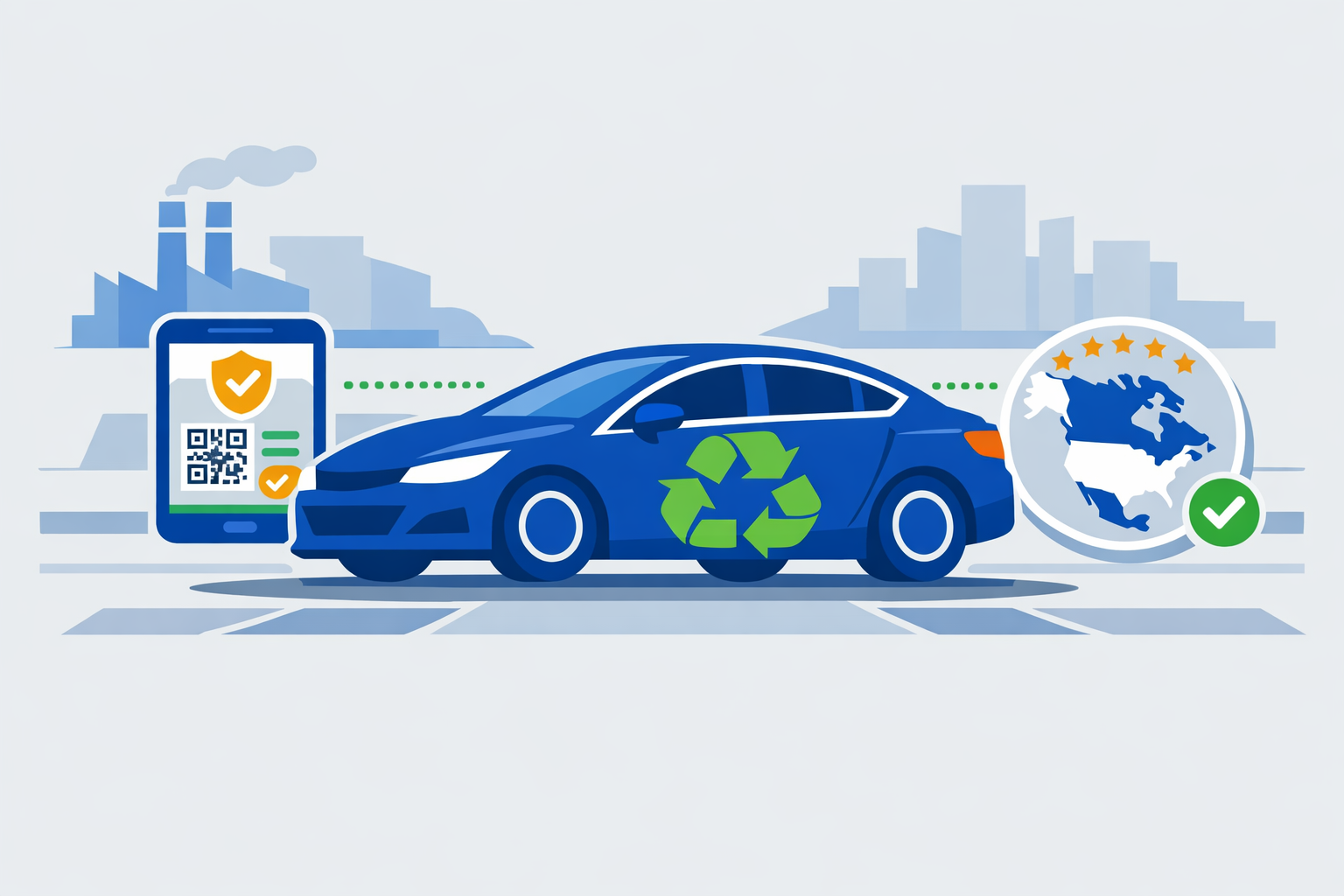
The global market for post-consumer recycled (PCR) plastics in automotive applications was valued at USD 11.92 billion in 2024 and is projected to reach USD 22.32 billion by 2030, growing at a compound annual rate of 11.1%[1]. For North American OEMs, that trajectory is no longer a market opportunity to weigh - it is rapidly becoming a compliance imperative, particularly for electric-vehicle (EV) battery enclosures.
Battery housings present one of the most demanding material environments on an EV platform. They must simultaneously deliver flame retardancy, dimensional stability across wide thermal cycles, chemical resistance to electrolyte exposure, and sufficient mechanical integrity to survive crash events. Integrating PCR content into these assemblies without compromising those attributes is the central engineering and procurement challenge defining the next 12 to 24 months for the North American EV supply chain.
The Regulatory Backdrop: A Patchwork With Escalating Pressure
Unlike the European Union - which has reached a provisional agreement mandating at least 15% recycled plastic content in new vehicles[1], rising to 25% over ten years - North America lacks a single binding automotive-specific PCR mandate. Instead, OEMs navigate a fragmented but intensifying regulatory environment.
At the federal level, the U.S. Inflation Reduction Act's Section 30D clean vehicle credit framework is the most consequential current lever. Under those rules, the share of an EV battery's component parts that must be manufactured or assembled in North America was set at 60% for vehicles placed in service in 2024 and 2025, rising incrementally to 90% by 2028, as codified in the Internal Revenue Code[2]. While these rules primarily target critical minerals and cell components rather than polymer enclosures, they signal a strong domestic-content ethos that increasingly extends to Tier 1 and Tier 2 material sourcing decisions.
At the state level, momentum is accelerating. As of August 2025, five U.S. states had passed laws requiring post-consumer recycled content in plastic products and packaging, per the Association of Plastics Recyclers[3]. California's extended producer responsibility (EPR) framework - Senate Bill 54 - remains the most consequential, targeting 65% recycling rates and a 25% reduction in single-use plastic, though regulatory rulemaking was sent back for revision in March 2025[4] amid industry cost concerns. Separately, the EPA is developing a national EPR framework for batteries[5] under the Infrastructure Investment and Jobs Act, with stakeholder conversations ongoing throughout 2025.
The cumulative effect: procurement leaders cannot wait for federal harmonization. Voluntary OEM commitments are filling the gap. Ford has pledged to use at least 20% recycled content across its vehicle lineup by 2025, while GM has set a target of 50% sustainable materials in all vehicles by 2030, according to market analysis from Grand View Research[1].
Battery Enclosure Polymer Selection: Where PCR Meets Performance Requirements
The battery pack is one of the most polymer-intensive structures on an EV platform. Manufacturers fabricate cell holders, module frames, thermal barriers, and insulation layers[6] using materials including polycarbonate (PC), polyethylene terephthalate (PET), and polybutylene terephthalate (PBT) - all of which must deliver dimensional stability, electrical insulation, flame retardancy, and high-temperature resistance.
The table below maps primary PCR polymer candidates against their relevant battery housing applications and the key quality hurdles each must clear:
{{component:TABLE_PLACEHOLDER}}
Polypropylene (PP) dominates current PCR usage in automotive, commanding approximately 43.78% of the PCR automotive market by revenue in 2024, driven by its chemical resistance and processability. For enclosure shells and cable ducts - lower-thermal-exposure components - PCR-PP with appropriate additive packages is already commercially viable, with established OEM qualification pathways.
More demanding applications - upper enclosure lids and module-level housings exposed to thermal runaway scenarios - require engineering resins such as flame-retardant PPE blends or PC/ABS compounds. PCR sourcing for these grades remains constrained. Covestro's recently introduced line of PCR polycarbonates derived from end-of-life automotive headlamps[7] - TÜV Rheinland-certified PC grades containing 50% recycled content, developed with Volkswagen and NIO - represents a landmark closed-loop initiative. North American supply chains for analogous ELV-derived PCR engineering resins remain less developed, creating a provenance gap that procurement teams must actively manage.
Supply Chain Realities: Capacity, Contamination, and Certification
The structural challenge for North American PCR integration is not a shortage of infrastructure aspiration - it is a gap between available throughput and automotive-grade output quality. North American recyclers can currently process an additional 2 billion pounds of plastic annually beyond existing volumes, per 2025 capacity data from the Association of Plastics Recyclers[8]. The bottleneck lies in translating that raw throughput into consistent, specification-compliant feedstock for demanding EV applications.
Contamination and consistency remain the dominant technical barriers. Collection programs vary widely across jurisdictions, and contamination from mixed materials continues to limit recovered plastic quality[9]. For battery enclosure applications specifically, trace contaminants can compromise electrical insulation integrity - a failure mode with direct safety consequences.
A further concern specific to North America: the growing volume of imported PCR from markets with limited oversight and inconsistent quality[10] risks undermining domestic recycler economics while introducing provenance gaps incompatible with automotive traceability requirements. The APR has highlighted that purchasing imported PCR may satisfy corporate reporting obligations without building the domestic circular infrastructure OEMs will depend on for long-term supply security.
For battery enclosure components, third-party PCR certification[3] is increasingly a baseline expectation rather than a differentiator, as OEM quality teams demand documented chain of custody from end-of-life material stream to molded component.
The North American Differentiation Opportunity
European OEMs are already validating PCR-containing materials for battery-adjacent applications under binding ELV regulation - and those global supply agreements will reach North American platforms within the same product development cycles. As covered in our analysis of EU mandates shaping EV battery enclosure composites, the EU's phased recycled-content targets are already reorienting how global Tier 1 suppliers qualify materials.
For North American procurement and R&D teams, the differentiation opportunity lies in proactive qualification ahead of regulatory obligation. Glass-fiber-reinforced PP with 65% PCR content has already achieved commercial application in structural automotive components[11] - including bumper brackets in production Volvo vehicles - demonstrating that performance thresholds are not insurmountable when supplier-OEM collaboration is structured appropriately.
The cost dynamic is also evolving. PCR materials historically carried a price premium due to processing complexity, but as domestic collection and sortation infrastructure scales - enabled in part by state EPR fee structures - the economics of domestic PCR versus virgin resin are expected to converge[10], particularly for commodity grades like PP. Engineering resin PCR premiums will persist longer, reinforcing the strategic value of early supplier partnerships.
Assessing Your Organization's PCR Readiness
The interactive tool below helps procurement, quality assurance, and materials engineering teams benchmark their organization's readiness to integrate PCR polymers into EV battery enclosure programs.
{{widget:WIDGET_PLACEHOLDER}}
Key Takeaways for Procurement and Strategy Teams
- No federal mandate, but de facto pressure exists. IRA domestic content rules, state EPR frameworks, and OEM sustainability commitments are creating procurement obligations that mirror regulatory requirements in practice.
- PCR-PP is the near-term entry point. For non-structural enclosure components - bracket shells, cable ducts, cover panels - PCR-PP compounds with validated flame-retardant additive packages are available and OEM-qualifiable today.
- Engineering resin PCR supply is the critical gap. PC/ABS and PPE-based PCR grades suitable for higher-thermal-exposure battery housing applications remain limited in North America. Early supplier development agreements carry strategic significance.
- Domestic sourcing and certification are non-negotiable. Third-party certified, domestically sourced PCR provides traceability assurance, supports domestic recycler economics, and reduces the provenance risk that imported PCR introduces into quality systems.
- EU benchmarking informs NA timelines. European OEMs validating PCR-containing materials now will embed them into global platforms reaching North American markets within two to three product cycles. Monitoring those qualification pathways provides forward intelligence for NA materials teams.
Frequently Asked Questions
{{component:FAQ_PLACEHOLDER}}