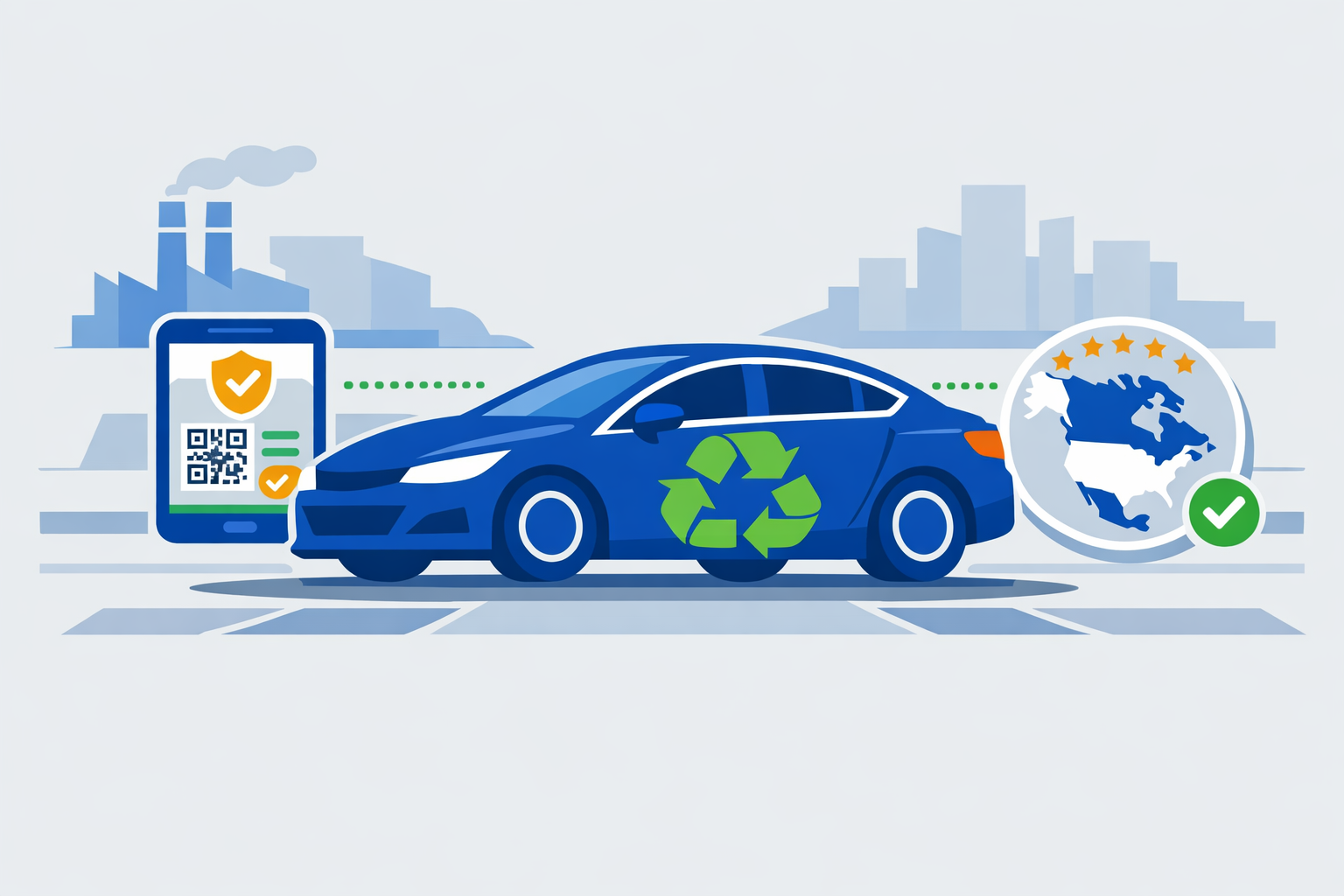
North American automakers and their Tier 1 polymer suppliers are accelerating programs to incorporate post-consumer and post-industrial recycled resins into electric vehicle battery housings. The push is driven by tightening recycled-content rules across multiple U.S. states and escalating pressure from international markets. The shift is generating new material qualification programs, supplier partnerships, and lifecycle analysis benchmarking as engineers work to resolve thermal management and flame-retardancy trade-offs inherent in substituting virgin polymers.
Background
As of 2025, no single federal recycled-content mandate exists for automotive plastics in the United States, but the regulatory vacuum is narrowing. With the Trump administration having deprioritized federal recycling legislation, the Circular Action Alliance now coordinates compliance across multiple states as a designated Producer Responsibility Organization, creating what analysts describe as a de facto national standard for multi-state manufacturers. Fourteen states are now implementing or advancing packaging EPR laws as of May 2025, and minimum post-consumer recycled (PCR) content thresholds are already law in five states. Industry groups including America's Plastic Makers have urged policymakers to advance voluntary recycled-content standards aligned with emerging global requirements, noting that major global markets including the European Union and Japan are advancing recycled-content requirements for vehicles, with mandatory thresholds expected within the next five to six years.
For U.S. manufacturers building platforms for export, that timeline is concrete. To continue selling and exporting vehicles into these major markets, U.S. automakers will need to meet these recycled-content standards, according to America's Plastic Makers. Meanwhile, the EU Battery Regulation 2023/1542 is already forcing redesigns around recyclable, flame-retardant resins that tolerate chemical depolymerization without additive loss, affecting platforms developed jointly with European partners.
Details
The EV battery housing ranks among the most technically demanding targets for recycled polymer integration. A typical electric vehicle contains approximately 110 kg of plastics, largely concentrated in the battery casing and cooling system, according to industry data from the global EV plastics market. Battery cases are among the fastest-growing plastic components in EVs, replacing traditional metal housings with lightweight, flame-retardant polymers that must simultaneously provide structural integrity, thermal runaway protection, electrical isolation, and resistance to coolant exposure.
Battery module housings represent the largest application segment for flame-retardant polyamide compounds in EVs, serving as the primary structural and protective enclosure for cell arrays. Key polymers under evaluation include glass fiber-reinforced polyamide 6 (PA6), polypropylene (PP) compounds, modified polyphenylene ether (mPPE), and polybutylene terephthalate (PBT). Research published in Polymer Engineering & Science (2025) demonstrated that recycled PA6 reinforced with 30% glass fiber achieves a tensile strength of 170 MPa, while thermal treatment increases the tensile modulus of recycled PA6 to 8,500 MPa, comparable to virgin PA6. The same study found that compounding recycled PP with thermoplastic elastomers improves its impact strength to 18 KJ/m², and calcium carbonate and talc enhance its thermal stability to 95°C.
Some OEMs now mandate using recycled materials for up to 25% of plastic components in EVs, according to Plastics Engineering magazine, while suppliers are exploring chemical recycling, mass balance accounting, and bio-attributed resins to reduce carbon footprints without compromising performance. SABIC, which accounts for approximately 12% of the global EV plastics market, specializes in recyclable and flame-retardant plastics for battery housings and interiors. The company's BLUEHERO initiative offers short and long glass fiber-reinforced polypropylene with non-halogenated flame retardance and high-temperature engineered thermoplastics for battery pack applications. A prototype enclosure concept developed jointly by Forward Engineering, SABIC, and injection molding equipment supplier Engel-displayed at the Battery Show in Detroit-used high-volume injection molding with long glass fiber-reinforced polypropylene between organosheet layers, incorporating built-in cooling channels.
Flame retardancy performance for recycled grades is under close scrutiny. Japan's Asahi Kasei has developed a modified polyphenylene ether grade for battery enclosures that survives more than five minutes without burn-through when a 3-mm-thick plate is subjected to an 850°C flame, and is rated UL V-0 at 0.75 mm. Canadian company Pyrophobic Systems offers intumescent polymer technology that can be injection molded or extruded to form fire-resistant battery pack components that expand under heat to form a protective char layer.
In May 2025, Toyoda Gosei developed new technology to recycle high-quality plastic from end-of-life vehicles to meet growing demand for recycled plastic in the EV and broader automotive industry against strengthened environmental regulations, according to Mordor Intelligence market data. Ford invested $50 million into Redwood Materials in 2021 and partnered to build a closed-loop battery recycling supply chain handling both production scrap and end-of-life packs, and GM Ultium Cells has engaged Redwood to recycle production scrap from its battery plants, feeding recovered materials back into new EV manufacturing.
Broader adoption of recycled polymers in battery housings faces persistent challenges. Ensuring consistent PCR feedstock quality at scale, maintaining flame-retardancy ratings required by UL 2596 and UL 94, and completing full lifecycle analyses that satisfy corporate sustainability reporting frameworks all add qualification time and cost. The industry's pivot to 800-volt electrical architectures further demands dielectric-robust resins capable of withstanding at least 20 kV/mm-a threshold that narrows the pool of validated recycled-grade candidates and is driving premium demand for polyimide, PEEK, and polyphenylene sulfide (PPS) compounds.
Outlook
The North American EV plastics market is estimated at approximately USD 395 million in 2025, with a projected compound annual growth rate of approximately 20% through 2034, according to market analysis data. As state-level PCR mandates mature and voluntary OEM targets become contractual supplier requirements, qualified recycled-grade thermoplastics for battery housings are positioned for accelerated volume growth. Industry observers expect material qualification timelines to compress as recycled polyamide and PP compound grades accumulate automotive test data and suppliers build dedicated PCR resin supply chains capable of delivering consistent lot-to-lot performance.
For related coverage, see our earlier reporting on bio-based and recycled fiber composites in EV battery enclosures and the EU's tightening recycled plastic rules for automotive composites.