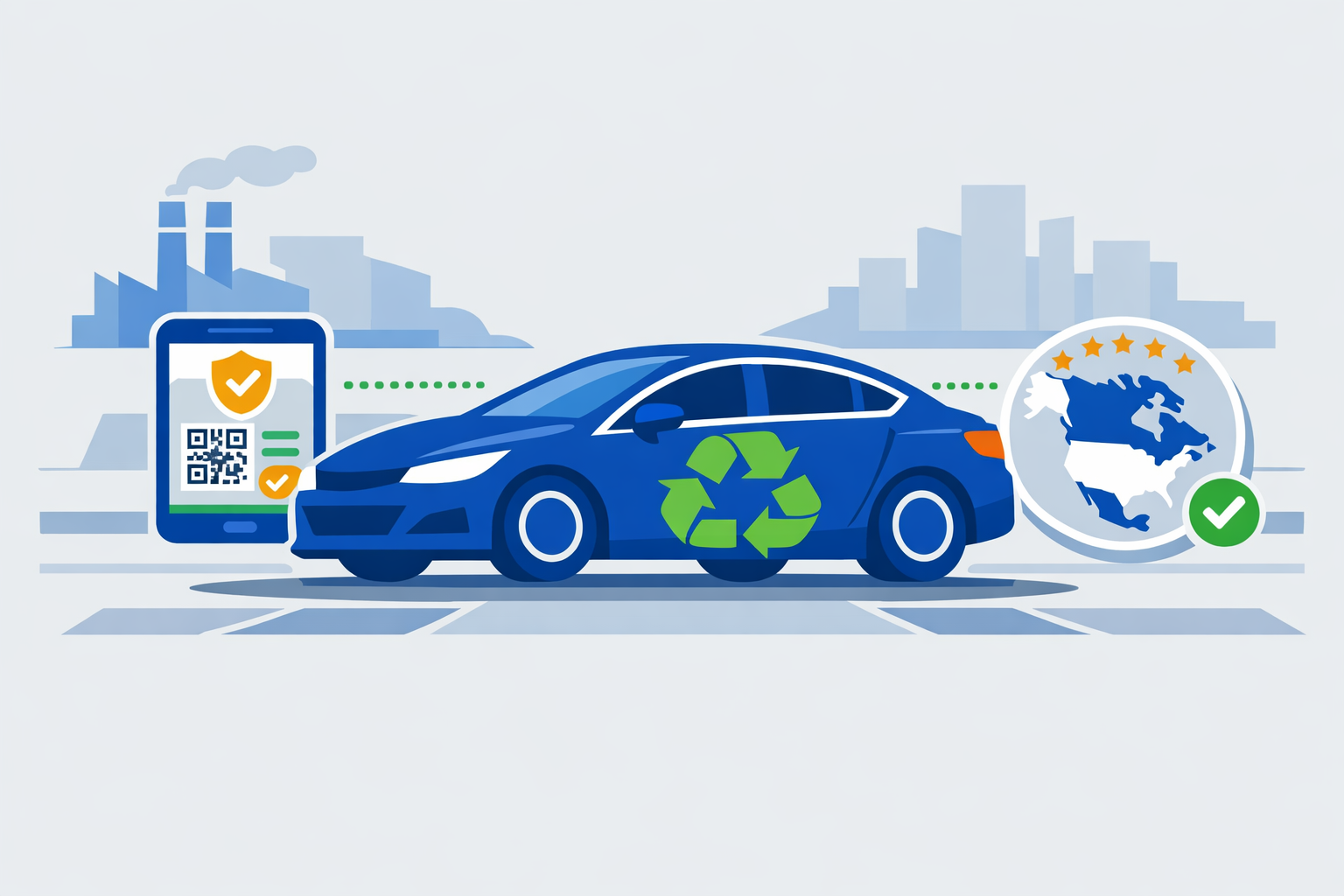
A cross-industry push is underway in North America to introduce third-party certification for post-consumer recycled (PCR) polymer content in electric vehicle battery housings, as automakers and Tier-1 polymer suppliers respond to tightening sustainability expectations, supply chain opacity, and escalating regulatory pressure.
The initiative draws on existing certification infrastructure developed by the plastics recycling industry, extending its requirements into one of the automotive sector's most technically demanding structural applications - the battery enclosure - where polymer performance, flame retardancy, and dimensional stability must be maintained even as recycled feedstock introduces variability.
Background
The structural case for polymer and composite-based EV battery housings has grown substantially. According to research published in ScienceDirect, polymer composites can reduce component weight by 50-60% compared to equivalent metallic parts, while enabling thermal management integration and modular pack design. As automakers pursue higher energy density and structural battery integration, EV battery components have become central to the region's electrification strategy, according to market analysis firm BIS Research, which values the North American EV battery components market at $13.11 billion in 2024, projected to reach $59.85 billion by 2035 at a CAGR of 14.54%.
Despite progress on metallic recycling loops, structural polymer housings remain a persistent gap in recycled-content strategies. According to OECD analysis, current automotive industry frontrunners use only 2-3% recycled content in their vehicles, and most plastic collected from end-of-life vehicles goes to landfill or energy recovery. Separately, a U.S. proposal - first reported on this portal - has outlined federal procurement requirements mandating recycled polymer content in vehicle components including battery enclosures, with implementation targeted for 2026.
The absence of a standardized, auditable framework for verifying PCR content in structural automotive parts has complicated both compliance planning and procurement. As of August 2025, no Canadian federal standard sets recycled content minimums for plastic products, according to the Association of Plastic Recyclers (APR), while U.S. requirements remain fragmented across state-level extended producer responsibility (EPR) laws. PCR certification is currently required under packaging EPR laws in California and Oregon, the APR states, but no equivalent mandate yet applies to automotive structural components in North America.
Details
The Association of Plastic Recyclers' PCR Certification Program - described as "a rigorous, ISO-accredited third-party auditing program" - provides the primary certification framework being adopted in this initiative. The program requires that certified material contains a minimum of 90% post-consumer plastic content, with independent auditors verifying material flow traceability and calculating input versus output quantities against declared PCR percentages. Certificates are valid for three years, with recertification audits required on that cycle. New reclaimers seeking initial certification after April 1, 2025 are required to certify to the updated standard, while existing certified reclaimers must transition by their certificate expiry dates.
Since its 2021 launch, the APR's PCR certification has been awarded to more than 35 plastic recyclers, covering an estimated 30% or more of postconsumer PET, PP, HDPE, LDPE, and LLDPE produced in North America, according to Recycling Today. The program employs independent auditors following international standards for chain-of-custody tracking, the APR states, aiming to build manufacturer confidence and reduce oversight burden.
For EV battery housings specifically, the certification push addresses two overlapping challenges: supply chain variability in recycled resin quality and the need for documented traceability that satisfies both OEM procurement teams and future regulatory auditors. According to EY and Ascend Elements, unstable supply chains represent one of the core challenges facing EV manufacturing, directly impacting product availability and costs. Industry observers note that high-performance engineering polymers used in battery housings - including reinforced polyamides, polycarbonate blends, and flame-retarded polypropylene compounds - present additional technical hurdles when incorporating PCR, given that flame retardant decomposition temperatures must exceed the melt temperatures of the recycling process.
On the supply side, automakers have been building closed-loop material partnerships. Ford invested $50 million into Redwood Materials in 2021 and partnered to build a closed-loop battery recycling supply chain, handling both production scrap and end-of-life packs, according to industry reports. Redwood Materials also recycles production scrap from GM's Ultium battery plants, feeding recovered materials back into new EV manufacturing.
The APR recommends that third-party certification "confirm postconsumer sources and ensure recyclers have chain-of-custody tracking," noting that this approach "builds manufacturer confidence, proves compliance, reduces state oversight burdens, and increases transparency."
Outlook
Parallel regulatory development in the European Union is shaping expectations for the North American market. The EU's revised Batteries Regulation introduced traceability requirements and a "battery passport" to track battery contents, while the EU's End-of-Life Vehicles regulation mandates phased recycled plastic content targets. These frameworks are widely viewed as benchmarks for incoming North American standards.
North America's EV battery materials sector is on course for a 20.6% CAGR through 2031 as IRA incentives accelerate local precursor and graphite projects, according to Mordor Intelligence. Suppliers seeking to serve this market will face mounting pressure to certify PCR content, demonstrate chain-of-custody compliance, and validate that recycled polymer fractions meet the flame retardancy and mechanical performance thresholds required for structural battery enclosure applications.
See also: US Proposes Federal Recycled Content Rule for Auto Plastics | EU Boosts Recycled and Biobased Composites for EV Battery Enclosures