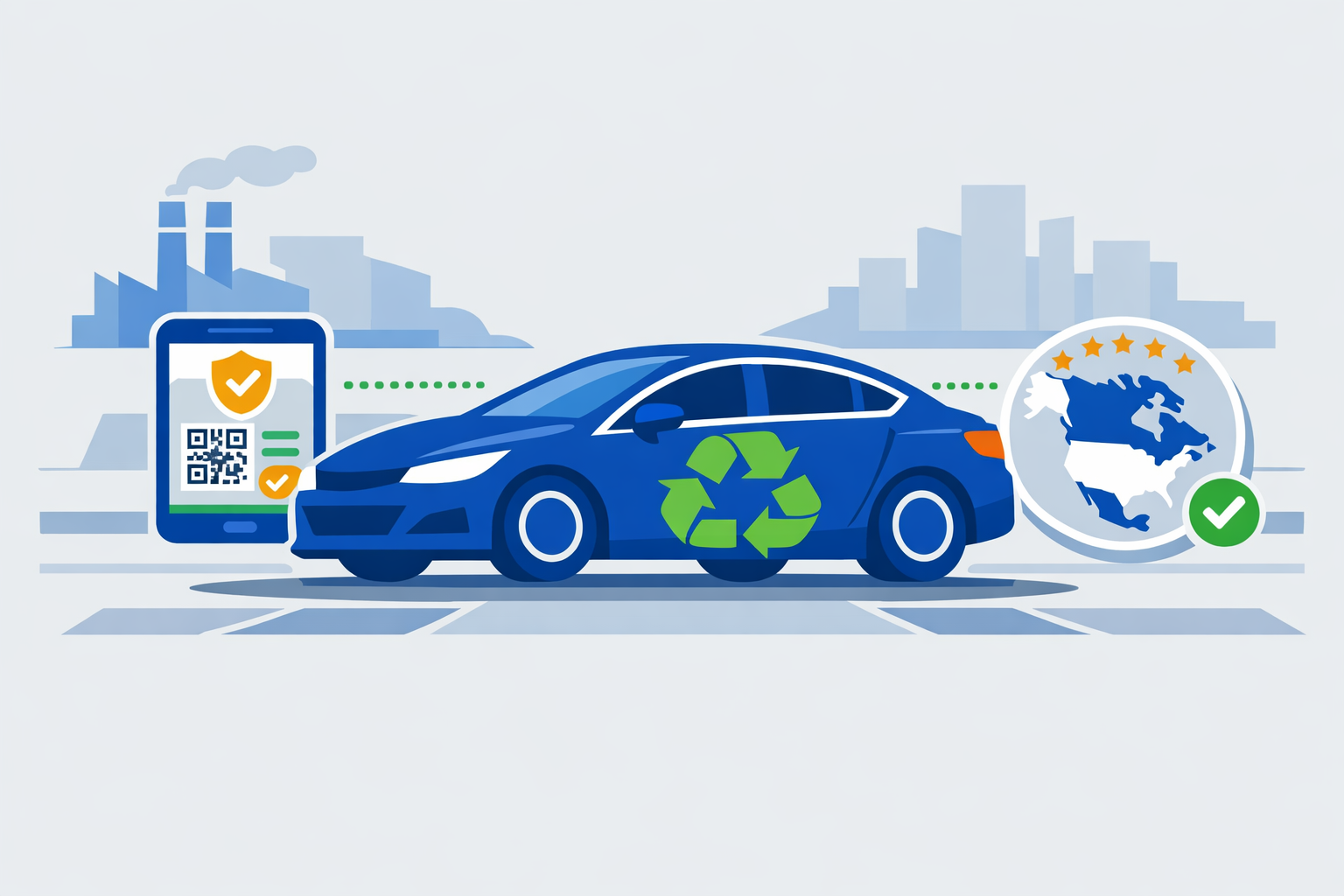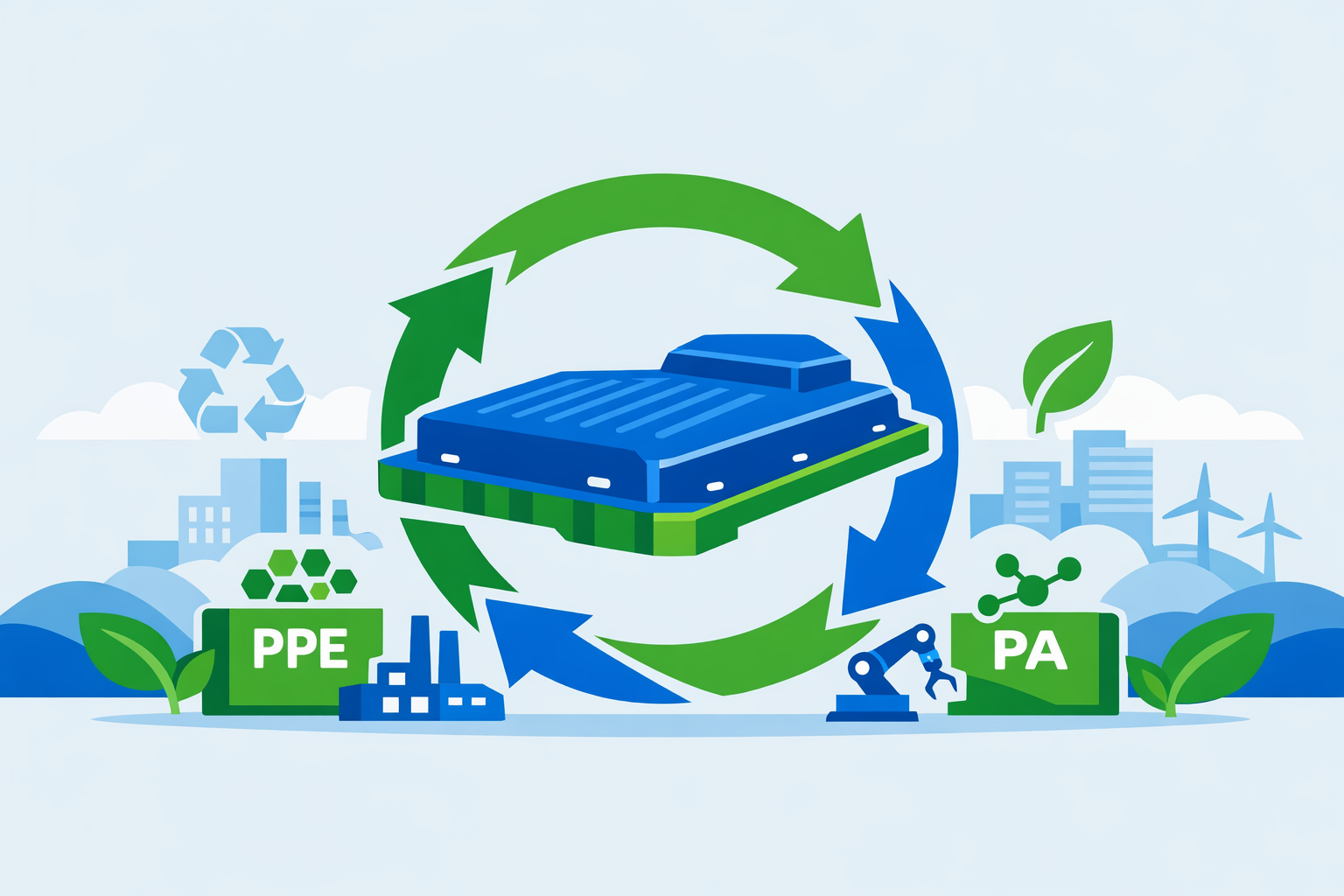
Major North American automakers are ramping up use of post-consumer recycled (PCR) polymers in electric vehicle battery housings, driven by tightening regulatory mandates, corporate sustainability targets, and a maturing supplier ecosystem capable of delivering recycled materials with near-virgin mechanical performance.
Background
The shift is unfolding against a broadening regulatory backdrop. As of mid-2025, seven U.S. states have enacted Extended Producer Responsibility laws for packaging, and at least five have passed statutes requiring post-consumer recycled content in plastic products, according to the Association of Plastic Recyclers (APR). While these mandates primarily target packaging, they are accelerating investment in PCR resin supply chains that directly benefit automotive compounders. The global post-consumer recycled plastics market for automotive applications was valued at approximately USD 11.92 billion in 2024 and is projected to expand at a compound annual growth rate of 11.1% through 2030, according to Grand View Research.
Ford has pledged to incorporate at least 20% recycled content across its vehicle lineup by 2025, while General Motors has set a target of 50% sustainable materials across all vehicles by 2030, according to market analysis by Grand View Research. Stellantis, through its SUSTAINera circular economy program, is pursuing a "Design for Circular Economy" approach from the product engineering phase, targeting closed-loop material cycles for recovered components and establishing North American recycling channels for alloy wheels and battery packs. The company aims to achieve more than €2 billion in total circular economy revenues by 2030.
The battery housing is a focal application for PCR integration. Thermoplastics currently dominate the EV polymer market due to their recyclability, lower production costs, and suitability for battery housings, interiors, and exterior panels, according to Market Research Future. Conventional aluminum enclosures, while structurally established, carry weight penalties that reduce specific energy density. Polyphenylene ether (PPE), polyamide (PA), and other polymers under consideration for battery housings can offer weight savings of up to 35% versus aluminum, according to Plastics Today.
Details
Recent materials science research is validating the technical viability of PCR-grade resins for structural battery applications. A 2025 peer-reviewed study published in Polymer Engineering & Science found that recycled polyamide 6 (r-PA6), when reinforced with 30% glass fiber, achieved a tensile strength of 170 MPa and a tensile modulus of 8,500 MPa after thermal treatment-performance figures comparable to virgin-grade PA6. The same study demonstrated that recycled polypropylene (r-PP) compounded with thermoplastic elastomers, calcium carbonate, and talc achieved a heat deflection temperature of 95°C and an impact strength of 18 kJ/m², with a melt flow index of 12-16 g/10 min optimized to prevent injection-molding defects.
Polyamide 6 and Polyamide 66 are among the primary resins used in EV battery trays, cooling circuits, and high-voltage connectors, as these grades provide the flame retardancy and electrical insulation required for safety-critical systems, according to Vantage Market Research. Flame retardancy remains a critical qualification barrier for PCR compounds. Battery housings must typically survive prolonged flame exposure-some OEM specifications require continuous resistance to flame temperatures of 850°C for five minutes and repeated exposure at 1,250°C for one minute, according to testing protocols cited by STS North America, a battery enclosure supplier.
Supply chain localization is emerging as a parallel imperative. Under the U.S. Inflation Reduction Act's domestic-content provisions, BASF invested USD 150 million in a polyamide expansion in Michigan and DuPont built a 25-kiloton PA66 line in Delaware, according to Mordor Intelligence. Celanese's compounding facility in Querétaro, Mexico, which qualifies as domestic under USMCA rules, supplies polymer compounds for General Motors' Ultium battery pack program. The APR has cautioned that reliance on imported PCR resin could undermine domestic recycling infrastructure investment, advocating for third-party certification standards to ensure chain-of-custody transparency.
The EV plastics market is projected to grow from USD 3.92 billion in 2025 to USD 17.32 billion by 2031, at a CAGR of 28.16%, according to Mordor Intelligence. EPA regulatory rules covering model years 2027-2032 could increase U.S. demand for engineering polymers by up to 220 kilotons per year, according to the same analysis.
Fiber-reinforced thermoplastic composites with thermoplastic matrices-notably PA and polybutylene terephthalate (PBT)-are considered more recyclable than thermoset alternatives, as thermoplastic systems are far more amenable to mechanical and chemical recycling loops. As one composite engineering firm stated in CompositesWorld, material suppliers will need to formulate "sustainable and recyclable options that not only meet the mechanical and thermal performance for battery enclosures, but also hit automaker price targets."
Outlook
Supply qualification timelines remain a constraint. Toyoda Gosei Co., Ltd. developed a new technology in May 2025 to recycle high-quality plastic from end-of-life vehicles to meet growing demand for recycled plastic across the automotive industry, in response to strengthened environmental regulations, according to Mordor Intelligence. As the North American PCR resin supply base matures through dedicated automotive-grade compounding capacity, procurement specialists are expected to accelerate supplier qualification programs for PCR polyamide and polypropylene in battery tray and enclosure applications. The ability of compounders to demonstrate consistent lot-to-lot flame retardancy, dimensional stability, and dielectric performance in PCR compounds will be decisive in determining the pace of adoption.