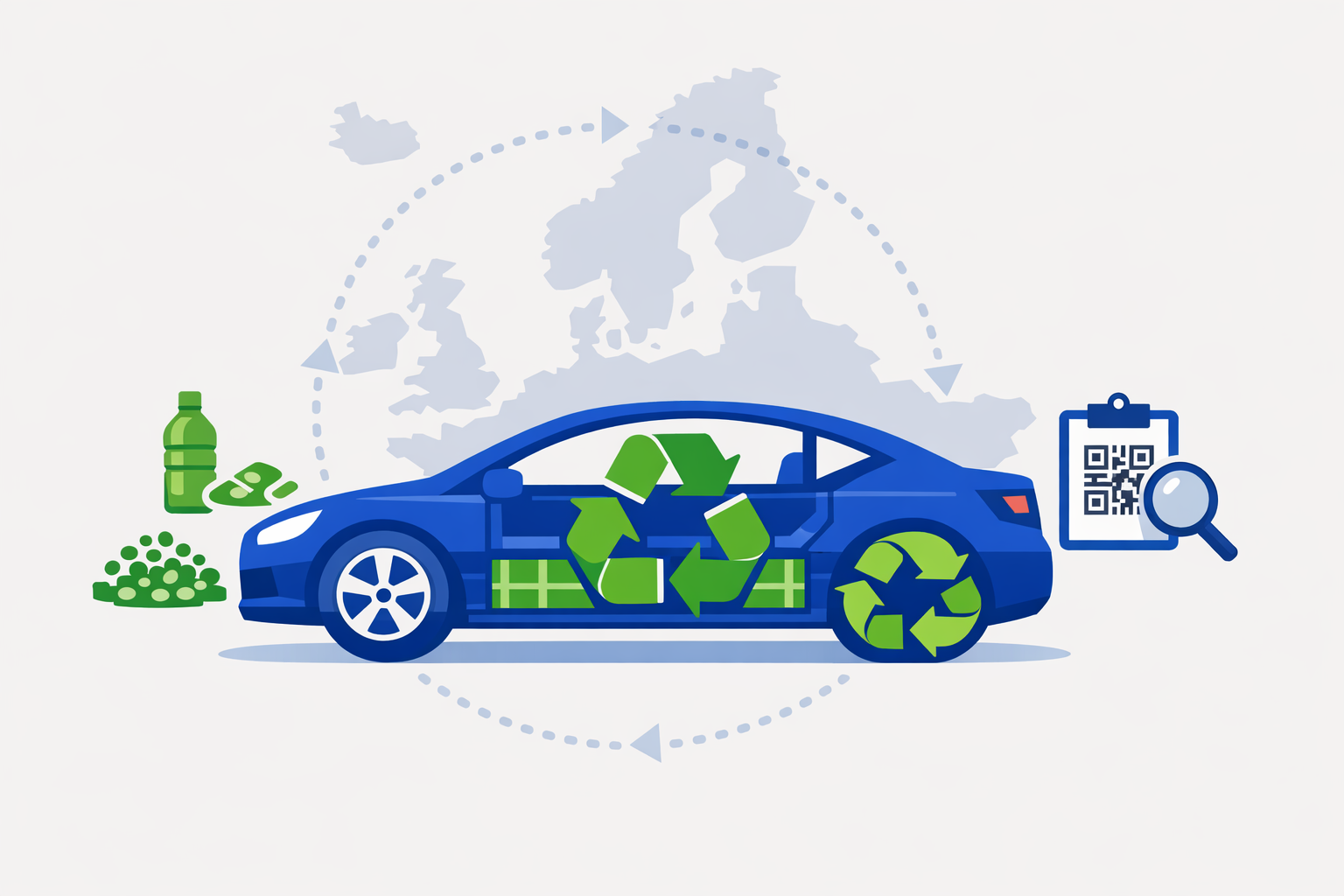
The European Union has adopted stricter mandates on recycled content for automotive composites, requiring at least 15% recycled plastic in new vehicle types within six years of enactment and increasing to 25% within ten years. Regulatory timelines for material origin disclosure and traceability have also been extended for OEMs and tier suppliers, particularly those producing battery enclosures, chassis components, and interior trims. Provisions permit temporary adjustments if recycled materials are unavailable or prohibitively expensive.
Background
These measures expand upon the EU's revised End-of-Life Vehicles (ELV) regulation, passed by the European Parliament in September 2025. The regulation aims to enhance circularity in vehicle design through requirements for dismantlability, recyclability, and incorporation of recycled plastic. The ELV rules align with the European Green Deal and circular economy strategies that seek to reduce waste, limit dependency on virgin materials, and bolster resource security.The updated ELV rules mandate 15% recycled plastic within six years of entry into force and 25% within ten years, with additional recycled steel, aluminum, and alloys considered pending feasibility studies, according to the European Parliament. The Council of the EU supports similar targets, introducing interim milestones: 15% by six years, 20% by eight years, and 25% by ten years. The Council also allows the Commission to grant temporary exemptions in cases of limited material supply or high prices.
Details
Automotive composites, especially those used in battery enclosures, chassis panels, and interior trims, are the primary focus of the new recycled content mandates. Qualifying recycled content must originate from post-consumer materials and may include biobased alternatives and tire-derived elastomers, subject to a future Commission review. Recycled polyolefins, such as polypropylene, are expected to facilitate compliance due to their availability and mature recycling processes.
For the first 48 months following enforcement, recycled material sourced from outside the EU cannot count towards compliance unless verified through third-party audits. This measure aims to reinforce local recycling capacity and traceability standards. Industry stakeholders, including recyclers and trade groups, have advocated a "mirror clause" to ensure imports meet equivalent compliance standards and to support domestic recyclate demand.
OEMs and tier suppliers face new requirements for reporting and material traceability. They must document the origins of recycled content, test recyclability, and implement digital tracking systems. These changes are expected to reshape supply chain management, procurement strategies, and investments in recycling infrastructure. Regulators plan to coordinate these requirements with existing extended producer responsibility (EPR) and end-of-life directives, further closing the circular economy loop.
Outlook
Automakers and suppliers must accelerate design validation and material qualification processes to integrate recycled composites into both structural and interior applications. Within the next few years, investment in recycling infrastructure and traceability technology will be critical. Ongoing interinstitutional negotiations may adjust implementation details, including provisions for biobased alternatives and conditions for temporary exemptions.