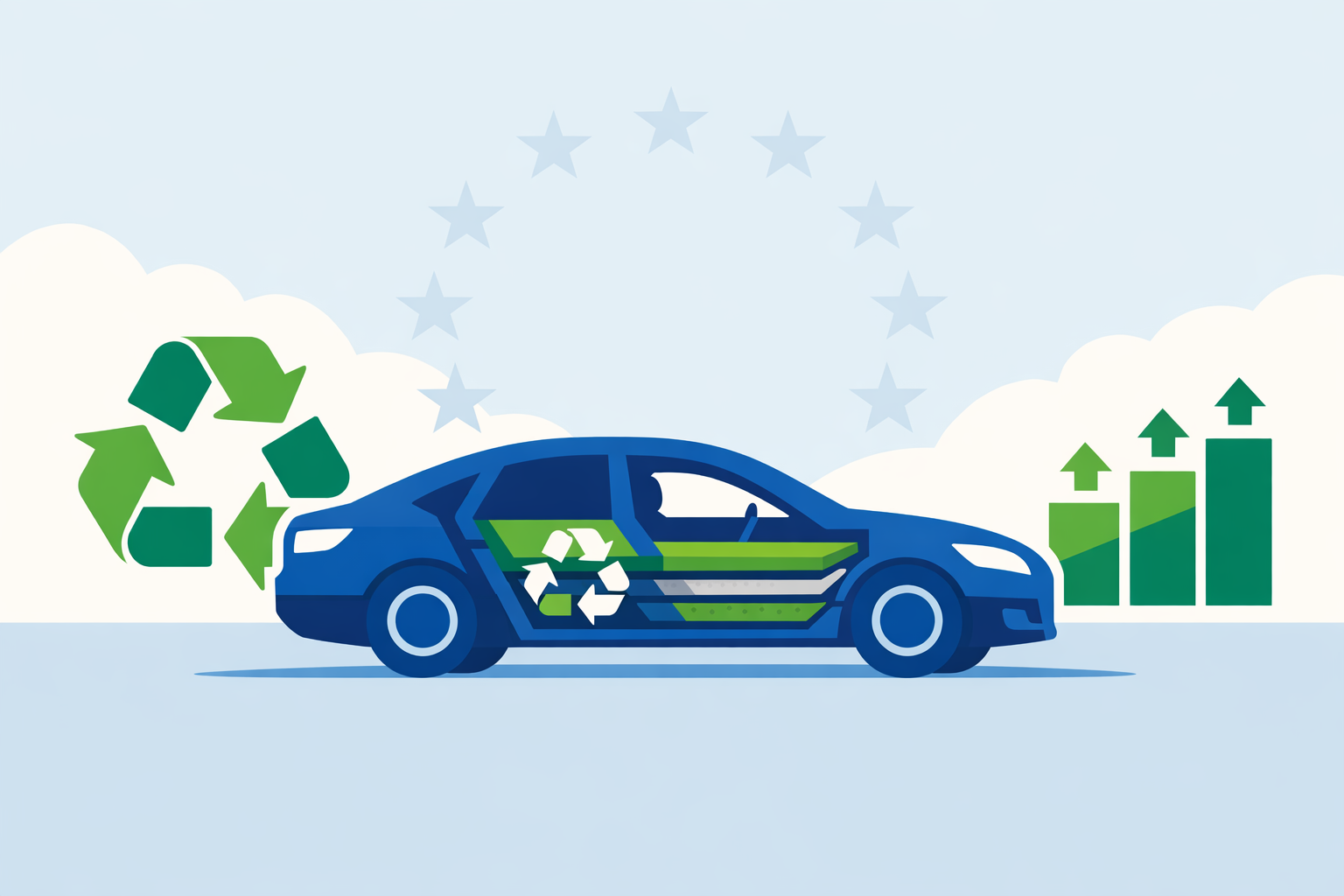
The European Union has enacted a regulation introducing phased minimum recycled-plastic content requirements for automotive composites, including electric vehicle (EV) battery enclosures. Manufacturers must ensure a minimum of 15% recycled plastic within six years, increasing to 25% within ten years. The regulation also mandates design-for-disassembly standards and extended producer responsibility, applying to cars, vans, heavy-duty vehicles, and motorcycles across the EU. Automakers and tier-1 suppliers must adapt sourcing, testing, and validation processes to achieve compliance. (Published April 4, 2026)[1]
Background
EU legislators have advanced circular economy objectives through measures such as the 2023 Commission proposal on circularity requirements for vehicle design and the revised End-of-Life Vehicles (ELV) Regulation. An initial 25% recycled plastic target within six years of enactment was revised following negotiations, creating a staged approach: 15% by six years, 20% by eight years, and 25% by ten years, with derogations possible if recycled material supply or costs pose challenges[2]. Trade associations and recyclers have advocated for ambitious targets to maintain stable demand for recyclates and encourage industrial investment[3].
Details
The regulation targets automotive composites, including materials such as glass-fiber-reinforced polypropylene and polyamide used in components like EV battery enclosures and underbody shields[4]. The graduated recycled plastic targets-15% at year six, 20% at year eight, and 25% at year ten-balance circularity objectives with industry feasibility[5]. Additional mandates require design changes for disassembly and recovery, along with extended producer responsibility for end-of-life management[1].
According to industry reports, affected OEMs and tier suppliers must adjust material sourcing and validation protocols. They are required to secure consistent supplies of recycled plastics and may consider biobased fibers for reinforcement. Strategies include evaluating alternative feedstocks, strengthening supply chain documentation, and modifying product designs to maintain composite performance and weight while meeting recycled content requirements.
Outlook
Implementation will proceed following the regulation's entry into force, with timelines at six, eight, and ten years. OEMs and suppliers are expected to increase investments in recyclate sourcing, validation testing, and design-for-recycling systems. Regulatory authorities may monitor compliance and allow temporary derogations if recycled materials remain limited or cost-prohibitive. Cross-border supply chains within the EU auto sector may adapt to maintain recycled material availability and traceability.