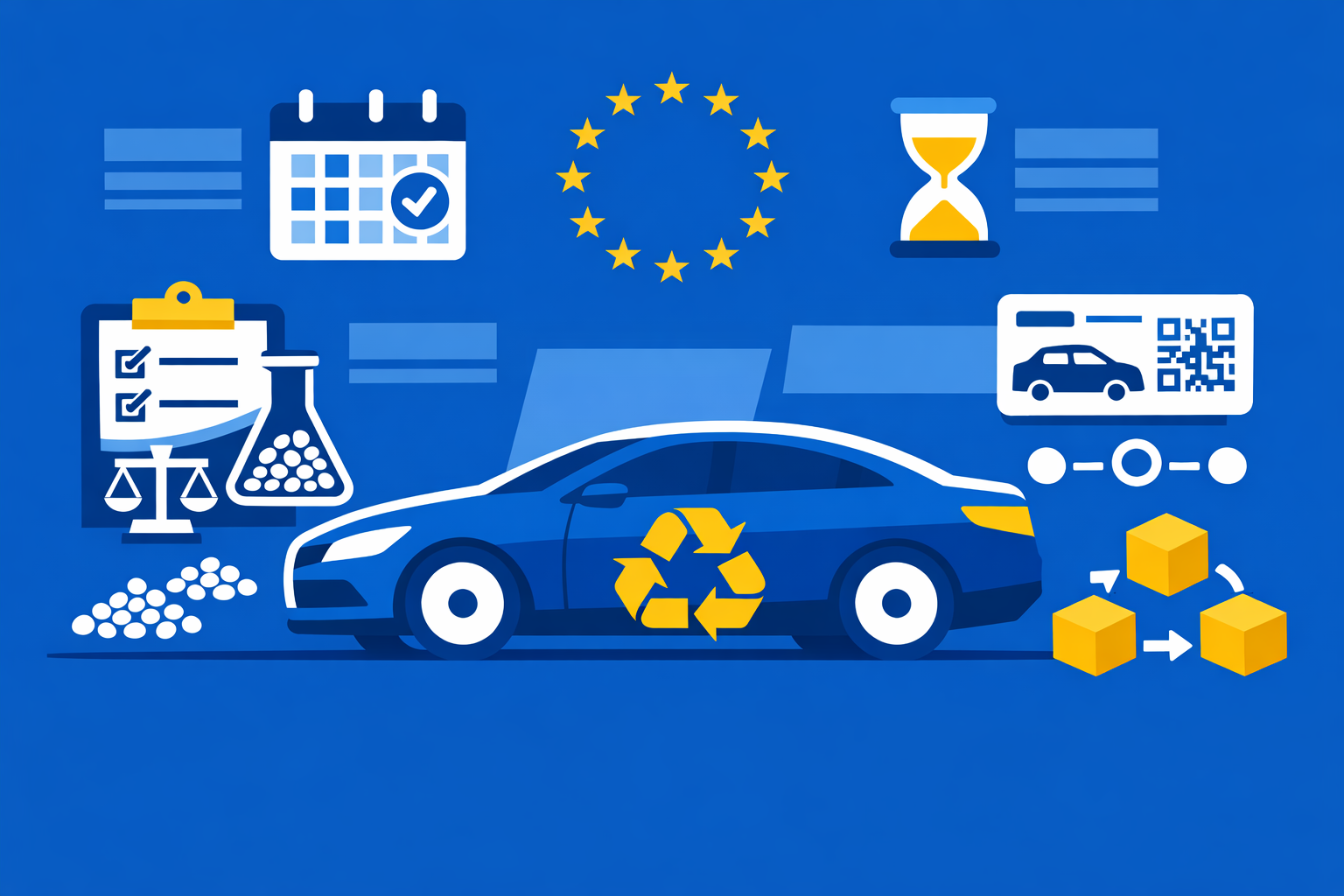
The European Union has set a December 2026 deadline for developing the standardized methodology to calculate and verify recycled plastic content in new vehicles. This procedural step under the provisional End-of-Life Vehicles Regulation (ELVR) will define how automakers and their suppliers demonstrate compliance with mandatory post-consumer recycled (PCR) content targets.
Background
EU institutions reached a political agreement on the revised End-of-Life Vehicles Regulation in December 2025, and the compromise text was published in February 2026, advancing a framework that replaces the original ELV Directive, in force since 2000. The rationale for the update is stark: according to the European Commission's Joint Research Centre, EU vehicles contain, on average, just 3% recycled plastic today, even though the automotive sector accounts for approximately 10% of total EU plastic demand. Of the recycled plastic currently used in new vehicles, around 80% originates from pre-consumer industrial scrap, with only approximately 109,000 tonnes of post-consumer recycled plastics from end-of-life vehicles entering car manufacturing in the EU each year.
The automotive industry's low PCR uptake reflects deep structural challenges. According to Auto Recycling World, most plastics recovered from scrapped vehicles are either downcycled into non-automotive applications or incinerated due to the lack of standardized collection and sorting systems. Cheap virgin resin continues to undercut demand for PCR material at ELV treatment sites, where metals dominate the existing business model.
Details
Under the provisional ELVR, recycled plastic content mandates will be phased in over ten years, with a minimum of 15% recycled content required six years after the regulation enters into force and a minimum of 25% required after ten years. At least 20% of these recycled content targets must be sourced from end-of-life vehicles, equating to 3% ELV-derived recycled content after six years and 5% after ten years. The mandates cover passenger cars, light commercial vans, heavy-duty vehicles, motorcycles, and special-purpose vehicles.
The regulation requires the European Commission to establish a standardized calculation and verification methodology-covering both mechanical and chemical recycling pathways-by December 2026. The European Parliament has requested this methodology be introduced through a delegated act that accounts for the best available recycling technologies, including chemical recycling. Only post-consumer-derived material will be allowed to count toward recycled content targets, with mass-balance accounting accepted for chemically recycled content. Digital product passports, which embed polymer-level material data into components, are identified in the regulation as a key traceability and audit mechanism.
Third-party verification requirements will be stringent for imported recyclates. Recycled material procured from outside the European Union will not be allowed to count toward minimum recycled content targets for 48 months after entry into force of the legislation, after which independent third-party audits will be required. Recognition schemes such as ISCC PLUS and ISO 14021-based certifications are already being adopted by material suppliers seeking to pre-position for compliance. The EU's broader chemical recycling methodology, based on a "fuel-use excluded" mass-balance allocation rule, is expected to serve as a template for future recycled content verification rules in the automotive sector.
Supply adequacy remains a central concern. According to ICIS Plastics Recycling Analyst Mia McLachlan, "recycled content mandates are expected to be met primarily through recycled polyolefins, supported by the wider availability of suitable waste feedstocks", with ICIS estimating 0.5 to 0.6 million tonnes of recycled polyolefins will be required by 2040, the majority supplied by recycled polypropylene. Automotive-grade recycled polyamide and polyethylene remain in shorter supply. The regulation does allow the European Commission to delay or lower plastic content targets if insufficient availability or excessive prices make compliance unreasonably difficult.
Outlook
Final adoption by the European Parliament plenary and the European Council will formally start the regulatory clock on the phased content targets. The December 2026 methodology deadline is the critical near-term milestone: without a standardized calculation framework, manufacturers cannot reliably demonstrate PCR content levels to market surveillance authorities. OEMs and Tier 1 suppliers face mounting pressure to begin supply chain audits, secure chain-of-custody documentation, and qualify PCR resin grades ahead of that date to avoid a compressed compliance window.