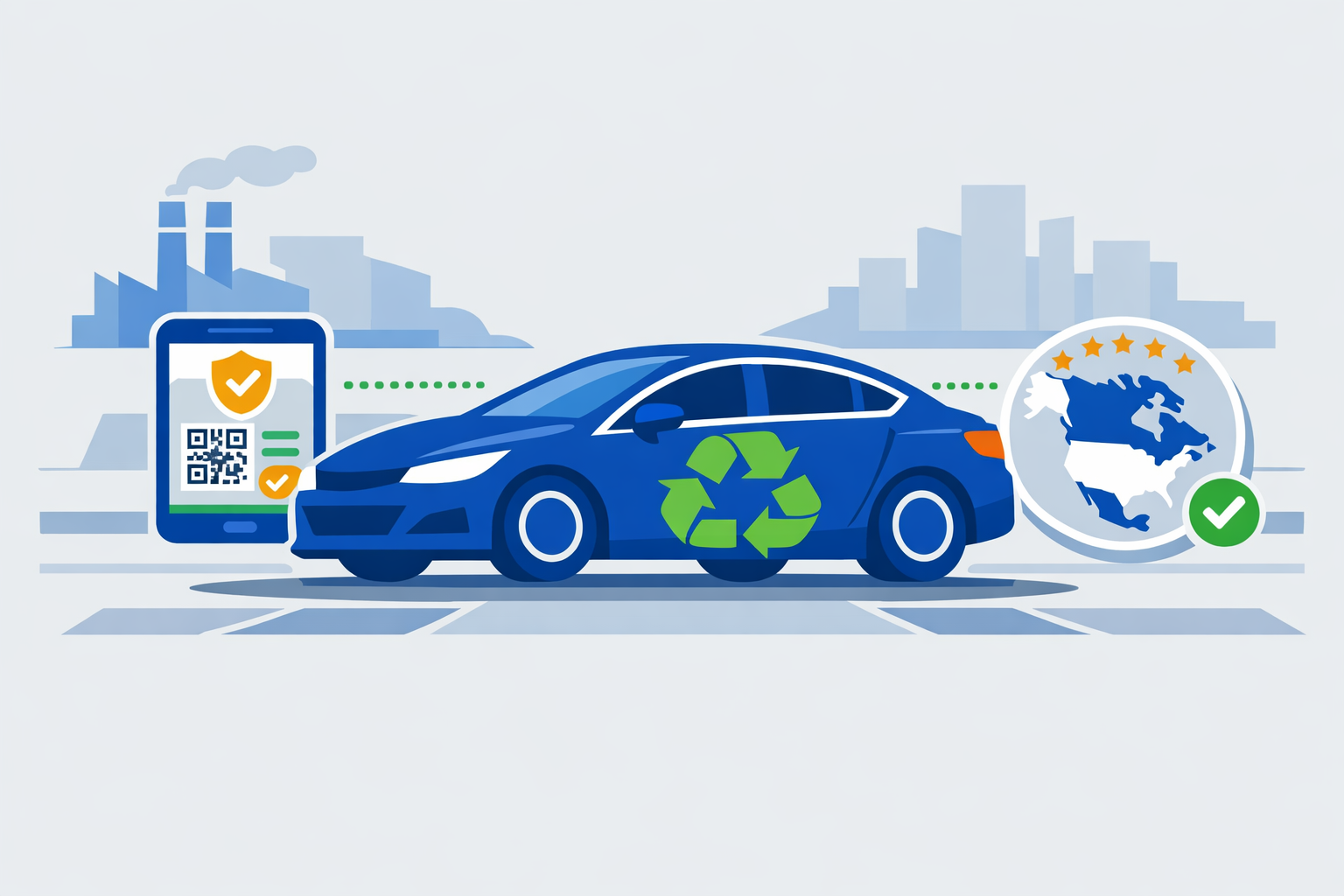
The European Union has set a firm December 2026 deadline for the European Commission to define the calculation and verification methodology for recycled plastic content in new vehicles - a foundational step under the bloc's landmark End-of-Life Vehicles (ELV) Regulation. The provisional agreement, reached between the European Parliament and the European Council in December 2025, mandates phased post-consumer recycled (PCR) plastic content in all new passenger cars, light commercial vans, heavy-duty trucks, and motorcycles, binding across all 27 member states.
Background
The EU's End-of-Life Vehicles Directive, which entered into force in September 2000, is being replaced by a directly applicable Regulation that supersedes existing member-state-level directives and embeds circularity requirements uniformly across the Union. The shift from directive to regulation closes previous implementation gaps by eliminating the national discretion that led to inconsistent recycling standards across the bloc.
The automotive manufacturing industry consumes approximately 6 million tonnes of plastics per year in the EU, yet currently makes limited use of recycled materials. The sector is also among the EU's largest consumers of primary raw materials, including more than 7 million tonnes of steel and around 2 million tonnes of aluminium annually, according to the European Commission. Existing rules have resulted in around 85% of ELV materials being recycled, but only small proportions of recovered plastics re-enter the automotive supply chain in high-quality form.
The regulation is positioned as a core element of the European Green Deal and the Circular Economy Action Plan, targeting resource security, industrial competitiveness, and reduced dependence on virgin polymer feedstocks.
Details
Under the provisional agreement, co-legislators set a minimum recycled plastic content of 15% in new vehicle types within six years of the regulation's entry into force, rising to 25% within ten years. At least 20% of the mandated recycled content must be sourced from closed-loop streams, specifically from end-of-life vehicles - equating to 3% of total plastic mass at the six-year mark and 5% at the ten-year mark.
ICIS Plastic Recycling Analyst Mia McLachlan noted that "recycled content mandates are expected to be met primarily through recycled polyolefins, supported by the wider availability of suitable waste feedstocks compared with other polymers used in the automotive sector."
The December 2026 deadline specifically requires the Commission to establish harmonised rules for how recycled content is calculated, verified, and reported - a prerequisite for enforcement. A feasibility study on setting additional recycled content targets is scheduled for 2027, with full material declarations under a Circularity Vehicle Passport system required by 2030. The Circularity Vehicle Passport will contain structured data on polymer types, joining methods, material provenance, and end-of-life handling instructions, and must remain current throughout the vehicle's market life.
Recycled material sourced from outside the European Union will not count toward the minimum recycled content targets for 48 months after the regulation enters into force. This provision is intended to protect EU-based recyclers from lower-cost imports that may not meet traceability or quality standards.
The regulation also allows the Commission to temporarily delay or revise downward plastic content targets "in case the lack of availability or excessive prices of specific recycled plastics make compliance with the minimum percentages of recycled content excessively difficult."
Environmental groups have criticized the final text. The European Environmental Bureau and Environmental Action Germany stated that lawmakers "slashed recycled plastic content targets from 25% to 15% six years after entry into force, postponing the 25% requirement until a decade after the regulation takes effect."
For OEMs and tier-one suppliers, the verification burden extends beyond material sourcing. The requirement creates a continuous data obligation: any change to design, supplier, material formulation, or sourcing can trigger updates to the vehicle's digital passport record. Compliance experts have noted that manual tracking through spreadsheets and PDFs cannot scale to the volume of plastic-containing components across a modern vehicle programme.
| Milestone | Recycled Plastic Target | Closed-Loop (ELV-Sourced) Minimum |
|---|---|---|
| 6 years post-entry into force | 15% | 3% of total plastic |
| 10 years post-entry into force | 25% | 5% of total plastic |
| End of 2026 | Verification methodology defined | - |
| 2027 | Feasibility study published | - |
| 2030 | Full Circularity Vehicle Passport obligations | - |
Outlook
The provisional agreement must be formally endorsed by both the European Parliament and the European Council before it enters into force, after which the regulation will begin applying two years later. Once active, the phased targets will reshape PCR material sourcing contracts, traceability infrastructure, and supplier qualification processes across the European automotive value chain. The Commission must also publish a review of bio-based plastics and elastomers within 72 months of entry into force, with potential for bio-based content to count toward recycled content targets in future legislative proposals.