The European Union has advanced a binding framework requiring automakers to incorporate phased minimum levels of recycled plastic content in new vehicles. Calculation methodologies and verification rules for recycled content in automotive plastics-including composites-are due to be finalized by the end of 2026.
The provisional agreement between the European Parliament and the Council, reached in December 2025 and published as a compromise text in February 2026, replaces the longstanding ELV Directive (2000/53/EC) with a directly applicable regulation. Unlike directives, which grant member states flexibility in national implementation, a regulation applies directly and uniformly across the EU. The measure forms a core part of the European Green Deal and the EU Circular Economy Action Plan.
Background
The automotive sector's relationship with plastics recycling has historically been limited in practice. Despite strong rhetoric on circularity, EU cars today contain an average of just 3% recycled plastic, even though the sector accounts for roughly 10% of total plastic demand. Only 19% of plastics from end-of-life vehicles is currently recycled. Around 80% of the recycled plastic used in new vehicles originates from pre-consumer industrial scrap, and only about 109,000 tonnes of post-consumer recycled plastics from end-of-life vehicles enter car manufacturing in the EU each year-roughly the plastic content of one million cars.
Automotive manufacturing is one of the EU's most resource-intensive sectors, consuming over 7 million tonnes of steel, around 2 million tonnes of aluminium, and 6 million tonnes of plastics per year, while making little use of recycled materials. The revised regulatory framework aims to structurally correct that imbalance.
Details
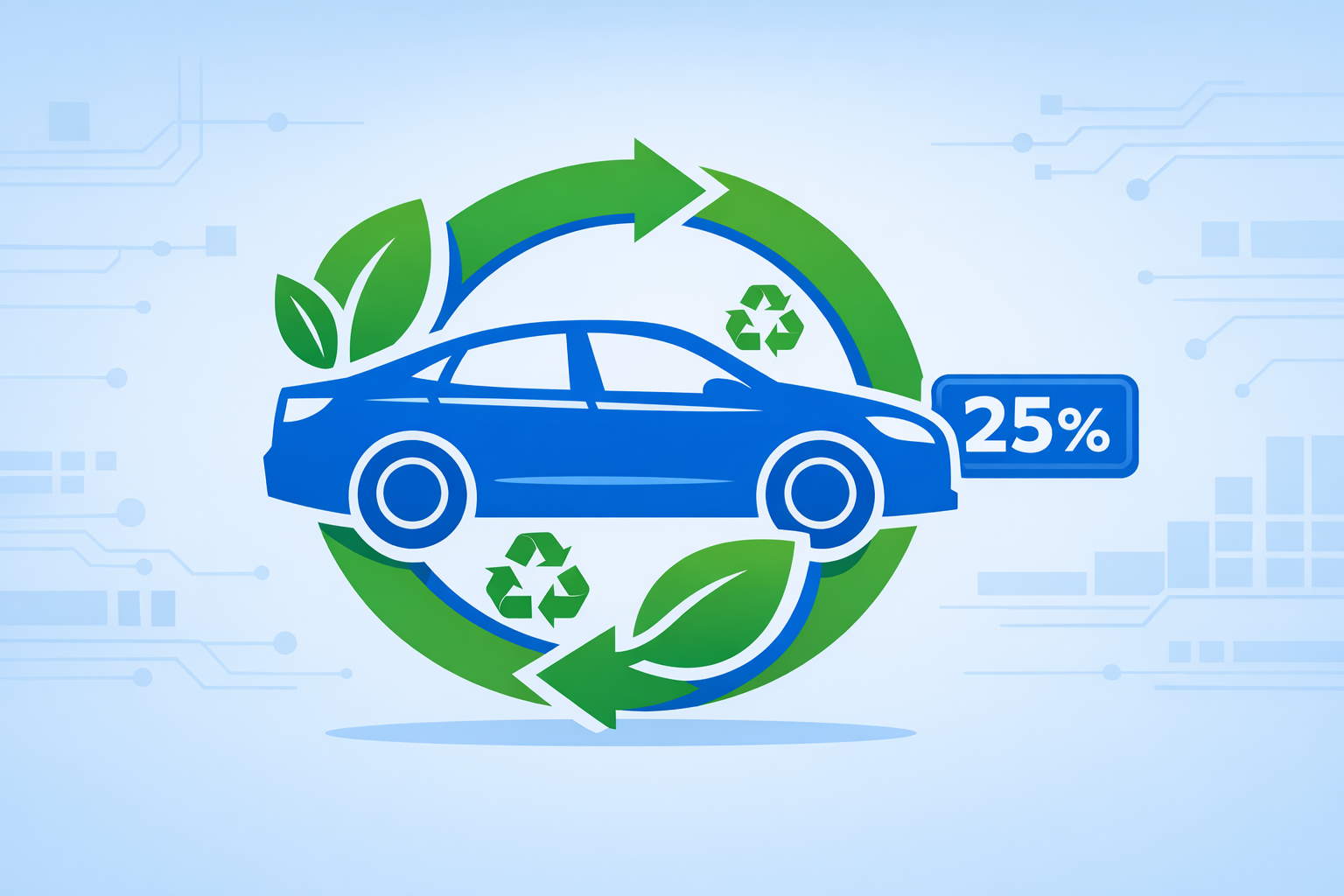
Under the provisional agreement, recycled plastic content mandates will be phased in over a 10-year period. A minimum 15% recycled content is required six years after entry into force, rising to 25% after ten years. At least 20% of these targets must be sourced from end-of-life vehicles-equating to 3% ELV-derived content after six years and 5% after ten years.
Calculation and verification rules for recycled plastic content are to be finalized by end of 2026, followed by a feasibility study for setting the recycled content target in 2027 and a declaration of material formats by 2030. The regulation does not prescribe exact target percentages immediately. Instead, it establishes the legal basis for these targets, with exact percentages and calculation methodologies to be defined through later implementing acts.
The mandates apply to passenger cars, light commercial vans, regular heavy-duty vehicles, motorcycles, and special-purpose vehicles, with an exception for small-volume manufacturers of heavy-duty special-purpose vehicles.
Compliance verification will rely on third-party certification schemes such as RecyClass or EuCertPlast, along with material traceability documentation. The EU increasingly recognizes chemically recycled materials provided they meet mass-balance certification standards. Non-compliance can lead to fines, extended producer responsibility (EPR) penalties, or restrictions on selling products in the EU.
For fiber-reinforced polymers, thermoplastic composites, and multi-material assemblies, the verification challenge is acute. The growing use of sophisticated composite materials poses particular difficulties for dismantling, reusing, and recycling end-of-life vehicles. Many polymers and composites-from thermoset parts to plastics with natural fibers-are incompatible with today's mechanical recycling processes. This technical constraint is directing investment toward advanced processing routes: parts such as bumpers, interior panels, and dashboards must be separated during disassembly to enable high-quality recycling, and chemical recycling may be required to process complex plastic mixtures.
Some OEMs are already repositioning. Nissan and BMW have incorporated recycled content into vehicle interiors and structural components, while Stellantis and Renault are expanding closed-loop plastic recovery programs in partnership with recyclers and dismantlers. Industry estimates suggest 0.5 to 0.6 million tonnes of recycled polyolefins will be required by 2040 to meet the mandates, with recycled polypropylene expected to supply the majority given its widespread use in automotive components.
Danish Environment Minister Magnus Heunicke stated at the time of the provisional agreement that "this provisional agreement marks a significant step towards a circular economy for the European automotive sector", adding that the framework "closes loopholes, ensures valuable materials are kept within the EU economy, and curbs the export of polluting, non-roadworthy vehicles to third countries."
Outlook
Regulators have acknowledged the significant challenges facing automakers in meeting these targets. Initial proposals set high recycled plastic content requirements, but policymakers recognized that the automotive supply chain lacks the infrastructure and material availability to comply within the originally proposed timeframe. This led to a softened transition timeline, though the fundamental shift toward greater recycled content remains unchanged. The provisional agreement also allows the European Commission to delay or temporarily revise down plastic content targets where insufficient availability or excessive prices of specific recycled plastics make compliance unreasonably difficult.
The provisional agreement must be endorsed by the Council and Parliament before formal adoption. The regulation is set to apply two years after entry into force, with overall environmental benefits assessed at an annual reduction of 12.3 million tonnes of CO₂-equivalent by 2035.