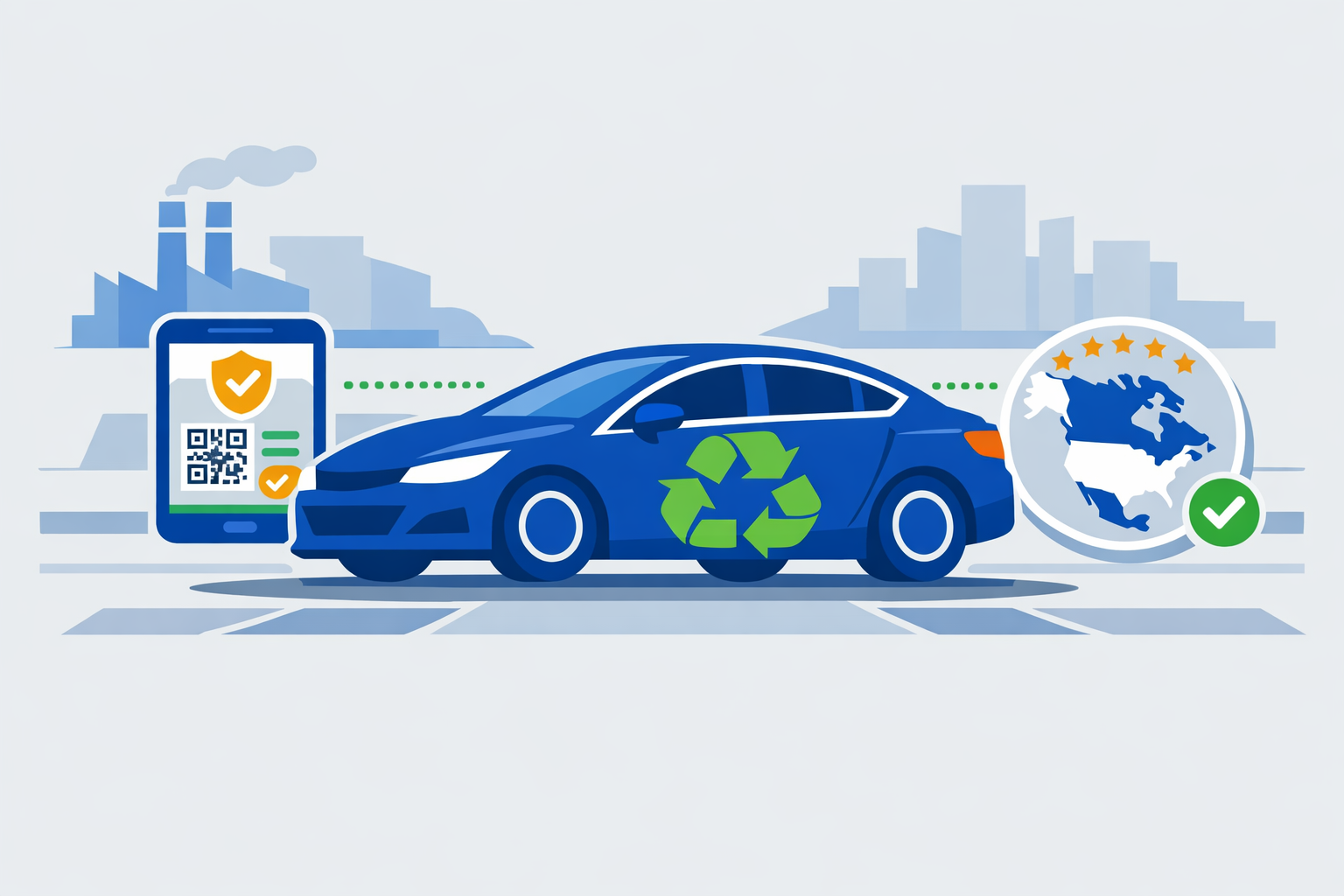
The European Commission faces an end-2026 deadline to establish the calculation and verification methodology for recycled plastic content in new vehicles - a critical step that will determine how OEMs and their suppliers certify compliance across automotive supply chains. The requirement stems from the revised End-of-Life Vehicles (ELV) Regulation, on which the European Parliament and Council reached a provisional agreement in December 2025 and published a compromise text in February 2026.
Background
The European Union introduced its original End-of-Life Vehicles Directive (2000/53/EC) in 2000, establishing recovery and recycling targets for the automotive sector. As vehicles grew more complex - incorporating more polymers, electronics, and composite structures - the Commission proposed a wholesale revision in 2023. In December 2025, the European Parliament and Council reached a political agreement on the revised framework, and in February 2026, the compromise text was published, marking the final stage before formal adoption.
The regulation forms part of the EU's Circular Economy Action Plan and shifts from a directive - requiring national transposition - to a directly applicable regulation uniformly enforceable across all Member States. The change aims to address longstanding problems with fragmented enforcement and inconsistent recycling infrastructure across the bloc.
Today's cars in the EU contain, on average, just 3% recycled plastic, even though the automotive sector accounts for about 10% of total plastic demand, according to the European Commission's Joint Research Centre (JRC). The same research found that around 80% of recycled plastic used in new vehicles originates from pre-consumer industrial scrap, not from post-consumer end-of-life vehicle streams.
Details
The provisional agreement sets phased mandatory recycled plastic content thresholds: a minimum of 15% recycled plastic within six years of entry into force, rising to 25% within ten years, according to the European Parliament. At least 20% of each target must be sourced from plastics recycled from end-of-life vehicles or components removed during the use phase, establishing a closed-loop requirement within the broader mandate.
The regulation covers passenger cars, light commercial vans, motorcycles, heavy-duty vehicles, and special-purpose vehicles, with limited exemptions for small-volume heavy-duty manufacturers. Extended producer responsibility provisions require manufacturers to finance collection, depollution, and treatment of vehicles at end of life.
Rules for recycled plastic content are to be calculated and verified by end of 2026, with a feasibility study on specific targets due in 2027 and a formal declaration of material formats in 2030, according to materials supplier Ascend Materials. Third-party certification schemes - including EuCertPlast and RecyClass - are among the instruments under discussion for verifying post-consumer recycled (PCR) material claims, alongside mass-balance certification standards for chemically recycled content. The regulation also mandates digital product passports to embed material data - including polymer type, additives, fillers, and end-of-life handling instructions - directly into components, improving traceability during dismantling and sorting.
Interior components such as dashboards, door panels, and seat bases - typically manufactured from ABS, PC/ABS blends, and modified polyolefins - and exterior parts including bumpers and mirror housings made from polypropylene (PP) and thermoplastic olefins (TPOs) fall directly within scope. Exterior plastic parts pose a particular challenge: multi-layer paint and primer systems applied to bumpers and fenders complicate mechanical recycling of those substrates, according to Plastics Engineering. New EU rules are driving development of laser-removable coatings and low-temperature debonding primers to address this.
Supply constraints remain a recognized risk. Automotive-grade recycled polypropylene (rPP), polyethylene (rPE), and polyamide (rPA) remain in short supply, according to IDTechEx. The market research firm forecasts that sustainable plastics content in vehicles is expected to reach only 18% by 2035, with recycled plastics representing 15% and bio-based materials the remaining 3% - a level that falls short of the 25% regulatory target for that period. The Commission has reserved authority to temporarily lower targets "in case the lack of availability or excessive prices of specific recycled plastics make compliance with the minimum percentages excessively difficult."
John Mortell, Senior Policy Manager at Plastics Europe, has cautioned that while verification and certification are central to traceability and compliance, fragmented implementation rules across Member States could undermine the framework's effectiveness.
Outlook
Formal adoption of the ELV Regulation is anticipated in mid-2026, after which phased compliance timelines will begin. The European Commission must publish the verification methodology by end of 2026, making this a pivotal near-term milestone for procurement, quality, and sustainability teams. OEMs and Tier-1 suppliers that have not already initiated PCR qualification programs and supply-chain audits face compressed timelines to map material flows, identify certified recyclers, and embed traceability documentation before phased content targets take effect.