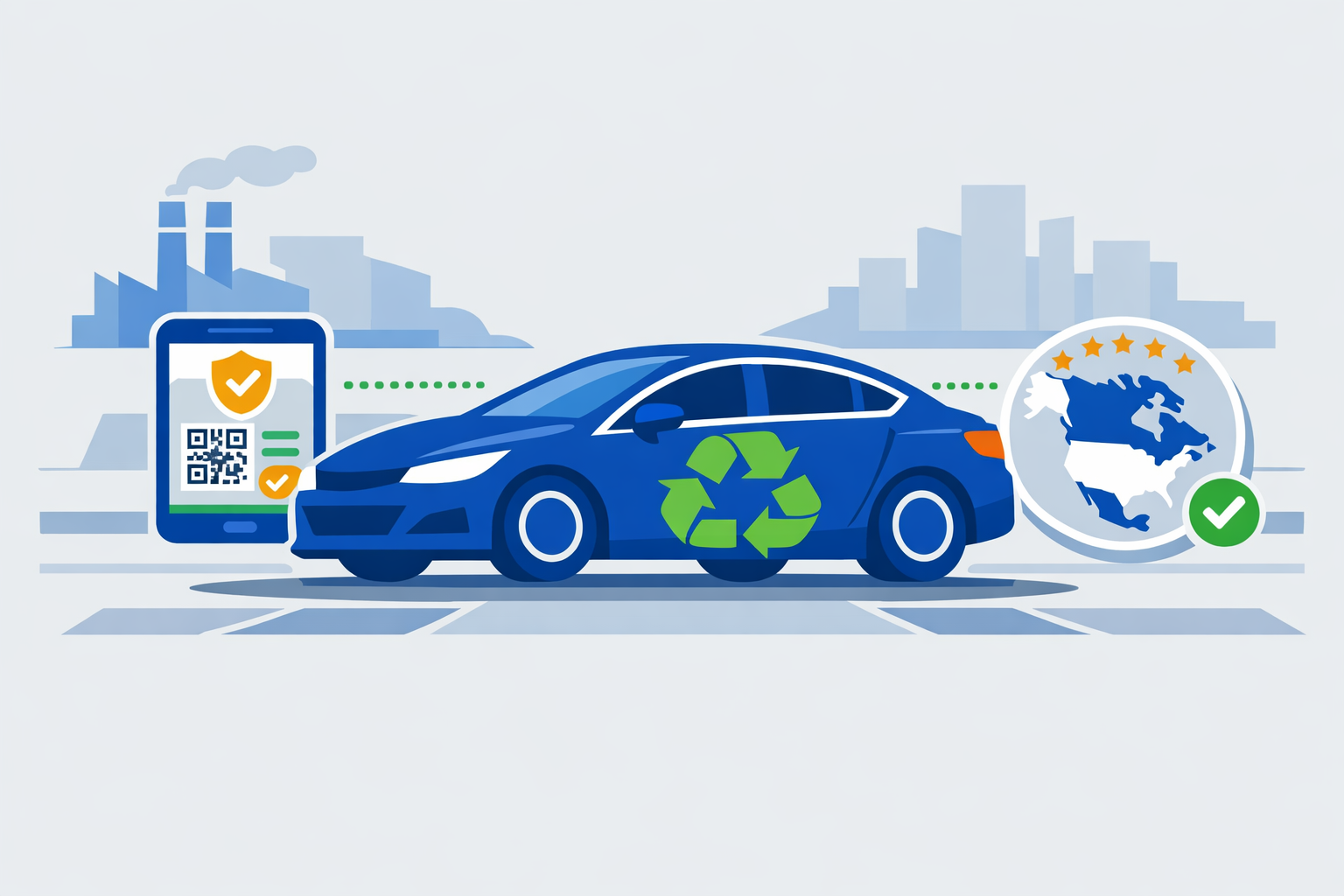
The European Union has reached a provisional agreement on binding traceability and recycled content requirements for plastics in new vehicles, placing OEMs, tier-one suppliers, and recyclers on notice as critical verification deadlines approach by year-end 2026. The deal, struck between the European Parliament and the European Council in December 2025, forms part of a revised End-of-Life Vehicles (ELV) Regulation replacing the bloc's original 2000 directive and introducing standardized compliance mechanisms across all 27 member states.
Background
The EU introduced its original End-of-Life Vehicles Directive in 2000, establishing the foundation for vehicle recycling and material recovery. As vehicles grew more complex and relied more heavily on polymer systems, regulators concluded the existing framework was insufficient to meet tightening circular economy objectives. The European Commission proposed a full revision of the directive in 2023 to align it with broader circular economy targets.
In December 2025, the Commission and the Council reached a political agreement on the revised framework. The compromise text was published in February 2026, marking a key step toward formal adoption. The updated rules extend well beyond end-of-life collection targets, establishing legally binding mandates covering vehicle design, materials specification, and upstream supply chain documentation.
Plastics comprise approximately 20% of a modern vehicle's weight and appear in interior, exterior, and structural parts. Interior components such as dashboards, door panels, center consoles, and seat bases rely on ABS, PC/ABS blends, and modified polyolefins. Today, 80% of plastics from end-of-life vehicles are still landfilled or incinerated, according to EuRIC, the European Recycling Industries' Confederation - a figure regulators cite as the central justification for mandatory demand-side intervention.
Details
The regulation introduces phased mandatory recycled plastic content targets for new vehicles. Under the provisional agreement, a minimum 15% recycled content will be required six years after entry into force of the regulation, rising to a minimum 25% after ten years. At least 20% of those recycled content targets must be sourced from end-of-life vehicles, equating to 3% of total vehicle plastic content after six years and 5% after ten years.
Traceability requirements are central to the framework's enforcement architecture. The regulation mandates third-party audits of installations producing recycled plastic content material, whether located in the EU or abroad - a provision the recycling industry has broadly welcomed as a step toward fairer competition and verified provenance. In addition, recycled material procured from outside the European Union will not be allowed to count toward minimum recycled content targets for the first 48 months after entry into force; once permitted, stringent independent audit requirements will apply to overseas-sourced material.
Rules for recycled plastic content are to be calculated and verified by the end of 2026, followed by a feasibility study for setting the recycled content target in 2027. The regulation also mandates Digital Product Passports (DPPs) for vehicles, providing detailed information on components, materials, and recyclability. Companies will be required to register entries via the EU Central DPP Registry, with that system's go-live date set for 19 July 2026.
According to ICIS Plastic Recycling Analyst Mia McLachlan, "recycled content mandates are expected to be met primarily through recycled polyolefins." ICIS estimates that between 0.5 and 0.6 million tonnes of recycled polyolefins will be required by 2040, with the majority supplied by recycled polypropylene.
Industry group Plastics Recyclers Europe reports the European region lost more recycling capacity in 2025 than in any previous year. A central concern for policymakers remains the growing volume of virgin plastic entering the EU market while being declared as recycled material.
Suppliers and OEMs are exploring technologies such as RFID and blockchain to link physical components to digital provenance records, enabling end-to-end material passports capable of satisfying both regulatory auditors and procurement teams.
Outlook
The decisive policy test is expected with the Commission's proposed Circular Economy Act, due in the third quarter of 2026, which will be critical in determining whether the EU can deliver a durable and competitive framework for plastics recycling. Formal adoption of the ELV Regulation is expected to follow the legislative process through the European Parliament, with finalized implementing rules for recycled content calculation - including methodology standards and laboratory accreditation requirements - due by end of 2026. Further updates to permissible polymer types and recycled content percentages are anticipated as recycling technology matures and feedstock quality improves.