Cannon unveiled its NEXUS mold thermoregulation system and POSSIBLE circularity platform at JEC World 2026 in Paris, targeting reduced energy consumption and enhanced end-of-life solutions for composite components. Demonstrated from March 10 to 12 at Paris Nord Villepinte, the NEXUS system showed an ability to lower energy use by up to 70% and reduce mold heating times by approximately 80%. The POSSIBLE platform enables the reintegration of recycled polyurethane (PU) and PU-glass fiber reinforced polymer (PU-GFRP) materials into new product formulations. These advances address the composites sector's increasing focus on energy efficiency and circular manufacturing.
Background
Cannon's presentation at JEC World 2026 reflects the industry's growing emphasis on digitalization, energy efficiency, and material circularity. The NEXUS system draws on more than ten years of research, featuring integrated composite heating elements that eliminate the need for traditional thermal fluid systems. POSSIBLE addresses the persistent challenge of recycling thermoset materials, such as polyurethane, which are difficult to process due to chemical cross-linking and fiber reinforcement.
Details
NEXUS incorporates heating elements directly within composite mold structures, enabling precise thermal zones with millimeter-scale temperature gradients. Manufacturer data shows the system reduced energy use by up to 70% and cut heat-up times by about 80% compared to conventional methods, improving process efficiency by roughly 25%. Heating rates of 30°C per minute were achieved, supporting accurate thermal regulation crucial for reaction injection molding (RIM) and thermoset processing. These results were validated through more than a decade of electrical and thermal testing, simulations, and industrial trials, with part quality matching existing production standards.
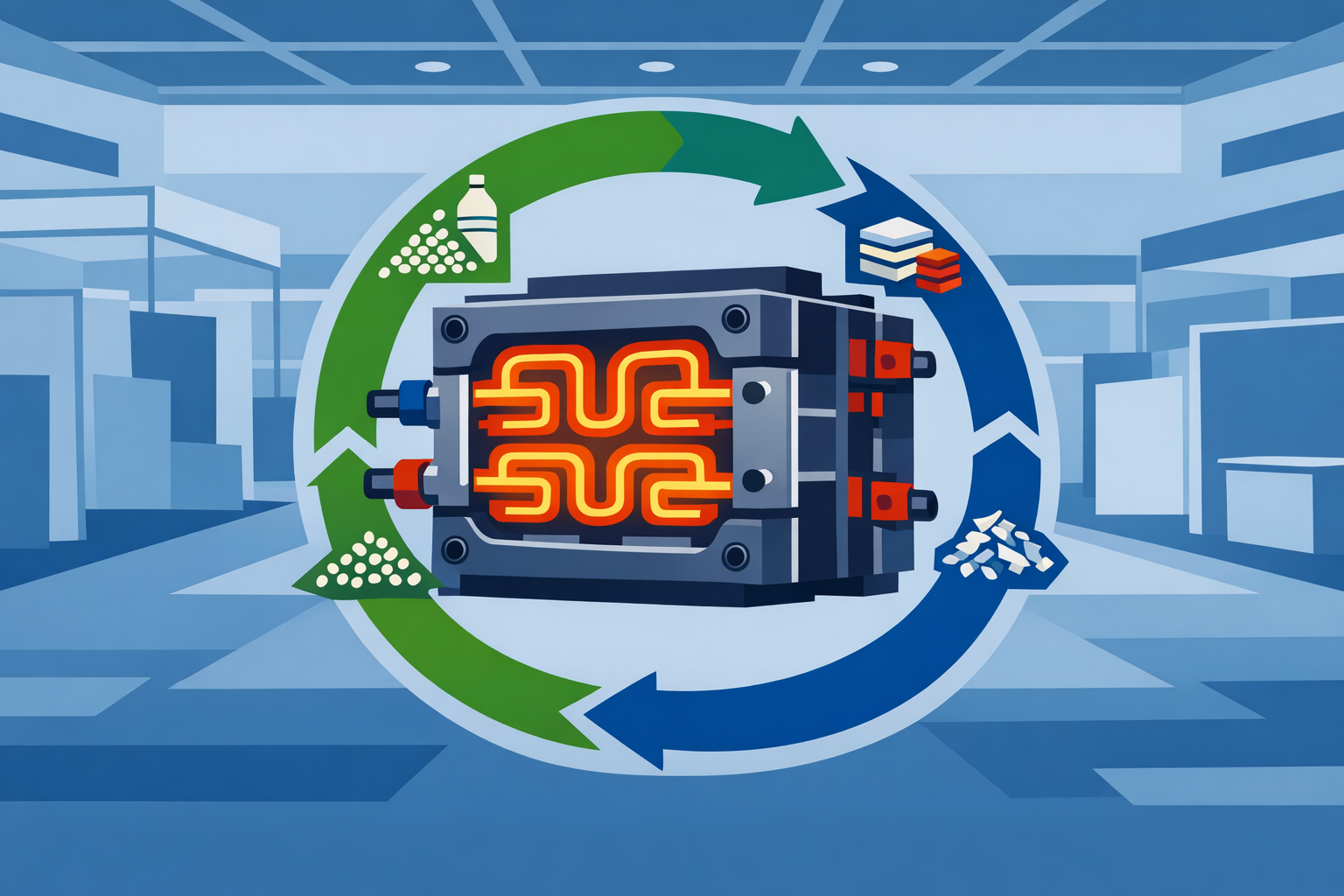
POSSIBLE-an acronym for PrOduce SuStainabLE Industrial Bodies-is a collaborative project with MAP S.p.A. and the University of Bergamo under Italy's NextGenerationEU initiative. It enables mechanical recycling of rigid PU foams and PU-GFRP composites by incorporating ground foam and composite granulate into new production streams. Controlled feeding technologies, including flexible screw conveyors, allowed recycled content levels up to 40% by weight to be dispersed uniformly. Tests confirmed that recycled content can be incorporated without affecting formulation quality or component performance.
Cannon also showcased related technologies at the event, such as validated thermocompression lines, patented vacuum systems, controlled resin injection for advanced composites applications, and compact high-tonnage short-stroke presses developed with Taylor Engineering & Plastics, designed for limited production spaces.
Outlook
The NEXUS and POSSIBLE platforms situate Cannon within key industry trends of energy-efficient automation and sustainable composite manufacturing. Widespread adoption depends on resolving challenges like equipment compatibility across diverse resin systems, capital investment requirements for new thermoregulation infrastructure, and the establishment of standards for material and data integration. As original equipment manufacturers and supply chain stakeholders look to support electric vehicle and mobility initiatives, these technologies may inform future partnerships, procurement strategies, and lifecycle assessment frameworks within the sector.