Automotive manufacturers and material suppliers are expanding the use of recycled carbon-fiber prepregs in vehicle programs as recycling technologies mature and regulations on circularity strengthen. In 2024, Hexcel reported recycling over 100 metric tons of prepreg scrap through its partnership with Fairmat in Europe, signaling an increase in supply-chain circularity efforts in North America. These actions respond to growing regulatory and OEM pressures to manage end-of-life composite materials more sustainably.
Background
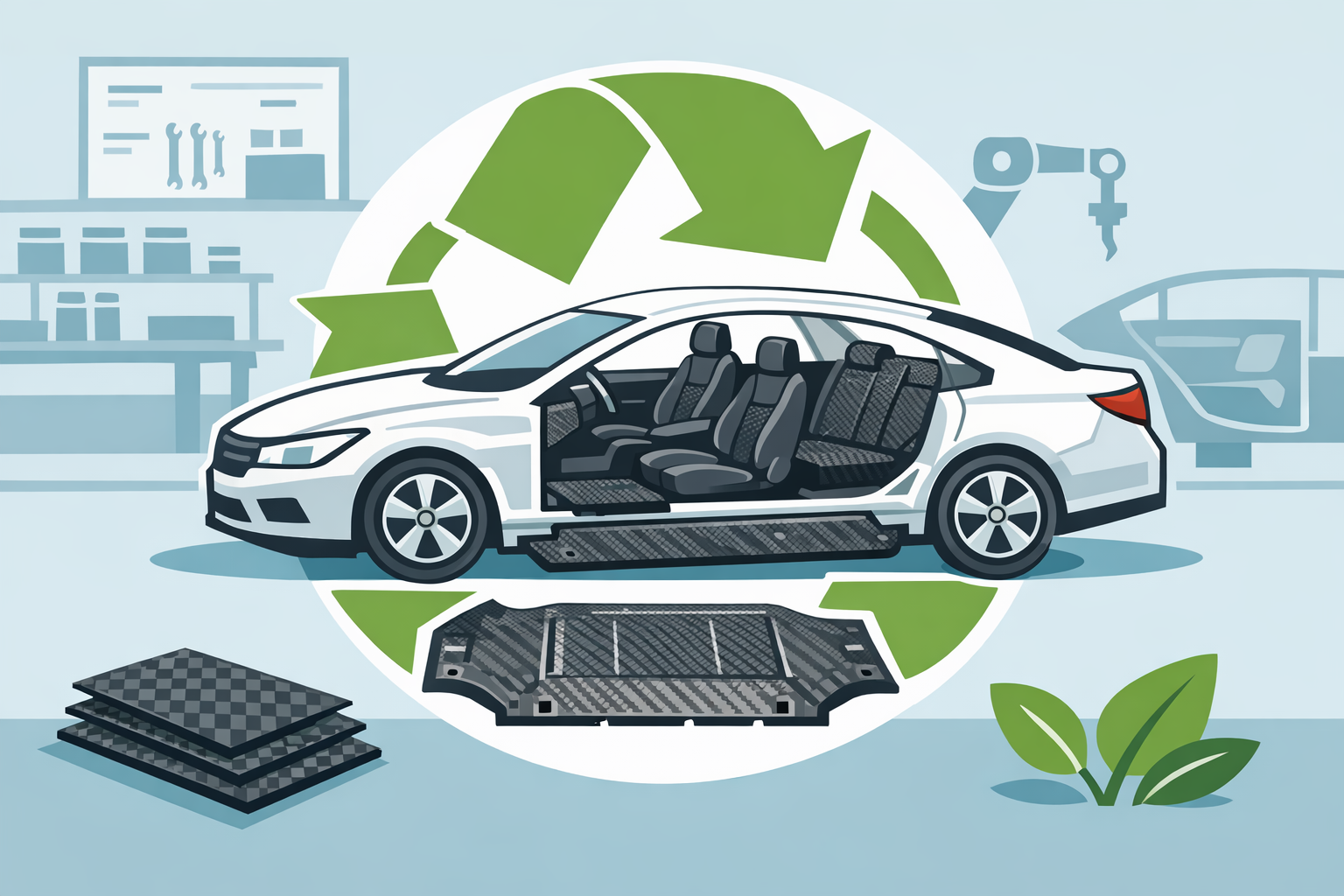
The European Union's 2024 Circular Economy Action Plan mandates a 65% composite recycling rate in automotive and aerospace sectors by 2030, with non-compliance fines ranging from €40 to €90 per ton. Germany has earmarked €1.2 billion for composite recycling hubs. The revised EU Waste Framework Directive further requires a 30% recycling rate for carbon-fiber composites by 2030. Meanwhile, Germany's VerpackG imposes a €120 per-ton levy on non-compliant products. In California, Senate Bill 54 will require 25% recycled content in plastics by 2028. In response, OEMs are incorporating recycled carbon-fiber-reinforced polymer (CFRP) into electric vehicle (EV) battery enclosures, underbody shields, and interior components to fulfill decarbonization and circularity objectives.{{cite}}{{cite}}
Details
Hexcel's 2024 sustainability report states over 100 metric tons of prepreg materials were recycled through the Fairmat collaboration, reflecting increased adoption of second-life materials in North America.{{cite}} Toray and Fairmat continue advancing capacity. Fairmat, for instance, targets 5,000 tonnes per year of recycled output from its Bouguenais facility serving European operations.{{cite}} Technical advancements in pyrolysis, solvolysis, and catalytic depolymerization now achieve fiber recovery rates of 90-95%, reducing energy input and preserving fiber integrity for structural reuse. AI-assisted sorting processes are improving feedstock purity to 98%, supporting the use of recycled CFRP in non-load-bearing automotive parts and in aerospace interiors.{{cite}} Market analysis indicates recycled CFRP offers 40-60% weight savings compared to steel and can reduce emissions by up to 75% versus virgin carbon fiber production. Battery enclosure and underbody panel programs-such as BMW's iX (15% recycled carbon fiber, saving approximately 2.3 kg CO₂-e per vehicle) and Mercedes-Benz's goal of 40% recycled composite content in EQ models-demonstrate increased OEM adoption. Tesla's Berlin operations have also begun trials incorporating locally recycled carbon-fiber underbody shields.{{cite}}
Outlook
Industry stakeholders expect that tightening regulations, combined with lower costs and new certification pathways, will accelerate adoption of recycled prepregs in mid- and mass-market automotive platforms. Technological advancements and strategic partnerships are projected to enable recycled composites to match the performance of virgin materials, while also supporting lifecycle emissions reductions and circularity objectives.