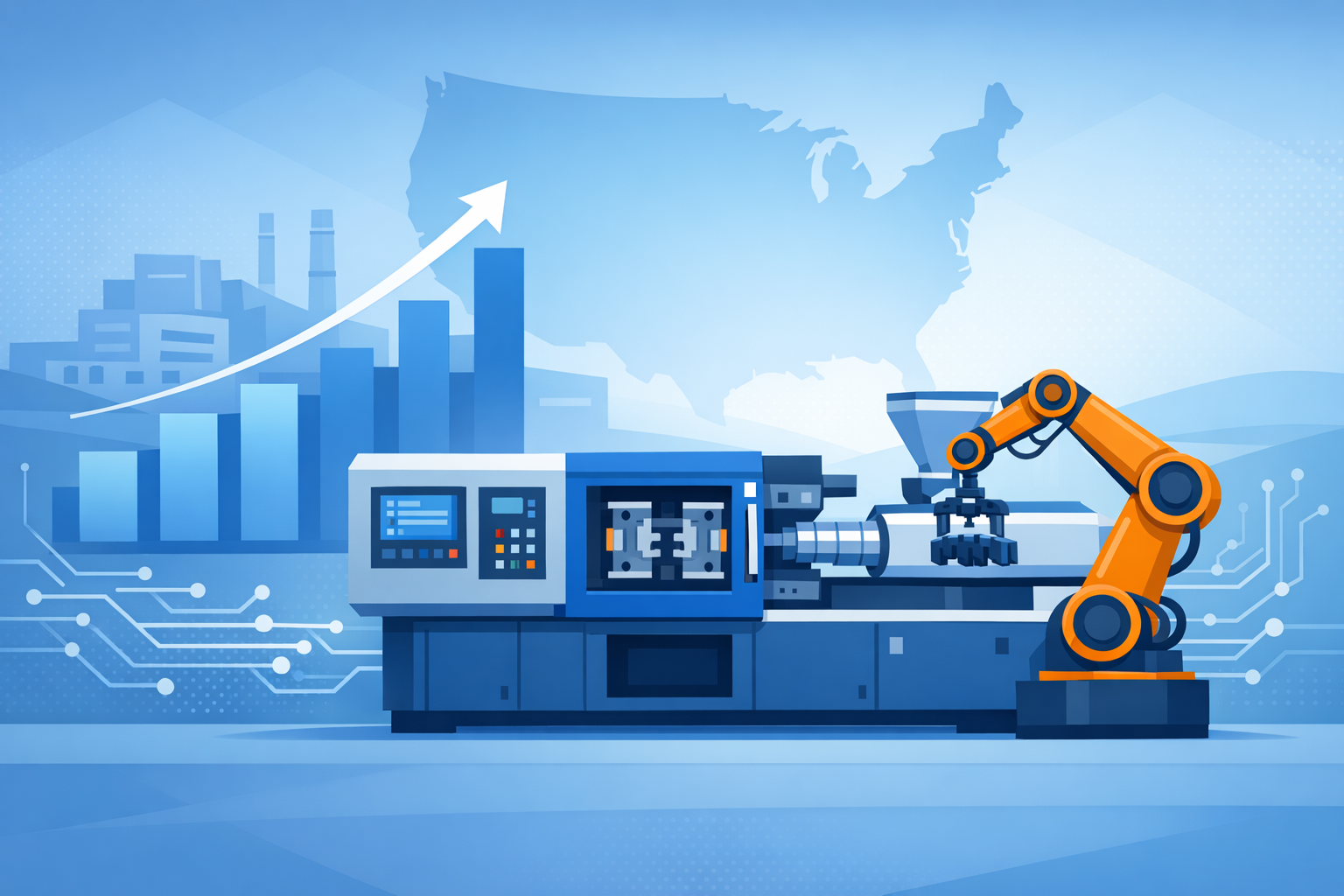
The U.S. injection molding equipment market is nearing a $14 billion annual run rate as automakers intensify electric vehicle (EV) lightweighting and implement China-plus-one supply chain strategies, according to industry analysts. OEMs are restructuring supply chains and introducing AI-driven automation-including predictive maintenance, adaptive process control, and IoT-enabled monitoring-to boost throughput, cut downtime, and enhance yield.
Background
Automotive OEMs face increasing pressure to reduce vehicle weight to maximize EV range, driving demand for high-performance engineering plastics and recycled feedstocks. Concurrently, geopolitical risks and supply chain disruptions have accelerated the shift from exclusive dependence on China to a 'China-plus-one' regional manufacturing approach. The interplay among lightweighting initiatives, reshoring, and automation is now shaping investment priorities within the injection molding sector.
Details
Industry forecasts project the North American injection molding machine market at approximately $2.36 billion in 2025, with the U.S. accounting for about $1.48 billion[1]. The automotive injection molding automation segment alone was valued at $545.2 million in 2024 and is expected to grow at a compound annual growth rate (CAGR) of 4.8% through 2034[2].
Automotive applications comprise nearly 34% of North American demand, followed by significant contributions from the healthcare and packaging sectors[3]. Globally, the injection molding machine market is expanding-from $10.51 billion in 2024 to an estimated $10.73 billion in 2025, and projected to reach $12.94 billion by 2034, at a CAGR of 2.1%[1].
Manufacturers are prioritizing energy-efficient, high-precision machinery. In the U.S., 25-30% of new orders are for electric injection molding machines, with hybrids making up an additional 15%[4]. Adoption of digital enhancements and predictive maintenance is rising, with more than 15% of the installed base in the U.S. considered candidates for digital retrofits[4].
Market momentum toward full automation continues to build. All-electric injection molding machines are expected to experience strong growth, with forecasts projecting the market will reach $2.1 billion in 2026 and $4.6 billion by 2033, corresponding to a CAGR of 11.4%[5].
Outlook
OEMs will likely continue to shift sourcing and production to reshored facilities equipped with advanced molding systems. The adoption of AI-enabled, energy-efficient equipment is anticipated to rise, driven by EV program expansion and the growing importance of circular economy practices. These factors are expected to contribute to the U.S. injection molding equipment market approaching a $14 billion annual run rate.