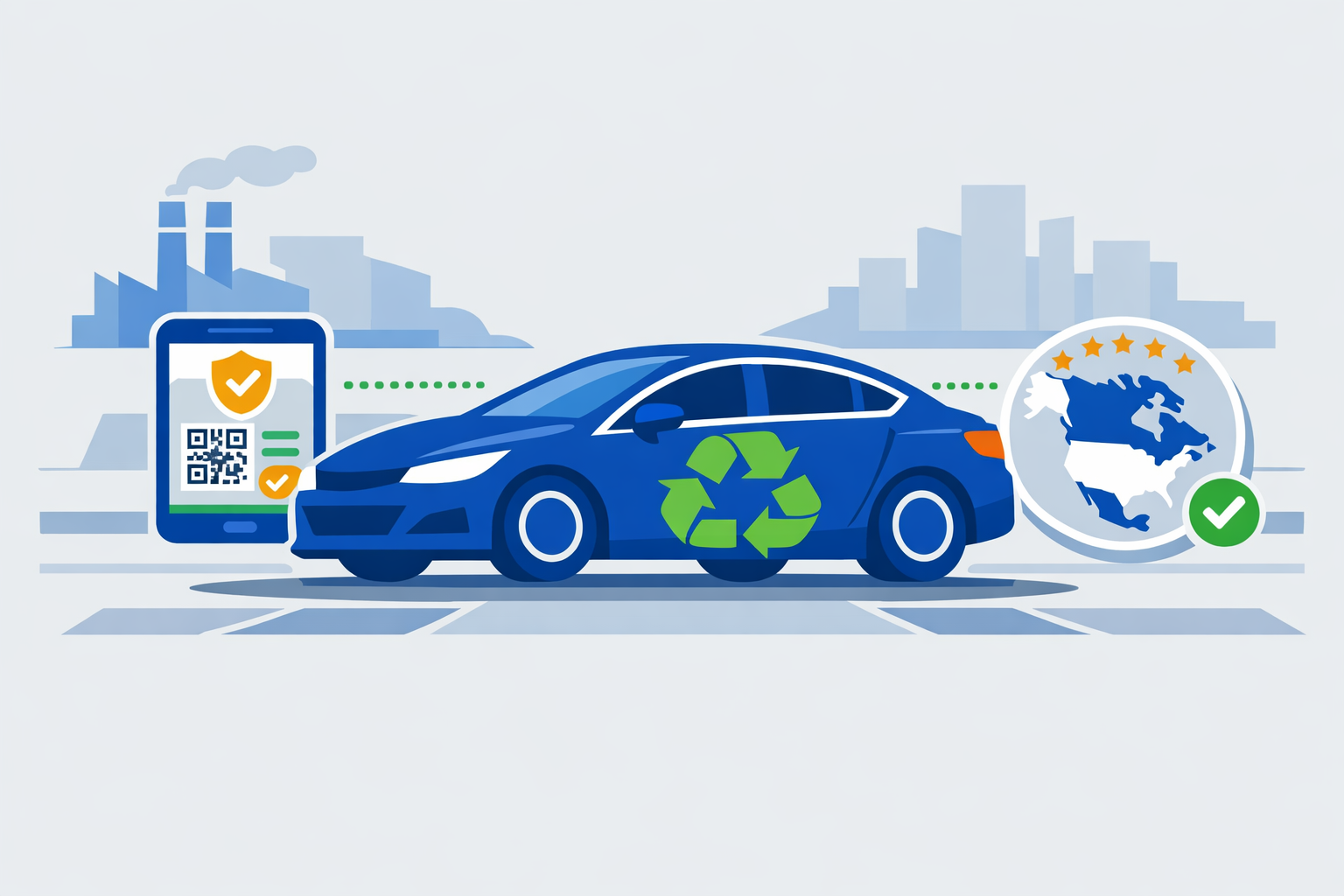
U.S. automakers and their Tier-1 suppliers are advancing post-consumer recycled (PCR) polymer pilot programs ahead of a federal recycled-content standard for light-vehicle interior plastics, with a compliance horizon targeting 2026. The proposed rule would expand the EPA's Comprehensive Procurement Guidelines beyond rebuilt vehicular parts and re-refined lubricants, establishing the first federal mandate specifically addressing recycled polymer content in components such as dashboards, door panels, center consoles, and interior trim.
Background
The regulatory push draws on the EPA's authority under Section 6002 of the Resource Conservation and Recovery Act (RCRA), which directs the agency to designate products that can be manufactured with recovered materials and to set minimum content recommendations for federal procurement. The EPA's current Comprehensive Procurement Guideline program covers 61 products across eight categories, with vehicular designations limited to rebuilt parts, re-refined lubricating oils, and recycled engine coolants-none of which address polymer content in vehicle interiors.
A broadened rule targeting interior plastics would mark a significant departure from that framework. Interior components-including dashboards, door panels, and seat bases-typically rely on polypropylene (PP), acrylonitrile butadiene styrene (ABS), PC/ABS blends, and modified polyolefins, according to industry technical references. Polypropylene is the most widely used plastic in automotive manufacturing, making it the primary candidate for early PCR integration.
The regulatory direction mirrors action already underway in Europe. The EU's updated End-of-Life Vehicles regulation mandates that new vehicles incorporate a minimum of 15% recycled plastic content within six years and 25% within ten years, with at least 20% required to come from closed-loop recycling of end-of-life vehicle plastics. Globally, only an average of about 3% of the plastic in new vehicles is currently made from recycled material, according to a 2025 analysis by the European Commission's Joint Research Centre, though some vehicle models already achieve up to 20%.
Details
The anticipated rule is compelling industry stakeholders to act ahead of final rulemaking. Ford has committed to using at least 20% recycled plastic content across its vehicle lineup, while GM is targeting 50% sustainable materials across all vehicles by 2030, according to market research published in 2025. Stellantis has announced plans to use 40% recycled content in vehicle plastics by 2030, partnering with European recyclers to source post-consumer polypropylene and polyamide compounds.
The global post-consumer recycled plastics market for automotive applications was estimated at USD 11.92 billion in 2024 and is projected to grow at a compound annual growth rate of 11.1% through 2030, according to Grand View Research. Interior components accounted for the largest application segment in 2024, representing more than 60% of market revenue, driven by PCR use in dashboards, door panels, and seat fabrics.
Supply chain qualification remains the principal technical barrier. Automotive-grade specifications require PCR polymers to pass thermal aging, impact resistance, UV stability, and low-VOC emissions testing-OEM-specific standards that virgin resin suppliers have long met but that recycled compound producers are still scaling to achieve consistently. Materials must typically conform to automotive standards including SAE J2640 and OEM-specific material specifications, and dashboards must meet FMVSS 201 impact standards, adding certification complexity for recycled-content substitution.
Certification and traceability infrastructure also demands investment. The EU's parallel approach-which introduced mandatory digital product passports from mid-2025 for material data including polymer types per ISO 1043, additives, and end-of-life handling instructions-has signaled a direction U.S. regulators may reference in their own standard-setting. About 80% of recycled plastic currently used in new vehicles is generated from industrial processes rather than post-consumer sources, the JRC analysis found, underscoring the structural challenge of scaling genuine post-consumer resin into vehicle interiors.
Cost implications for OEMs hinge on resin market conditions. Imported recycled plastic has become cheaper over the past year, leading some companies to source recycled content internationally rather than from domestic recyclers, according to the Association of Plastic Recyclers-a dynamic that could influence both the rule's design and its domestic supply chain incentives.
Outlook
Public comment and interagency review are expected before the rule is finalized, with industry observers anticipating a phased implementation schedule that gives suppliers time to qualify recycled-compound grades and establish traceable sourcing. Demand for automotive-grade PCR polypropylene and ABS is forecast to grow sharply: recycled plastics content in automotive applications is projected to grow at a CAGR of 29.1% between 2025 and 2035, according to IDTechEx, though analysts caution that actual sustainable polymer use in vehicles is likely to remain below many stated OEM targets, reaching close to 18% by 2035. Whether a federal mandate can close that gap will depend on how quickly U.S. recycling infrastructure scales to meet automotive-specification demand.