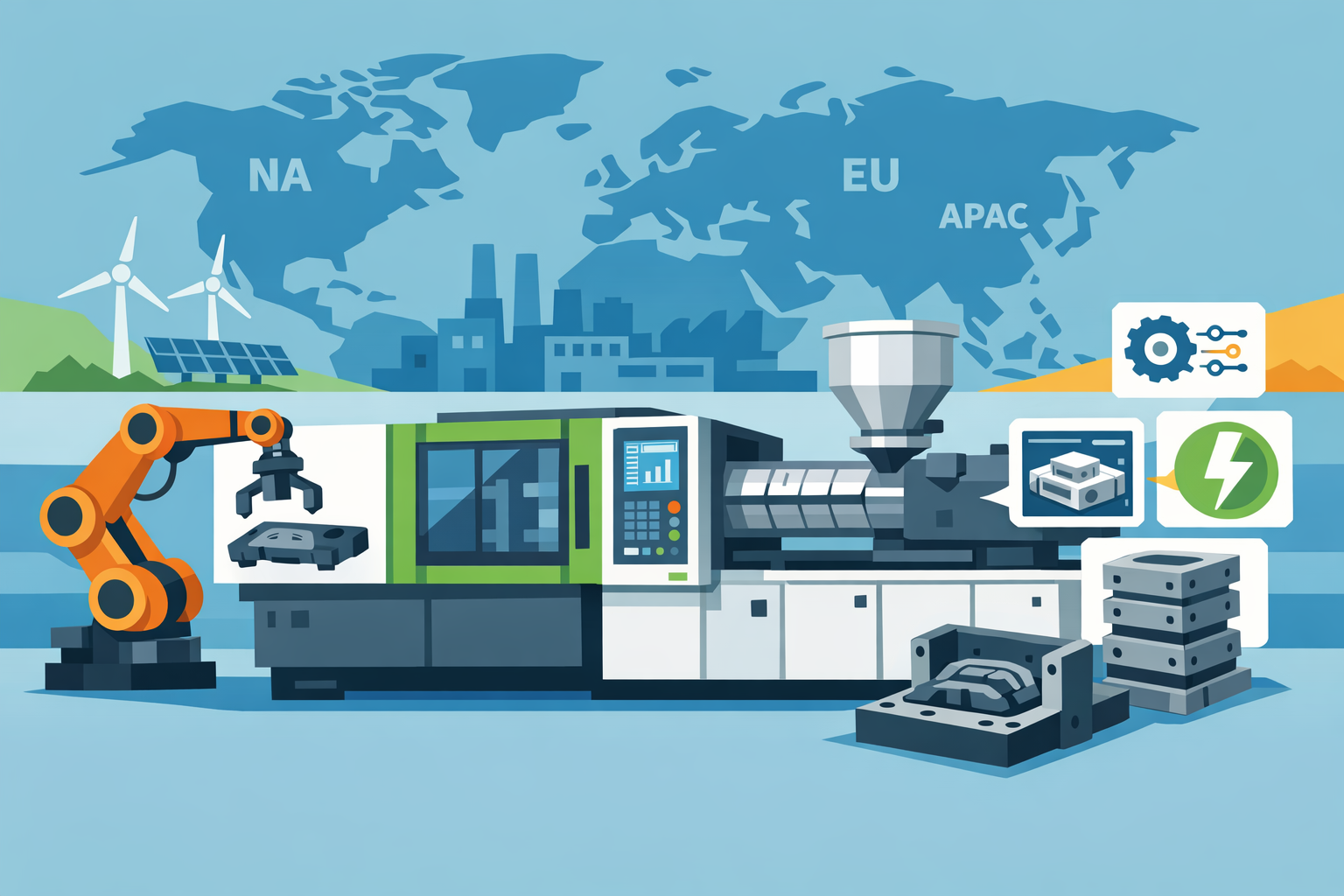
Automotive supply-chain diversification linked to electric vehicle (EV) production is shifting global demand for injection molding machinery. Suppliers report increased interest in scalable automation and smart tooling as original equipment manufacturers (OEMs) adopt multi-regional sourcing and near-shoring to strengthen supply-chain resilience.
Background
Automakers are accelerating regional production strategies-including China-plus-one models and near-shoring-to reduce supply-chain risks and reliance on single sourcing hubs. This shift drives demand for flexible manufacturing systems capable of producing diverse EV components and lightweight materials. At the same time, sustainability initiatives and ongoing electrification push OEMs toward energy-efficient, modular equipment that aligns with circular economy objectives.
Details
Market analysis forecasts the global injection molding machine sector will grow from USD 11.41 billion in 2025 to USD 11.90 billion in 2026. Automotive holds the largest segment share and is projected to grow at a compound annual growth rate (CAGR) of 4.27 percent, led by demand for lightweight parts and EV components. In 2026, North America, Europe, and Asia-Pacific are expected to account for 28 percent, 25 percent, and 39 percent of the market, respectively.[1]
Industry data shows electric machines comprise approximately 28-30 percent of the global unit share, and 42 percent of machinery manufacturers have budgeted for automation upgrades.[2] Smart manufacturing features-including IoT sensors, AI-driven process control, predictive maintenance, and embedded analytics-are increasingly standard, with up to 40 percent of new machine installations integrating such technologies.[3]
In Europe, stringent regulatory and sustainability requirements have driven early deployment of energy-efficient injection molding machines. About 12 percent of the European installed base is scheduled for digital upgrades, while many new units qualify for energy audit thresholds that enable tax incentives.[4]
Automotive OEMs are requesting high-speed, multi-cavity, and variotherm tooling to address complex EV components including battery housings and integrated sensors. The transition from hydraulic to all-electric machines continues; electric units deliver 30-70 percent energy savings, with return-on-investment periods shortened to 18-24 months.[2] Demand is also increasing for large-platen "mega-molding" machines capable of molding integrated EV panels in single cycles.[2]
Regional market differences are pronounced. North America's EV expansion fuels investments in robotic part handling and inline quality monitoring. Europe's regulatory environment supports precision molding systems employing energy-efficient, hybrid technologies.[1] In both regions, OEMs and tooling suppliers are focusing on modular, scalable automation solutions designed to adapt to evolving production requirements and support circular-economy targets.
Outlook
Machinery suppliers are expected to further expand offerings that integrate smart automation, energy efficiency, and modularity. As automakers continue to regionalize EV supply chains, investments in adaptive injection molding technologies-particularly high-precision electric machines and digital tooling-are likely to rise, supporting resilient and sustainable production strategies.