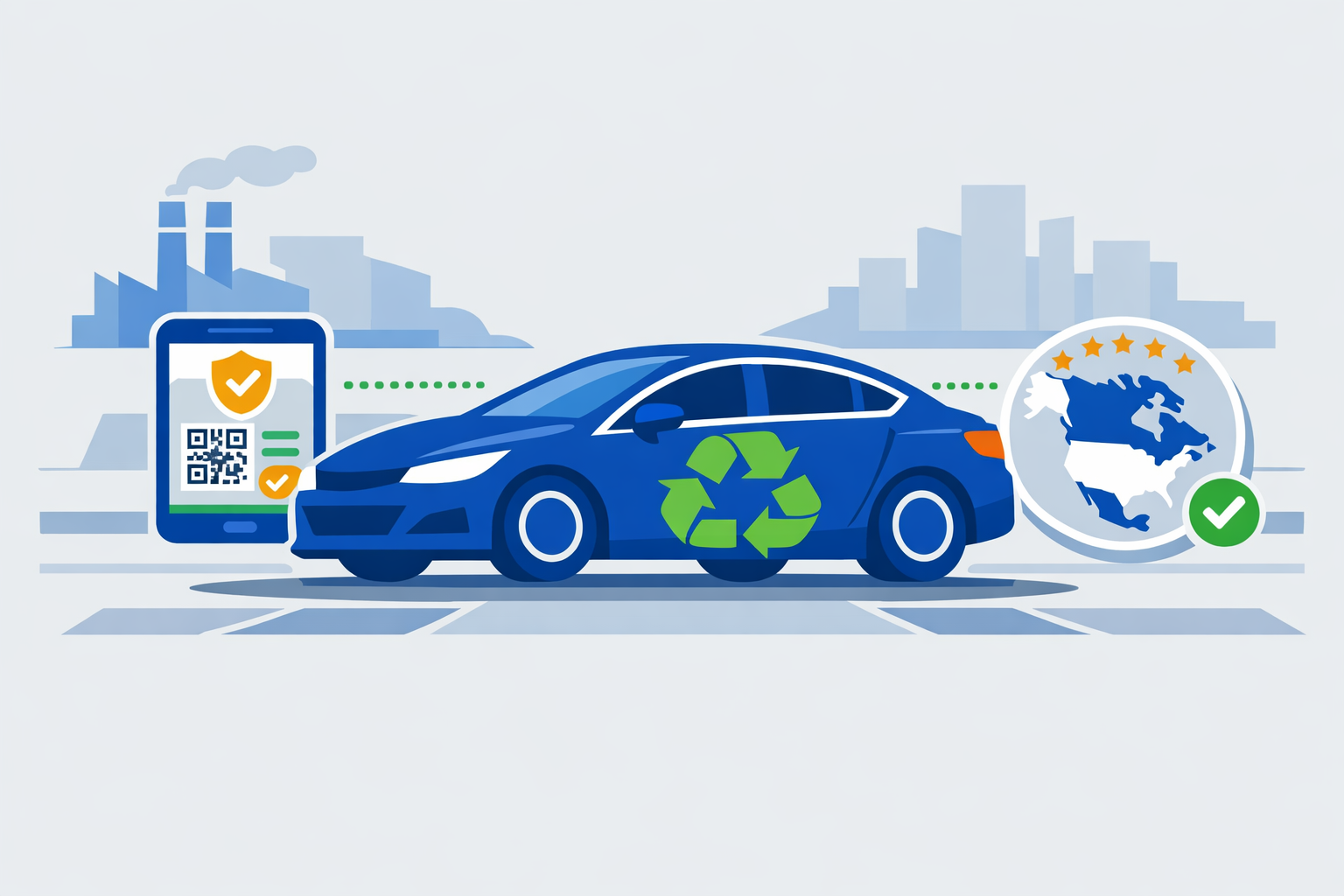
North American automakers are intensifying supply-chain scrutiny by requiring independent, third-party post-consumer recycled (PCR) content certification for polymer-intensive EV battery housings - a move reshaping qualification requirements across the Tier-1 and Tier-2 supplier base.
The push reflects mounting pressure from corporate sustainability targets and an evolving North American regulatory environment. Ford has pledged to use at least 20% recycled content across its vehicle lineup, while GM has committed to incorporating 50% sustainable materials in all vehicles by 2030, according to Grand View Research. As EV battery housings increasingly incorporate structural thermoplastic composites - including glass-fiber-reinforced polypropylene and polyamide-based systems - OEMs are demanding documentation that recycled polymer feedstocks can be independently verified, not simply self-declared.
Background
Demand for traceable recycled content in EV battery enclosures is accelerating alongside a broader regulatory shift. A separately proposed U.S. federal rule would mandate minimum recycled polymer content in light-vehicle components, including battery housings - a measure still under review. Internationally, the European Union has moved further: EU end-of-life vehicle regulation requires 15% recycled plastic in new vehicles within six years, rising to 25% within ten years, with at least 20% of that sourced from closed-loop end-of-life vehicle recycling.
In North America, state-level mandates are also advancing. As of mid-2025, five U.S. states had enacted laws requiring post-consumer recycled content in plastic products, and seven states have Extended Producer Responsibility laws for packaging in place, according to the Association of Plastic Recyclers (APR). Both Oregon and California cite APR's PCR Certification Program for aspects of state-law compliance, creating a regulatory reference point that automotive procurement teams are now applying beyond packaging.
The global post-consumer recycled plastics market in the automotive sector was estimated at USD 11.92 billion in 2024 and is projected to grow at a compound annual growth rate of 11.1% through 2030, according to Grand View Research. EV battery housings represent a structurally demanding application where performance requirements historically favored virgin polymers. The push for certified PCR in this segment marks a significant escalation of recycled-content expectations.
Details
The certification framework drawing the most attention from North American automotive procurement teams is the APR PCR Certification Program. APR PCR Certification is a full chain-of-custody, third-party assessment that verifies recycled content in plastic pellets or flake originates from post-consumer sources, developed in coordination with EU RecyClass, according to the APR. The APR launched an upgraded certification standard in November 2024, requiring all reclaimers seeking new certification after April 1, 2025 to comply with the new standard. Audits review material flow documentation, traceability records, and input-versus-output mass balance calculations. Certificates are valid for three years, provided ongoing conformance is maintained, with audit costs beginning at approximately USD 5,000, according to APR.
APR's audit process reviews documents supporting material flow and traceability of PCR through the process, and performs calculations verifying input versus output quantities and product PCR content. Suppliers offering audited, certified PCR grades are increasingly positioned for preferred-supplier status, according to market analysis from Research and Markets.
The certification requirement poses a direct challenge for battery housing suppliers. Structural components demand consistent mechanical performance across production lots - properties that can vary in PCR feedstocks depending on source stream, contamination levels, and reprocessing method. To address this, Tier-1 suppliers face pressure to validate certified PCR compounds against automotive-grade specifications for impact strength, heat deflection, and dimensional stability, adding to qualification timelines and cost. Innovations in polymer blending and additive technology now allow recycled polypropylene and polyethylene to meet the safety and performance standards required by automotive OEMs, according to Grand View Research.
Traceability infrastructure is also evolving. SMX (Security Matters) and Tradepro announced in October 2025 a collaboration to embed molecular markers into recycled plastics, enabling auditable, regulatory-ready reporting of recycled content percentages and material origin across the U.S. plastics market. Such molecular-level traceability tools are being evaluated as a complement to traditional chain-of-custody audits in automotive supply chains.
On the battery systems side, Ford previously ran a blockchain-based battery passport pilot with Everledger, launched in October 2022, which used blockchain, artificial intelligence, and auto-identification tools to record battery origin, chemistry, condition, and ownership data - a traceability model that industry observers say foreshadows analogous approaches for housing materials.
Outlook
Suppliers unable to provide independent PCR certification documentation risk losing qualification in upcoming EV platform sourcing decisions, particularly as OEM purchasing agreements begin codifying certification standards as contractual requirements rather than voluntary preferences. The APR's PCR Working Group, composed of supply-chain representatives, is scheduled to conduct ongoing reviews to ensure the standard keeps pace with legislative and industry developments. As certification infrastructure matures, pressure is expected to intensify on reclaimers and compounders to offer automotive-validated, certified PCR grades suited to the structural and thermal demands of EV battery housing applications.