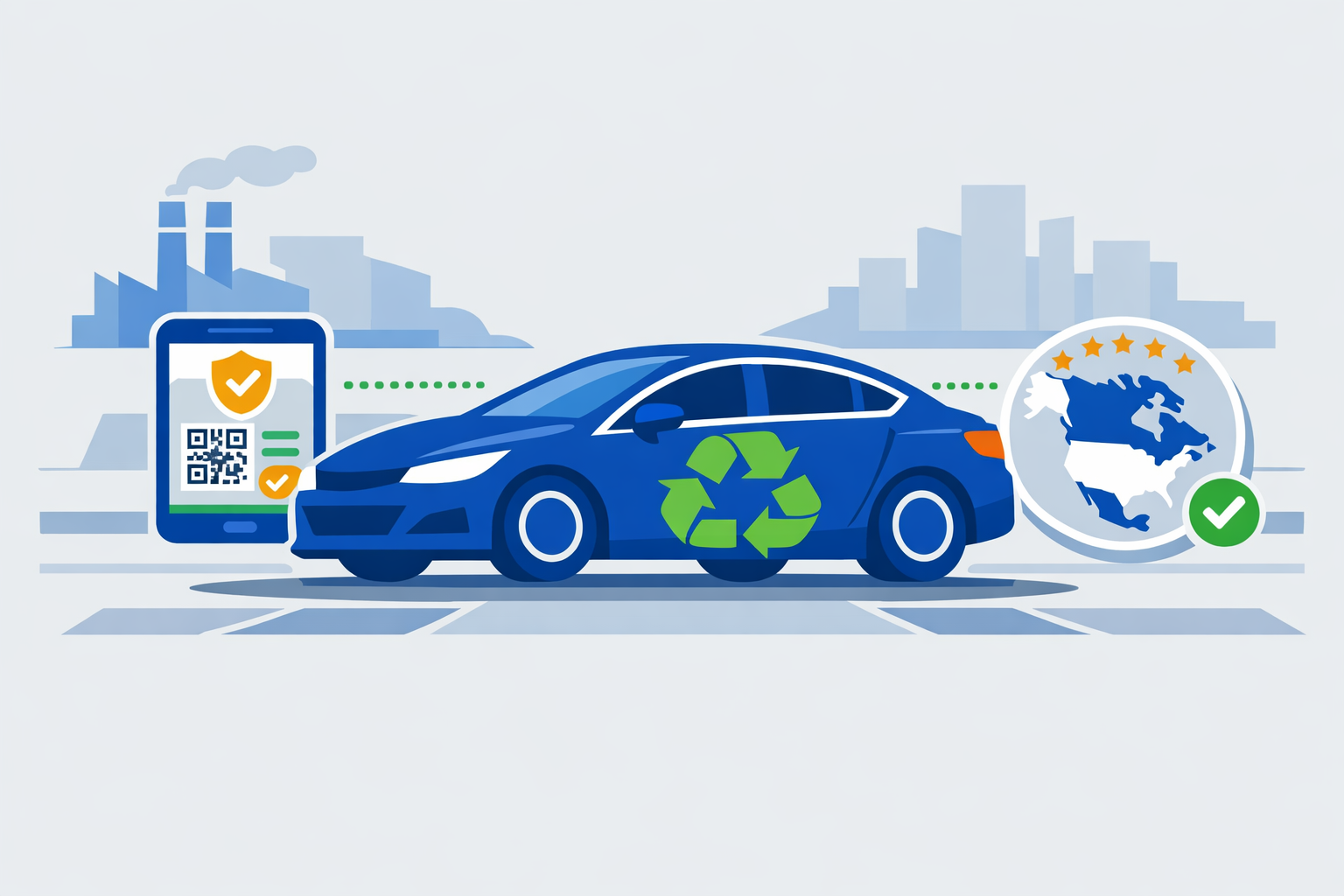
North American automakers are moving to require independent third-party certification of post-consumer recycled (PCR) plastic content in electric vehicle battery housings, tightening vendor qualification standards as supply-chain scrutiny intensifies ahead of escalating regulatory deadlines in 2026 and beyond.
The shift reflects converging pressure from the U.S. Inflation Reduction Act (IRA), proposed federal recycled-content mandates for automotive plastics, and a global push for traceable battery supply chains. OEMs are embedding PCR certification clauses into supplier contracts for structural and non-structural polymer components used in battery enclosures-components that must simultaneously meet strict mechanical, thermal, and electrical isolation requirements.
Background
The IRA's battery sourcing thresholds are the most immediate commercial driver. To qualify for the full $7,500 EV clean-vehicle tax credit under the IRA, the value of battery components manufactured or assembled in North America must reach 70% for vehicles placed in service in 2026, rising to 80% in 2027, 90% in 2028, and 100% by 2029. In parallel, critical minerals contained in the battery must be extracted, processed, or recycled in North America or a U.S. free-trade-agreement country-at 70% of value for 2026 model-year vehicles and 80% for those placed in service after December 31, 2026. These escalating thresholds compel OEMs to document material provenance at the component level, including the polymer housing systems that encase and protect battery modules.
At the certification infrastructure level, the Association of Plastic Recyclers (APR) updated its PCR Certification Program standard in 2024. Under the revised standard, reclaimers seeking new or initial certification after April 1, 2025, are required to certify to the new standard, which mandates complete chain-of-custody traceability for post-consumer plastic resin. According to the APR, the program recognizes pellet or flake containing a minimum of 90% post-consumer plastic material. As noted in the ISO standard referenced by the APR framework, the value of certification rests on impartial, third-party demonstration of fulfillment of specified requirements-a principle now being applied to automotive-grade PCR streams.
A parallel development emerged in September 2025, when SAE International introduced the J3327 Surface Vehicle EV Battery Global Traceability standard, described as the first industry-wide framework to document and track the journey of critical minerals used in EV batteries from extraction and manufacturing through to end of life. The standard creates a structured Electric Vehicle Battery Traceability Record to enable transparent tracking of mineral sourcing and chain of custody throughout battery production and lifecycle, according to SAE.
Details
For battery housing suppliers, the practical implications of third-party PCR certification are substantial. Battery enclosures must satisfy multiple performance criteria simultaneously: battery housing must meet requirements including impact resistance, fire protection, and electrical isolation, according to market analysis by Emergen Research. Introducing post-consumer recycled polyolefins, polyamides, or glass-fiber-reinforced PCR compounds into these assemblies requires validation data equivalent to virgin-resin baselines-a process that can add several months to material qualification timelines.
Market data signals growing commercial momentum. The global battery device enclosure market using PCR plastics is estimated to be valued at USD 1,480.0 million in 2026, according to Future Market Insights. A separate forecast from Strategic Revenue Insights projects the same market growing from approximately $1.31 billion to $3.73 billion by 2033, driven by OEM sustainability mandates and tightening regulatory requirements.
According to the Association of Plastic Recyclers, third-party PCR certification affects multiple tiers across the value chain: reclaimers must obtain third-party certification on their PCR pellet and flake, packaging and component manufacturers must certify PCR in final products, and brand companies-in this case OEMs-bear ultimate responsibility for compliance. Both Oregon and California cite the APR PCR Certification Program, or a similar program, for aspects of compliance with state laws, and more states are likely to include certification requirements to ensure accountability, the association noted. As of August 2025, five U.S. states had passed laws requiring post-consumer recycled content in plastic products, adding a state-level compliance dimension for Tier-1 and Tier-2 suppliers operating across multiple jurisdictions.
Supplier qualification timelines are further affected by constrained availability of automotive-grade PCR feedstock. According to Boston Consulting Group, demand for cathode materials will more than double between 2025 and 2030, but most battery material available for recycling until around 2035 will be production scrap rather than end-of-life EV batteries-a supply dynamic that similarly limits the volume of high-purity PCR structural polymers accessible for housing components.
On the traceability side, battery certificates or passports are emerging as a key mechanism to carry information including composition, recycled content, country of origin, and end-of-life instructions, according to ERA Environmental. In the European Union, Regulation 2023/1542 requires that EV and industrial batteries with a capacity greater than 2 kWh be electronically registered with a battery passport carrying an identification QR code from February 18, 2027, per TÜV SÜD. While this requirement applies to the EU market, North American OEMs supplying global platforms must align their PCR documentation systems with both IRA compliance frameworks and EU battery passport obligations simultaneously.
Outlook
Vendor qualification processes for PCR-content battery housings are expected to lengthen in 2026 as OEMs formalize audit and recertification requirements within supplier quality management systems. North American automakers are securing long-term procurement agreements to stabilize costs and reduce supply risks across the battery value chain, according to SNE Research data cited by Battery Technology. Suppliers that invest early in certified PCR supply chains and digital chain-of-custody systems stand to hold an advantage as qualification windows tighten ahead of the IRA's 2029 100% North American battery component threshold.