The average European car contains around 240 kilograms of plastic, yet only about 3% of plastics in EU vehicles today come from recycled sources, according to a Joint Research Centre supply-chain analysis[1]. That gap is about to narrow sharply. A provisional agreement reached between the European Parliament and the Council in December 2025 introduces mandatory recycled-plastic content targets for new vehicles - and the implications for fiber-reinforced plastics (FRP) manufacturers and composite-part suppliers are substantial.
For an industry built on material performance, the challenge extends well beyond sourcing post-consumer recyclate (PCR). Composite producers must now navigate a certification and traceability framework that touches resin chemistry, fiber recovery, manufacturing process validation, and end-of-life design - all under tightening timelines.
What the Regulation Requires
The new End-of-Life Vehicles Regulation (ELVR)[2], which replaces two earlier directives with a single directly applicable legal instrument, sets phased recycled-content mandates for plastics used in new vehicles:
| Milestone | Timeline | Recycled Plastic Minimum | Closed-Loop (ELV-Sourced) Share |
|---|---|---|---|
| Phase 1 | 6 years after entry into force (~2032) | 15% | 20% of target (i.e., 3% from ELVs) |
| Phase 2 | 10 years after entry into force (~2036) | 25% | 20% of target (i.e., 5% from ELVs) |
| Steel & Aluminium | ~2 years post-entry | TBD (delegated act) | Pending feasibility study |
Co-legislators agreed that the plastic used in each new vehicle type should contain a minimum of 15% recycled plastic within six years and 25% within ten years of the rules' entry into force, with 20% of those targets sourced from closed-loop streams[3] - meaning plastics recovered from end-of-life vehicles or parts removed during the vehicle's use phase.
Critically, rules for recycled plastic content calculation and verification are to be established by the end of 2026, according to the compromise text[4]. This 2026 milestone lays the foundation for how automakers and their composite suppliers will demonstrate compliance.
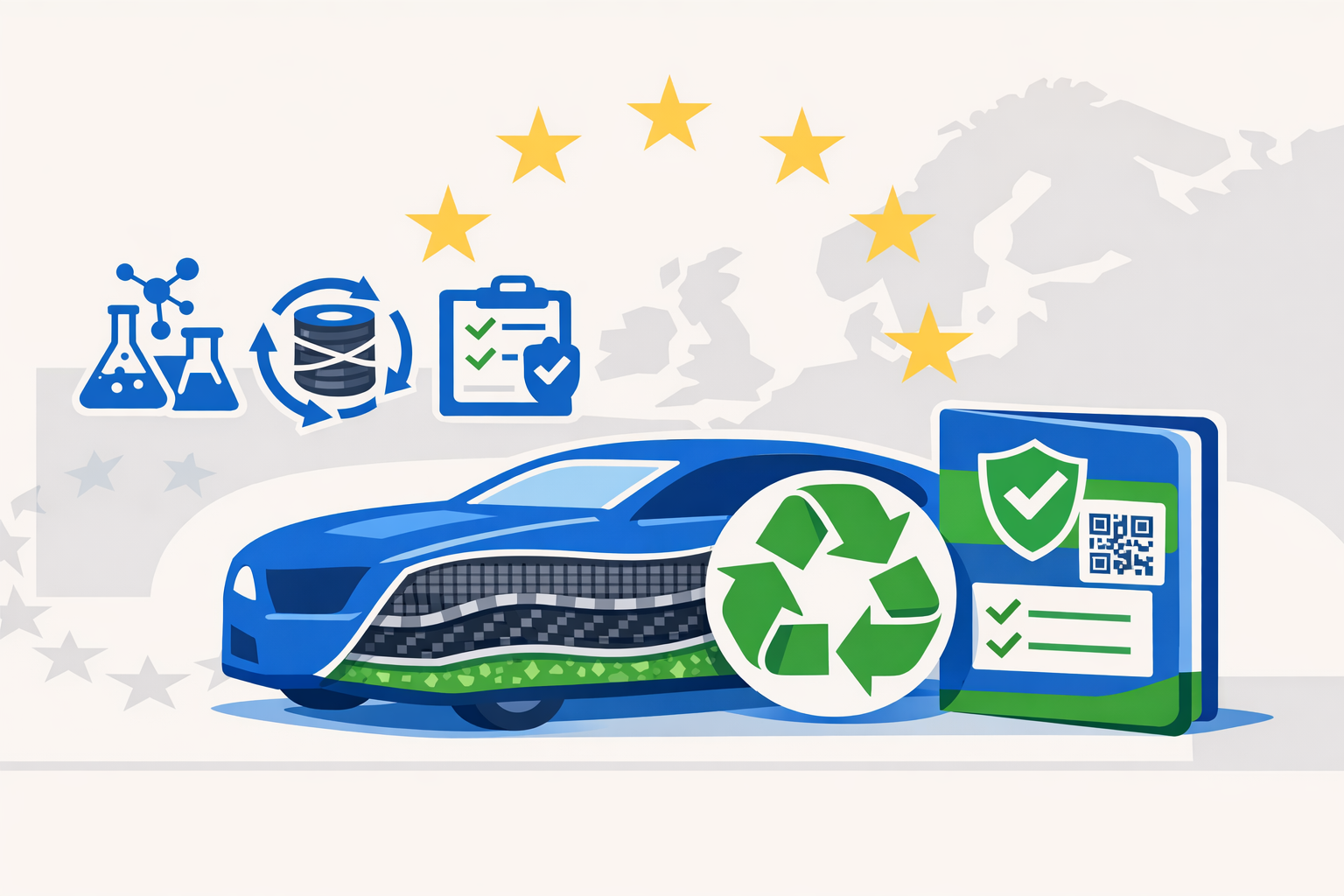
The regulation also introduces design-for-recycling requirements, a Circularity Vehicle Passport[5] for enhanced traceability, and strengthened extended producer responsibility (EPR) obligations. Non-compliance could result in market access restrictions and financial penalties.
Why Composites Face a Unique Challenge
While the regulation applies broadly to all automotive plastics, fiber-reinforced composites - glass-fiber-reinforced polypropylene (PP-GF), polyamide (PA-GF), carbon-fiber-reinforced polymers (CFRP), and sheet molding compounds (SMC) - face a disproportionately complex compliance path compared to unreinforced thermoplastics. The reasons are both technical and structural.
Thermoset Recyclability Remains a Bottleneck
Approximately 80% of fiber-reinforced polymers are manufactured with thermoset resins such as epoxy, polyester, and vinylester, which form irreversible cross-linked structures during curing[6]. Unlike thermoplastics, thermosets cannot be melted and reprocessed. Current recycling methods - mechanical grinding, pyrolysis, and chemical solvolysis - each carry trade-offs.
- Mechanical recycling reduces composites to powder and short fibrous fractions suitable only as low-value fillers, with limited potential for reuse in structural applications.
- Pyrolysis operates at 450-700°C and can recover carbon fibers effectively, but thermal recycling of glass fiber under high temperatures reduces tensile strength by up to 80%, according to published composite recycling research[7].
- Chemical recycling (solvolysis) can yield higher-quality recovered fibers but faces challenges with process efficiency, environmental impact, and contamination tolerance.
Recent work at the U.S. National Renewable Energy Laboratory (NREL)[8] has demonstrated a promising acetolysis process using hot acetic acid to deconstruct epoxy-amine resins in carbon fiber composites, potentially offering a scalable pathway. However, commercial-scale deployment for automotive-grade recyclate remains in early stages.
Thermoplastic Composites Offer a Clearer Path - With Caveats
Thermoplastic-matrix composites such as PP-GF and PA-GF are more amenable to recycling through melt reprocessing and injection molding. These materials see increasing use in under-the-hood components, underbody shields, and structural brackets.
However, challenges persist:
- Fiber shortening during reprocessing reduces mechanical performance in subsequent use cycles.
- PCR feedstock consistency varies, requiring careful validation of blends with virgin material.
- Coupling agents and stabilizers are essential when combining recycled content with virgin polymers. As industry suppliers note[9], maleic anhydride-grafted polypropylene and UV stabilizers are critical to maintaining compatibility and long-term performance of PCR-based composites.
| Challenge | Thermoplastic Composites (PP-GF, PA-GF) | Thermoset Composites (Epoxy-CF, SMC) |
|---|---|---|
| Recycling method | Melt reprocessing / injection molding | Chemical recycling, pyrolysis, or solvolysis |
| Fiber recovery quality | Moderate - fiber shortening occurs | Variable - glass fiber severely degraded by thermal methods |
| PCR feedstock availability | Broader - polyolefins and PA widely recycled | Limited - thermoset composites rarely enter recycling streams |
| Manufacturing compatibility | Higher - fits existing molding lines | Lower - may require new formulations and cure cycles |
| Certification complexity | Moderate - established test protocols | High - less standardized for recycled thermoset systems |
Certification and Traceability: The 2026 Milestone
The regulation's 2026 certification milestone will require composite suppliers and automakers to establish robust verification infrastructure. Key elements include:
- Material traceability documentation verifying the origin and percentage of recycled content in each component, aligned with standards such as ISO 14021 for environmental labeling[9].
- Third-party certification through bodies such as EuCertPlast, RecyClass, or TÜV SÜD[10], validating recycled content claims across the supply chain.
- Digital product passports listing polymer types (per ISO 1043), additives, fillers, joining methods, and end-of-life handling instructions, as mandated under the updated framework[11].
- Performance validation encompassing tensile strength, impact resistance, thermal stability, chemical resistance, fire resistance, and UV stability - particularly critical for exterior panels and structural composites exposed to environmental stress.
For fiber-reinforced plastics specifically, certification is further complicated by the need to demonstrate that recycled-content blends maintain the mechanical integrity required for crash safety-critical modules such as bumper systems, door panels, and underbody shields.
The EU has indicated that chemical recycling is approved for compliance, while bio-based materials await a separate Commission review to be completed within 72 months of the regulation's entry into force, according to Plastics Today's analysis of the provisional text[12].
Supply Chain and Strategic Implications
Feedstock Availability Is the Near-Term Constraint
The automotive sector consumes roughly 6 million tonnes of plastics each year in Europe, yet recycled plastics supply remains inconsistent and fragmented[13]. According to ICIS analysis reported in ELVR coverage, recycled content mandates are expected to be met primarily through recycled polyolefins, with an estimated 0.5 to 0.6 million tonnes of recycled polyolefins required by 2040, with recycled polypropylene expected to supply the majority[12].
For composite-part manufacturers, the most practical near-term compliance path may involve:
- Prioritizing thermoplastic composite components (PP-GF, PA-GF) where PCR integration is technically feasible.
- Securing long-term offtake agreements with post-consumer recycling facilities and mechanical recyclers.
- Exploring regional recycling partnerships, particularly as EU infrastructure for plastics-from-ELVs recycling scales up. Currently, only 19% of plastics from end-of-life vehicles in the EU is recycled, per European Council data[3].
OEM Adoption Is Accelerating
Leading automakers are not waiting for enforcement. Stellantis plans to use 40% recycled content in vehicle plastics by 2030, focusing on non-visible structural parts like battery trays and underbody shields, according to Plastics Engineering[11]. BMW is testing interior panels made entirely from recycled thermoplastics with single-material designs to improve closed-loop recyclability. In the advanced composites space, recycled carbon-fiber prepregs are scaling for automotive applications, with fiber recovery rates now exceeding 90% through pyrolysis and solvolysis.
Compliance Costs and Component Redesign
The regulation imposes upfront costs that suppliers and OEMs must factor into near-term planning:
- Testing and qualification of PCR-based resin systems against automotive OEM specifications.
- Process adjustments to injection molding, compression molding, or resin transfer molding lines to handle recycled feedstock with potentially different viscosity and thermal profiles.
- Component redesign to accommodate recycled-content materials while preserving crash safety, durability, and dimensional stability.
- Audit readiness - domestic certification bodies will be empowered to audit supplier materials and production records.
What Comes Next
The provisional agreement still requires formal approval by the European Parliament Plenary and the European Council before becoming law. Published following a positive vote from the European Parliament's committees on February 25, 2026, the compromise text[12] is widely expected to proceed without major changes. The Commission has also signaled that implementation timelines could face adjustments depending on market conditions.
For composite-part manufacturers and FRP suppliers, the strategic calculus is clear: early movers who invest in PCR-compatible resin development, material traceability systems, and recycling partnerships will be positioned to capture share as compliance timelines approach. Those who delay face not only regulatory risk but potential loss of preferred-supplier status with OEMs already building recycled content into their procurement specifications.
As earlier analysis of EU circularity rules for automotive composites has noted, machinery suppliers and processors may also need to invest in equipment capable of handling greater volumes of recycled plastics. The regulation's scope - extending beyond passenger vehicles to include heavy-duty vehicles and trailers - further broadens the addressable market for compliant composite solutions.
The transition will not be frictionless. But for an industry that has long demonstrated its ability to engineer materials to exacting specifications, the question is less whether compliance is achievable and more who will move first - and fastest - to convert regulatory pressure into competitive advantage.