The European Union has set a firm end-of-2026 deadline for developing the methodology to calculate, verify, and certify recycled plastic content in new vehicles, placing automotive OEMs and their composite and interior-plastics suppliers under immediate pressure to restructure material sourcing and documentation processes. The mandate stems from the EU's revised End-of-Life Vehicles (ELV) Regulation, on which EU institutions reached a political agreement in December 2025 and published the compromise text in February 2026.
Background
The revised ELV Regulation replaces the original ELV Directive (2000/53/EC), which shaped automotive recycling compliance across Europe for more than two decades. EU institutions reached a political agreement on the revised framework in December 2025, and the compromise text was published in February 2026. Unlike its predecessor-which required Member States to transpose rules nationally-the new regulation applies uniformly across the EU, reducing legal fragmentation and strengthening cross-border enforcement.
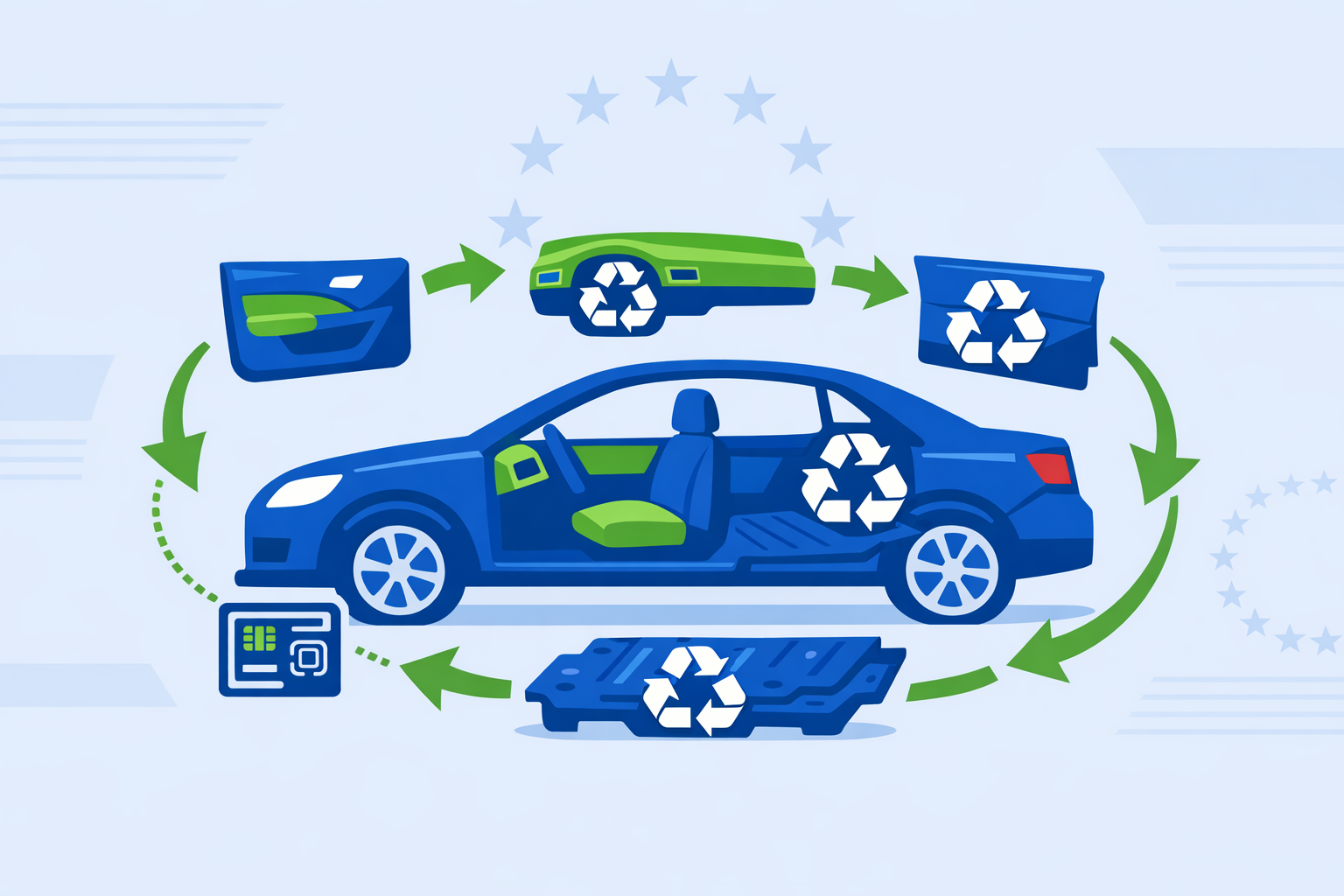
The regulatory shift moves compliance upstream, embedding circularity obligations into vehicle type approval and market surveillance rather than confining them to end-of-life treatment. Plastics comprise approximately 20% of a modern vehicle's weight, appearing in interior, exterior, and structural components, making plastic traceability a central enforcement challenge. Interior components-including dashboards, door panels, center consoles, and seat bases, typically manufactured from ABS, PC/ABS blends, and modified polyolefins-fall within the verification regime's scope, as do glass-fiber-reinforced composites used in body panels, underbody shields, and battery enclosures.
Details
Under the regulation, rules for recycled plastic content are to be calculated and verified by the end of 2026, followed by a feasibility study for setting binding recycled content targets in 2027 and formal declaration of material formats in 2030. The phased content targets require a minimum of 15% recycled plastic in each new vehicle type within six years of the regulation entering into force, rising to 25% within ten years, with at least 20% of those volumes derived from closed-loop ELV sources.
Third-party verification is central to the framework's integrity. Under established EU certification practice, recycled content claims are validated through independent bodies such as RecyClass or EuCertPlast, using material traceability documentation aligned with standards including ISO 14021. The EU increasingly recognizes chemically recycled materials provided they meet mass-balance certification standards-a pathway relevant for glass-fiber-reinforced and multi-material composites that resist mechanical recycling.
A core pillar of the regulation is the Circularity Vehicle Passport, a digital, structured record that must remain accurate and current throughout a vehicle's market life. Any change to design, supplier, material formulation, or sourcing can trigger updates to the passport, effectively turning recycled-content compliance into a continuous data management obligation rather than a periodic reporting exercise.
The verification burden is reshaping OEM-supplier relationships. To stabilize pricing and ensure a reliable supply, OEMs and Tier I suppliers must establish long-term agreements with recyclers and invest in closed-loop systems that secure material availability at predictable costs, according to IDTechEx analysis. Supply of automotive-grade recycled polypropylene (rPP), polyamide (rPA), and polyethylene (rPE) remains constrained, with most plastics from scrapped vehicles currently either downcycled into non-automotive applications or incinerated due to the lack of standardized collection and sorting systems.
Several major OEMs have begun adjusting material strategies ahead of formal deadlines. Stellantis has targeted 40% recycled content in vehicle plastics by 2030, partnering with European recyclers to obtain post-consumer polypropylene and polyamide compounds. BMW Group is testing interior panels made entirely from recycled thermoplastics and has incorporated digital material passports accessed via QR codes embedded in components. On the supplier side, Tier 1 supplier Faurecia has developed PP and ABS compounds with up to 50% recycled content under its NAFILean and MATTrim material brands, tailored for injection molding in automotive interior applications.
Outlook
A feasibility assessment for recycled steel and aluminium targets is currently underway, with the Commission required to introduce those targets two years after the regulation enters into force. According to IDTechEx's latest market forecast, sustainable plastics content in vehicles is expected to reach 18% by 2035, with recycled plastics accounting for 15% and bio-based plastics the remaining 3%-a projection that falls short of the regulation's 25% plastic target, underscoring the scale of supply chain development still required. Non-compliance carries the risk of fines, extended producer responsibility (EPR) penalties, or restrictions on vehicle sales in EU markets, making the 2026 verification deadline a critical gateway for the entire automotive materials supply chain.