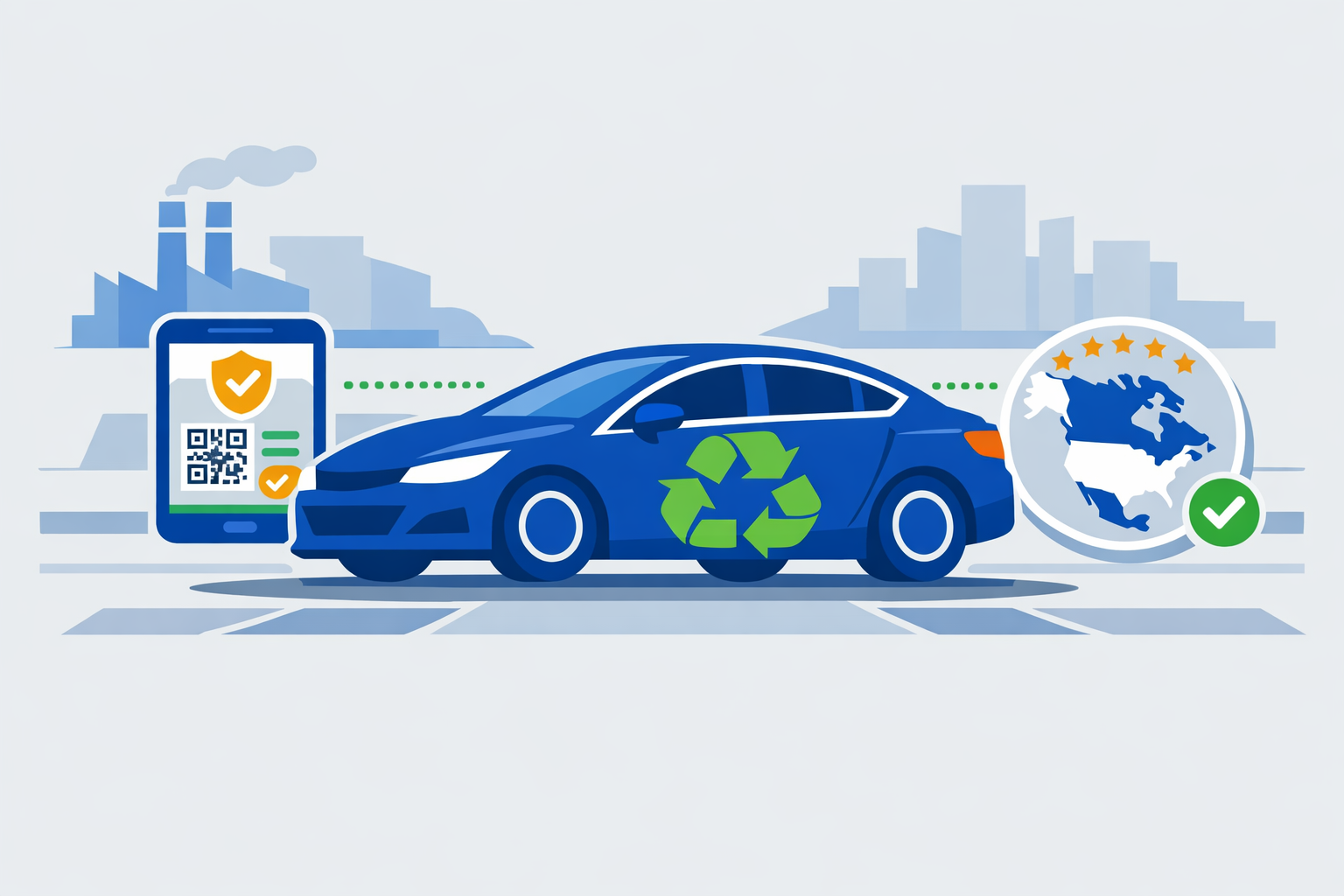
Only around 3% of the plastic in new EU-manufactured vehicles is currently sourced from recycled material-despite plastics comprising 14-18% of a modern vehicle's mass[1]. That gap is now at the center of a landmark regulatory shift. European policymakers have set a December 2026 deadline for introducing a standardized methodology to calculate and verify recycled plastic content in new vehicles-a foundational step before binding content targets can be enforced across the automotive sector.
The deadline sits within the broader framework of the EU's revised End-of-Life Vehicles (ELV) Regulation, which reached political agreement in December 2025[2] and whose compromise text was published in February 2026. For manufacturers, suppliers, and test laboratories, the verification milestone is not a finishing line-it is the starting gun.
From Directive to Directly Applicable Regulation: What Changed
The shift from the former ELV Directive to a directly applicable ELV Regulation is more than a legal technicality. Under the new framework[3], requirements apply uniformly across all EU member states, eliminating the patchwork of national transposition that allowed inconsistent enforcement. This reduces fragmentation, improves legal clarity, and strengthens enforcement for manufacturers and treatment operators alike.
The regulation introduces mandatory recycled plastic content requirements for new vehicles for the first time, with exact percentages and calculation methodologies to be defined through later implementing acts. The December 2026 verification deadline is a critical prerequisite: without a validated, standardized methodology, downstream content targets cannot be credibly enforced.
The European Parliament explicitly requested that the Commission develop a standardized method for calculating and verifying recyclate content in plastics[4], to be introduced through a delegated act. Crucially, that methodology must account for the best available recycling technologies, including chemical recycling-a recognition that mechanical recycling alone cannot address all automotive polymer streams.
The Phased Content Targets: What Manufacturers Are Preparing For
The verification deadline precedes a series of binding recycled content milestones that will reshape materials procurement across the automotive value chain.
| Milestone | Timeline | Requirement |
|---|---|---|
| Verification methodology established | End of 2026 | Standardized calculation and verification method for recycled plastic content introduced via delegated act |
| Regulation enters into force | ~2027 | 20 days after publication in the EU Official Journal; directly applicable across all member states |
| Application begins | ~2029 (2 years post-entry) | Design-for-recycling obligations and Circularity Vehicle Passport become active |
| First recycled plastic target | ~6 years post-entry (~2032) | Minimum 15% recycled plastic per new vehicle type; at least 20% of that from closed-loop (ELV-sourced) recycling |
| Bio-based plastics review | 72 months post-entry | Commission reviews sustainability requirements for bio-based plastics and tyre elastomers |
| Second recycled plastic target | ~10 years post-entry (~2036) | Minimum 25% recycled plastic per new vehicle type; at least 20% from closed-loop recycling |
Sources: European Parliament[2], PlasticsToday[5], Ascend Materials[6]
At least 20% of the recycled plastic content target in vehicles must be sourced from closed-loop recycling-specifically, material recovered from end-of-life vehicles. This equates to 3% total recycled content from ELVs at the first target, rising to 5% at the second. The regulation also permits the Commission to temporarily revise targets downward[5] if specific recycled plastics become unavailable or prohibitively expensive-a concession acknowledging real-world supply chain volatility.
Notably, recycled material procured from outside the European Union will not count toward the minimum recycled content targets for 48 months after the regulation enters into force, a provision designed to stimulate domestic recycling capacity.
The Verification Architecture: Circularity Passports, Delegated Acts, and Third-Party Certification
The compliance burden tied to December 2026 centers on infrastructure-establishing the systems, documentation, and testing protocols that will underpin all future content claims.
The Circularity Vehicle Passport
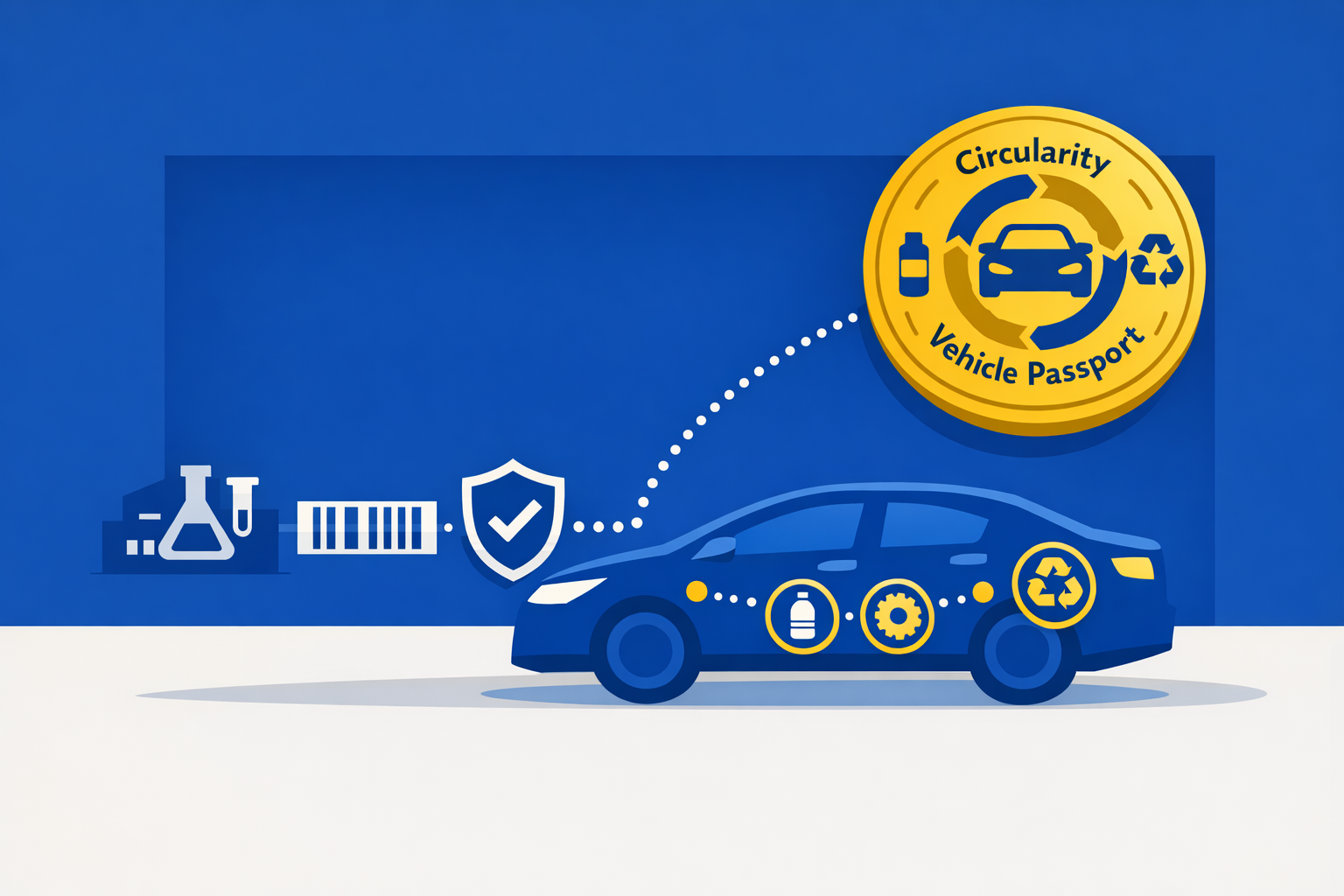
The regulation introduces a Circularity Vehicle Passport[7], an EU-wide instrument requiring manufacturers to document restricted substances, the share of recycled content, circularity strategies, and references to the spare parts catalogue. This digital record creates a traceable chain of custody from raw feedstock through to the finished vehicle-a significant data management challenge for OEMs operating across complex, multi-tier supply chains.
Manufacturers must also provide clear, detailed instructions for removing and replacing parts[7] during use and at end of life, directly informing recyclability scoring and life-cycle environmental impact assessments.
The Delegated Act on Calculation Methodology
The December 2026 deadline centers on the delegated act that will define precisely how recycled content is calculated and verified. This is technically non-trivial. Existing methods for quantifying post-consumer recycled (PCR) content in automotive polymers-including gel permeation chromatography, differential scanning calorimetry, and rheological profiling-suffer from variability introduced by processing conditions, polymer grades, and additive formulations[8]. A harmonized, reproducible protocol that is also commercially scalable across the volume of components involved remains an active area of technical development.
Emerging analytical approaches, including fluorescence-based marker systems, offer promising routes to low-cost, high-throughput verification independent of sample dimensions and processing history. Whether such methods gain regulatory acceptance under the delegated act will be closely watched by test laboratories and materials suppliers.
Supply Chain Traceability as a Competitive Differentiator
Supply chain traceability and certification are becoming key differentiators[9] in the automotive plastics market. Suppliers capable of offering audited PCR grades with chain-of-custody documentation are expected to gain preferred status as OEMs navigate compliance. The challenge is that most manufacturers already possess relevant data, but it is fragmented across multiple systems and operational stages[10]-ERP platforms, PLM tools, logistics databases, and supplier declarations rarely communicate in real time.
Design for disassembly[11] is equally important: vehicles must be engineered for easier removal, reuse, and recovery of components so that high-quality recyclate can be generated at end of life, feeding back into the closed-loop sourcing requirement.
Supply Chain and Industry Implications
Higher-Complexity Components Under Early Scrutiny
Industry groups anticipate that components with higher material complexity-dashboards, door trim panels, acoustic insulation, and center consoles-will face the most immediate verification demands. Interior components such as dashboards and door panels typically use ABS, PC/ABS blends, and modified polyolefins, all of which now face minimum recycled content requirements and traceability obligations through digital product passports. Exterior components, including bumpers and mirror housings manufactured from polypropylene and TPOs, present additional challenges due to multi-layer paint systems that complicate mechanical recycling.
Safety-critical components are expected to remain predominantly virgin plastic[12] for the foreseeable future due to regulatory and performance constraints-a reality that limits the total addressable volume for recycled content integration and concentrates compliance activity on interior and semi-structural applications.
The Economics of Compliance
While PCR feedstocks can reduce virgin material costs in some scenarios, downstream processing, certification, color matching, and logistics add overhead[9]. Compounders and recyclers that invest in auto-grade PCR capability-and the certification infrastructure to prove it-will be better positioned to absorb these costs within competitive pricing structures. Those that do not risk losing ground in a market where European OEMs increasingly specify recycled-content plastics as a baseline requirement[9].
Economic barriers[1] also include the persistent prioritization of metal recovery over plastics in ELV treatment, given higher metal values. Regulatory pressure to improve plastic recovery economics will likely be necessary alongside the content mandates themselves.
Compliance Roadmap: Six Actions for Manufacturers and Suppliers
Organizations across the automotive plastics value chain should begin preparing now, well ahead of the December 2026 verification framework publication.
Audit existing material declarations. Review all polymer component data for recycled content documentation, polymer type classification per ISO 1043, and additive or filler records. Identify gaps against future Circularity Vehicle Passport requirements.
Engage Tier-1 and Tier-2 suppliers immediately. Establish chain-of-custody protocols with upstream compounders and recyclers. Certification readiness at the supplier level will directly determine OEM compliance exposure.
Map the closed-loop sourcing gap. Since at least 20% of the recycled content target must come from ELV-sourced material, OEMs and compounders should model current sourcing against this closed-loop mandate and identify partnerships with authorized treatment facilities (ATFs).
Monitor the delegated act process. The methodology for calculating recycled content-including how chemical recycling outputs are credited-will be defined through the Commission's delegated act. Internal data systems should be stress-tested against multiple likely methodological approaches before finalization.
Consolidate lifecycle data infrastructure. Material origin, processing history, and additive usage data must be accessible in a format compatible with the Circularity Vehicle Passport. Fragmented legacy systems represent one of the most significant operational risks.
Build relationships with accredited test laboratories. Third-party verification will be non-negotiable. Early engagement with accredited facilities ensures access to testing capacity and input into evolving standardized protocols.
Conclusion
The December 2026 verification deadline is not merely a bureaucratic milestone-it is the moment at which the technical and administrative foundations for automotive plastics circularity must be in place. The binding content targets that follow are consequential enough to reshape sourcing strategy, component design, and supplier relationships across the entire European automotive sector.
The policy direction is clear[3]: increase secondary raw material demand, improve recycled plastic quality from end-of-life vehicles, and reduce dependence on primary materials and non-EU imports. Whether the industry meets those objectives will depend largely on the traceability infrastructure built between now and the end of 2026-and on the willingness of the entire value chain, from dismantlers to OEMs, to treat verification not as a compliance cost but as a competitive capability.
For further context on how the EU's broader ELV circularity framework is reshaping automotive composites design and processing, see our coverage of the EU's tightened circularity rules for automotive composites.