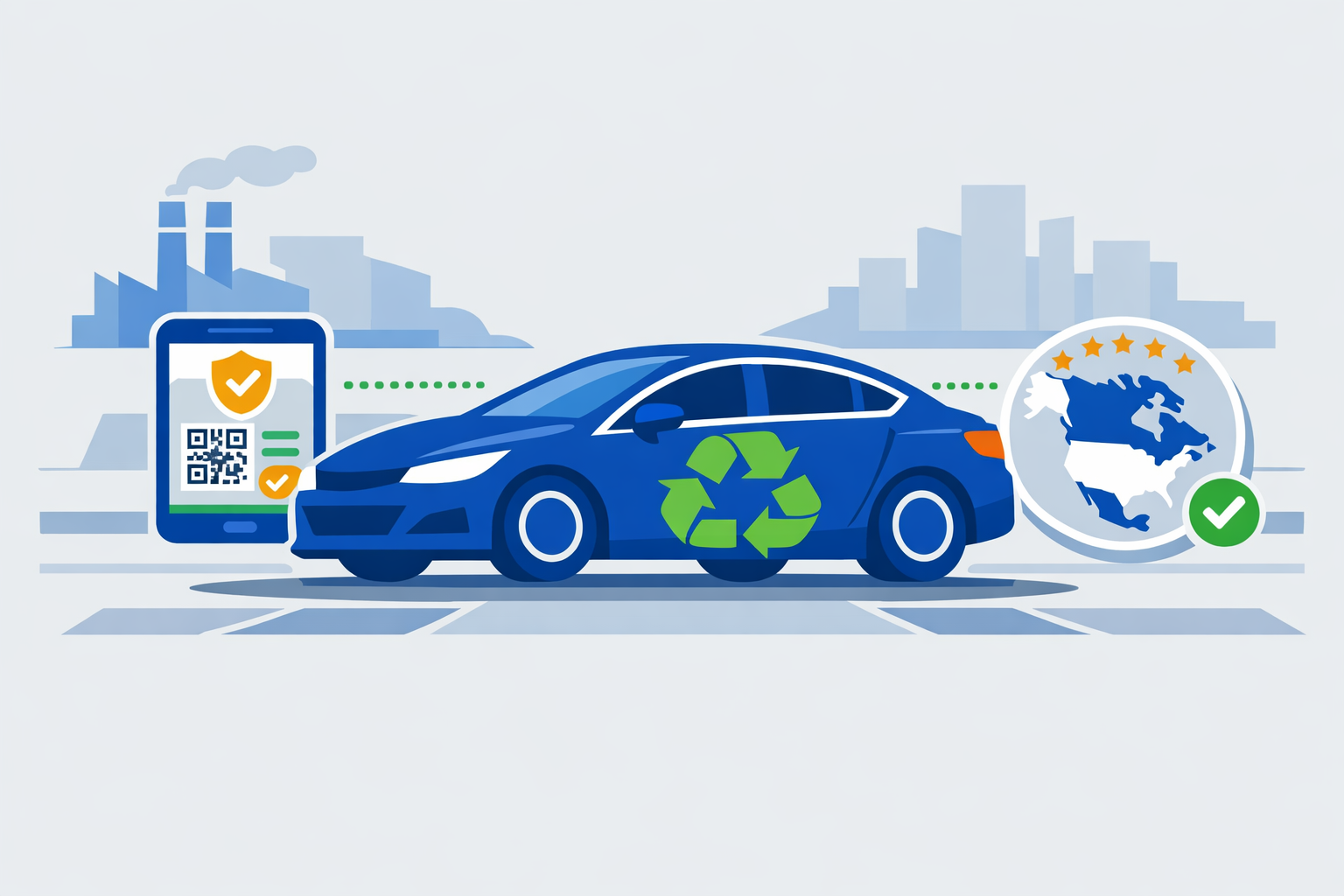
Every year, around 6.5 million vehicles reach the end of their lives across the EU - yet most of the plastics they contain are either downcycled into lower-value applications or incinerated. The reason is not a lack of ambition. It is a lack of verified data. European policymakers are now moving to close that gap with a binding certification framework under the new End-of-Life Vehicles (ELV) Regulation, targeting finalized methodology rules by the end of 2026.
The regulation does not simply set headline targets. It builds the architecture needed to prove that recycled content is actually present - standardized calculation methods, documentation chains, and mandatory third-party verification. For OEMs, polymer suppliers, and recyclers operating across the EU single market, the implications extend well beyond procurement.
The Regulatory Framework: Beyond Headline Targets
The EU's provisional ELV Regulation, agreed between the European Parliament and the Council in December 2025, represents a fundamental redesign of how vehicles are treated at end-of-life - and how recycled materials must flow back into new ones.
Under the provisional agreement, recycled plastic content mandates phase in over a 10-year period: a minimum 15% recycled content required six years after entry into force, rising to a minimum 25% at 10 years. Crucially, at least 20% of these recycled-content targets must be sourced from end-of-life vehicles - equating to 3% from ELVs after six years and 5% after ten.
The mandates apply to passenger cars, light commercial vans, regular heavy-duty vehicles, motorcycles, and special purpose vehicles. Critically, the requirements apply to all manufacturers intending to place vehicles on the EU market, irrespective of where they are based.
This last point carries significant weight for global supply chains. The regulation is not a domestic manufacturing rule - it is a market access condition.
The 2026 Certification Deadline: What Is Actually Being Finalized
While the recycled-content targets themselves are phased over six to ten years, the methodology underpinning compliance is due far sooner. Rules for calculating and verifying recycled plastic content are expected by the end of 2026, followed by a feasibility study for setting recycled content targets in 2027 and material format declarations in 2030.
This sequencing matters. The 2026 milestone is not about enforcement - it is about establishing the technical infrastructure for enforcement. One of the most important new elements is the introduction of mandatory recycled material requirements, especially for plastics. While the regulation creates the legal basis for these targets, the exact percentages and calculation methodologies are expected to be defined through later implementing acts.
In practice, the implementing acts will define:
- How recycled content is calculated across complex multi-polymer components
- What documentation must accompany recycled materials from waste sorting through compounding to finished parts
- Which third-party verification schemes are officially recognized for certification
Although no requirements concerning the use of recycled content exist at a global level, many manufacturers have already incorporated recycled materials into their vehicles. Establishing targets and uniform calculation provisions will provide legal certainty and contribute to fair competition between manufacturers.
The 2026 deadline is therefore a structural inflection point - the moment the industry moves from voluntary sustainability claims to a verifiable compliance regime.
A Note on Cross-Border Harmonization
One of the most commercially significant aspects of the incoming certification rules is their function within the EU single market. Once adopted, the new rules will allow recycled plastics to shed their waste classification and circulate more easily across all 27 Member States under harmonized criteria. These measures aim to facilitate the use of recycled plastics in manufacturing, reduce administrative burden for recyclers, and support a more stable supply of high-quality recyclates across the Union.
According to industry estimates, the absence of Union-wide end-of-waste criteria for plastics costs the EU plastics recycling sector around EUR 120 million per year. Harmonized certification directly addresses this fragmentation.
What Verification Requires in Practice
The distinction between declaring recycled content and certifying it is technical, costly, and time-consuming. Existing certification frameworks - such as RecyClass[1], EuCertPlast, and PolyCert Europe - offer a preview of what EU implementing acts are likely to formalize.
RecyClass certification uses a percentage-based recycled content calculation approach verified throughout the entire value chain, ensured via the Chain of Custody ISO 22095 and the Recycled Plastics EN 15343:2006 standards. Transparency is further warranted through a system of third-party certification audits.
The PolyCert Europe technical platform builds on accredited organizations under ISO 17065 or ISO 17021 and includes chain of custody. The methodology identifies all waste streams and provides a comprehensive way of calculating recycled content in newly converted products, with recyclate declarations based on ISO EN 14021 and ISO EN 472 definitions.
For automotive plastics specifically, verification is complicated by component complexity. Plastics comprise about 20% of a modern vehicle's weight and appear in interior, exterior, and structural parts. Interior components such as dashboards, door panels, center consoles, and seat bases often use ABS, PC/ABS blends, and modified polyolefins. Verifying recycled content in blended, co-extruded, or overmolded parts requires batch-level traceability that most current supply chains are not yet equipped to provide.
Broader sustainability claims will also face stricter scrutiny. From September 2026, all sustainability labels used in the EU must either be established by a public authority or based on a certification scheme that complies with regulatory requirements. Certification schemes must meet requirements on transparency, openness, and credibility, and a trader's compliance must be verified by a third party independent of both the scheme owner and the trader.
Operational Implications for OEMs and Suppliers
The certification requirements carry direct, practical consequences for materials selection, supplier management, and product development timelines.
Supply chain restructuring is the most immediate challenge. The limited availability of high-quality recycled plastics suitable for automotive applications remains a primary obstacle to meeting ELV targets. Automotive-grade recycled polypropylene (rPP), polyethylene (rPE), and polyamide (rPA) remain in short supply. At present, most plastics from scrapped vehicles are either downcycled into non-automotive applications or incinerated due to the lack of standardized collection and sorting systems.
Recycled content mandates are expected to be met primarily through recycled polyolefins, supported by wider waste streams. ICIS has previously estimated that 0.5 to 0.6 million tonnes of recycled polyolefins would be required by 2040, with the majority supplied by recycled polypropylene - the key polymer used in automotive components.
Performance qualification adds a further layer of complexity. OEMs incorporating higher levels of rPP or rPA into dashboards, door panels, and exterior trims must re-validate UV resistance, color stability, gloss retention, and mechanical strength. Stellantis has announced plans to target 40% recycled content in vehicle plastics by 2030, partnering with European recyclers for post-consumer polypropylene and polyamide compounds. BMW Group is testing interior panels made entirely from recycled thermoplastics, focusing on single-material approaches to simplify disassembly and closed-loop recycling. Its i Vision Circular concept includes digital material passports, accessed through QR codes embedded in parts, to improve transparency throughout a vehicle's life.
Digital traceability is becoming a non-negotiable element of the compliance stack. To manage material tracking and meet regulations, OEMs are deploying product lifecycle management (PLM) systems with recyclability assessment tools. Manufacturing execution systems (MES) link polymer data for each batch to digital passports, enabling clear material tracking through the production process.
Cross-Border Compliance Note: The ELV Regulation applies to all manufacturers placing vehicles on the EU market, regardless of origin. Suppliers exporting certified recycled-content materials into Europe must meet equivalent documentation and verification standards - a key driver for third-party certification adoption beyond EU borders.
The Recycled Plastics Supply Equation
Demand for certified automotive-grade recyclates is set to outpace current production capacity. According to IDTechEx's latest market forecast, sustainable plastics content in vehicles is expected to reach 18% by 2035, with recycled plastics accounting for 15% and bio-based plastics making up the remaining 3%.
Despite regulatory mandates, the cost gap between virgin and sustainable plastics remains a significant barrier to wider adoption in automotive applications. The ELV Regulation does include a safeguard: the provisional agreement allows the European Commission to delay or temporarily revise downward plastic content targets if lack of availability or excessive prices of specific recycled plastics make compliance with the minimum percentages unreasonably difficult.
However, industry analysts caution against treating this flexibility as a compliance buffer. The regulation will force automakers and suppliers to rethink materials strategies, supply chains, and recycling partnerships. The ability to comply will depend on supply chain collaboration, investment in recycling technologies, and regulatory flexibility in the coming years.
Using recycled plastics in manufacturing could cut CO₂ emissions by 3.5 million tonnes per year by 2030 - equivalent to removing over 2 million cars from the road, according to European Commission projections. The certification framework being finalized in 2026 is the mechanism by which those reductions become auditable.
Key Milestones at a Glance
| Milestone | Target Deadline | Key Requirement |
|---|---|---|
| Calculation & Verification Rules | End of 2026 | Commission to finalize methodology for measuring, verifying, and certifying recycled plastic content |
| Feasibility Study for Targets | 2027 | Assessment for setting binding recycled-content targets across vehicle categories |
| Minimum 15% Recycled Plastic | Year 6 after entry into force | ≥15% recycled plastic per vehicle; ≥3% from end-of-life vehicles |
| Material Format Declarations | 2030 | Mandatory material declarations for all vehicle types on the EU market |
| Minimum 25% Recycled Plastic | Year 10 after entry into force | ≥25% recycled plastic per vehicle; ≥5% from end-of-life vehicles |
| Bio-Based Plastics Review | Within 72 months of entry into force | Commission to assess potential for bio-based plastics to count toward targets |
FAQ
What is the difference between post-industrial recycled (PIR) and post-consumer recycled (PCR) content under the ELV Regulation?
Post-industrial recycled (PIR) content refers to manufacturing scrap reintroduced before reaching the consumer. Post-consumer recycled (PCR) content comes from materials recovered after end-of-consumer use - such as scrapped vehicle components. The ELV Regulation places particular emphasis on PCR and specifically on plastics recovered from end-of-life vehicles. Of the mandatory recycled-plastic targets, at least 20% must derive from closed-loop ELV sources, meaning OEMs cannot rely solely on PIR materials or non-automotive PCR streams for compliance.
Will the recycled-content requirements apply to imported vehicles and materials?
Yes. The ELV Regulation applies to all manufacturers intending to place vehicles on the EU single market, irrespective of where they are based. The regulation permits sourcing of secondary raw materials from outside the EU, provided those materials are accompanied by equivalent certification and documentation meeting EU standards.
Which polymer types are most affected by the recycled-content mandates?
Recycled polyolefins - particularly recycled polypropylene (rPP) - are expected to bear the largest share of compliance volumes, given polypropylene's prevalence in bumpers, door panels, and instrument panels. Recycled polyamides (rPA) and ABS/PC-ABS blends used in interior trim also fall under the mandate. ICIS estimates that 0.5 to 0.6 million tonnes of recycled polyolefins will be required annually by 2040 under the regulation.
What certification standards are currently relevant?
RecyClass (based on ISO 22095 and EN 15343), EuCertPlast, and PolyCert Europe (ISO 17065/17021) are among the frameworks gaining traction ahead of the EU methodology finalization. For chemical recycling, mass-balance certification under frameworks such as ISCC PLUS is increasingly recognized. Manufacturers should monitor EU implementing acts, due by the end of 2026, for the official approved methodology.
Can the European Commission adjust the recycled-content targets if supply is insufficient?
Yes. The provisional ELV agreement includes a safeguard clause allowing the Commission to delay or temporarily revise targets downward if lack of availability or excessive prices of specific recycled plastics make compliance unreasonably difficult. This flexibility was introduced in recognition of current supply chain constraints for automotive-grade recyclates.
For broader context on how the EU ELV Regulation reshapes composite and multi-material vehicle components, see our earlier coverage: EU Tightens Circularity Rules for Automotive Composites.