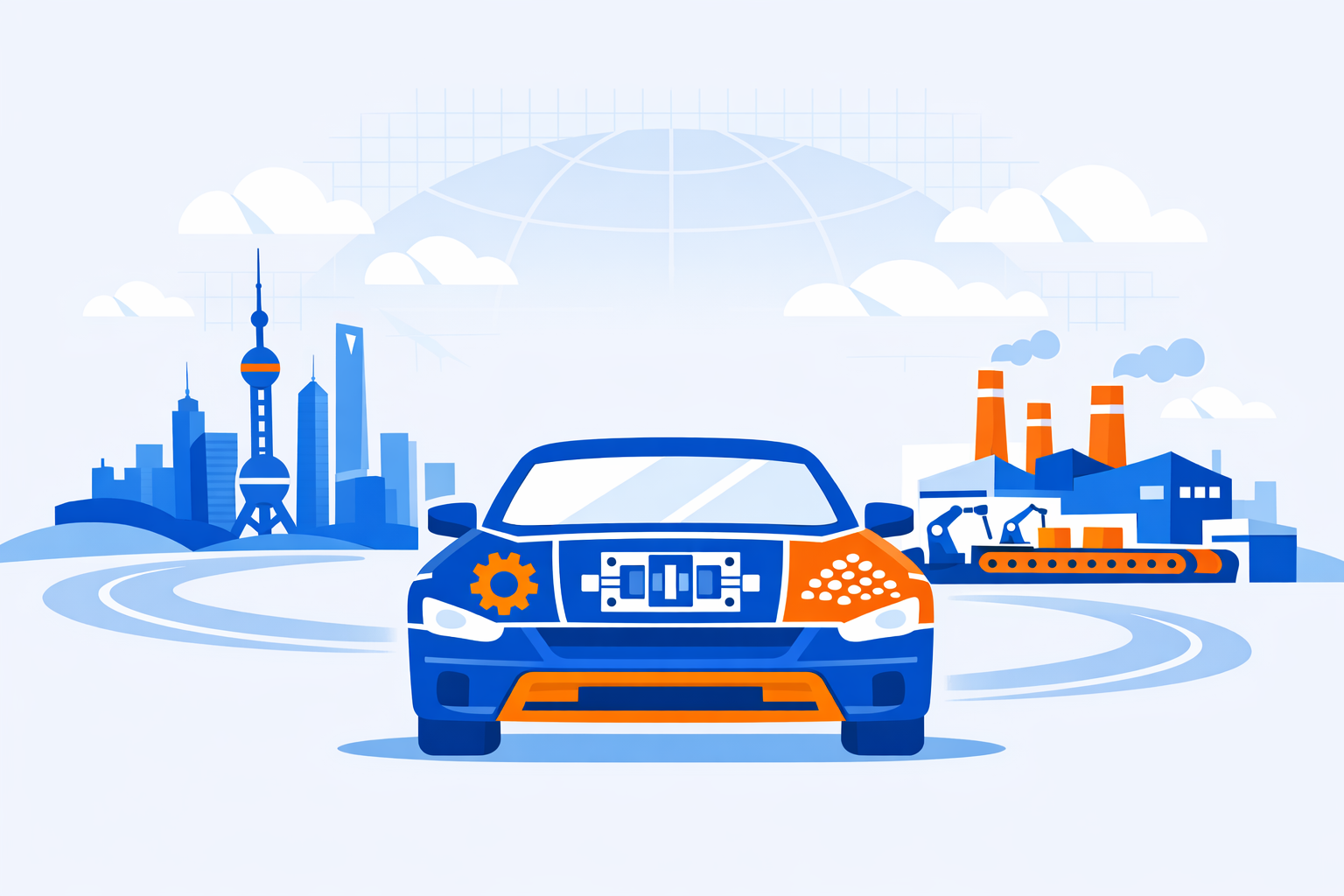
Automotive plastics manufacturing is undergoing significant realignment under the "China+1" strategy, with major suppliers expanding capacity both within China and in alternative regions through 2030. BASF's Cellasto® division has committed approximately €60 million to a second plant in Shanghai, targeting a nearly 70% increase in Noise-Vibration-Harshness component production beginning in 2027. This investment addresses growing demand from electric vehicle (EV) manufacturers in China and reinforces regional supply chains. Concurrently, German high-performance plastics producer ElringKlinger plans to quadruple capacity at its Qingdao Ecopark site, with a Phase II investment projected at 200 million yuan by 2029, up from 20 million yuan in Phase I.
Background
The China+1 strategy, driven by geopolitical tensions and a focus on supply chain resilience, encourages companies to diversify operations across Southeast Asia, India, Mexico, and Eastern Europe. These regions provide incentives such as tax holidays, land grants, and local content stipulations, while preserving access to China's industrial scale. Regulations in Thailand require manufacturers to meet domestic production quotas to qualify for EV tax and import benefits, fostering regional localization of plastics supply chains. Europe's automotive sector remains reliant on China for battery and polymer components, a vulnerability that the European Union is actively seeking to address.
Details
BASF's Cellasto® expansion in Shanghai, announced in April 2025, aims to meet expanding local EV demand by introducing advanced molding capabilities and optimizing proximity to OEM customers. ElringKlinger will grow its Qingdao facility in two phases, with output value expected to rise from RMB 50 million to RMB 300-400 million annually by 2029. In Southeast Asia, Thailand's EV policy-encompassing import duty reductions, excise tax cuts, and local content mandates-encourages automakers to source high-performance plastics domestically. Simultaneously, EU dependence on Chinese lithium-ion batteries and polymers persists, while Eastern European nations continue to strengthen automotive component production to mitigate this exposure.
Outlook
Automotive plastics capacity is anticipated to follow a dual-track approach: sustained domestic growth in China and increased investment in Southeast Asia and Eastern Europe. These dynamics are expected to improve lead times and decrease import reliance for North American and European markets, though some regions may experience competitive pressures from potential oversupply.