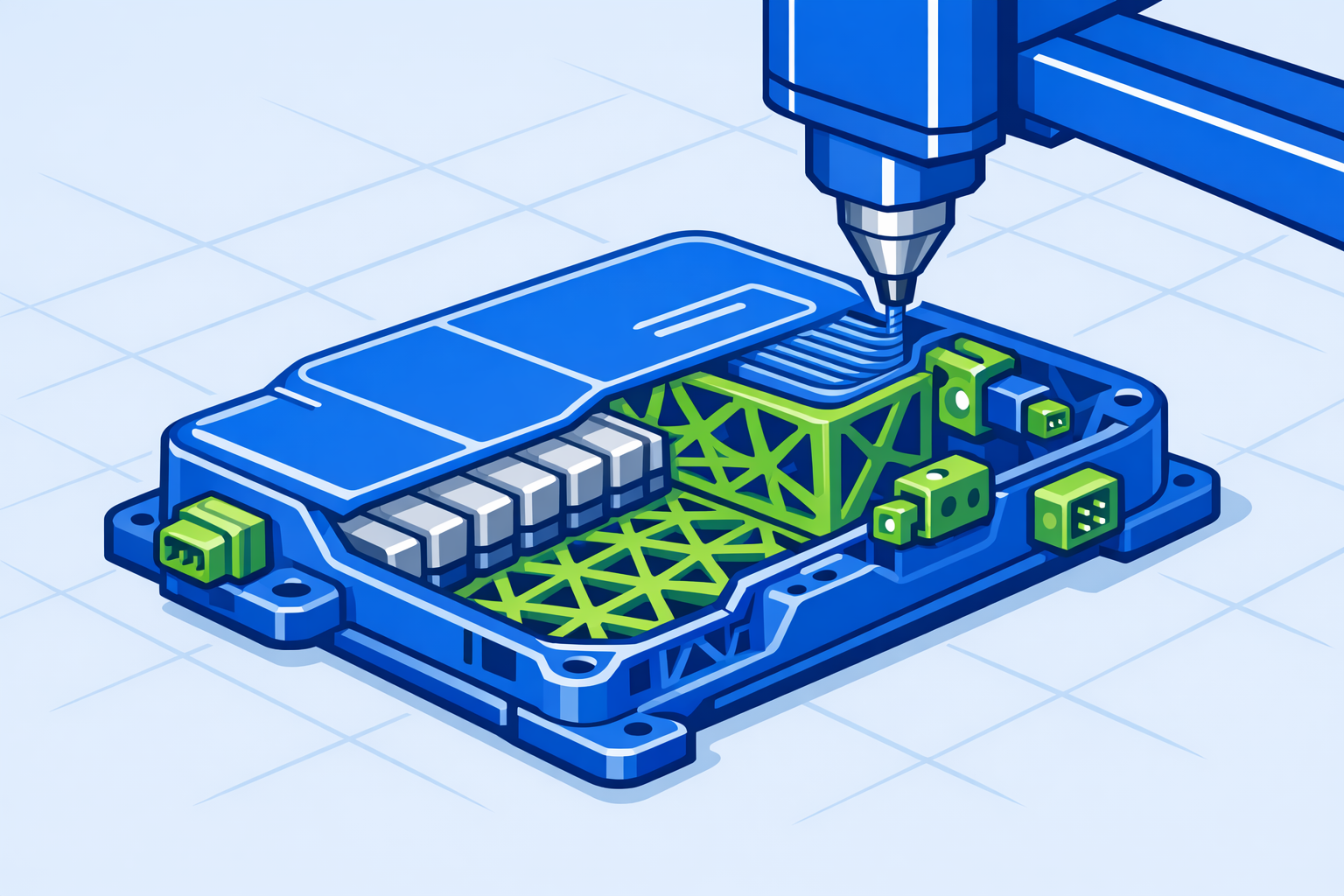
Volkswagen's engineers recently acknowledged using 3D printing to produce AI-optimized battery housing prototypes - geometries so complex that additive manufacturing is the only viable production method - yet stated explicitly that the technology will not be used for volume manufacturing[1] in the near term. That tension between technical capability and production readiness defines the current state of 3D-printed polymers in electric vehicle applications.
Additive manufacturing is advancing rapidly into EV battery enclosures and sensor assemblies. Early pilots demonstrate genuine performance improvements in thermal management, part customization, and cost-per-part for low- to mid-volume production runs. Yet the pace of adoption is outrunning the regulatory and certification infrastructure needed to bring these components into mainstream vehicle platforms - and analysts warn that without harmonized standards, the benefits may remain limited to niche applications through 2026-2027.
Why 3D-Printed Polymers Are Attractive for EV Components
The case for additive manufacturing in EV battery systems rests on several converging advantages that conventional injection molding cannot easily replicate.
Weight and geometry freedom. 3D printing paired with topology optimization[2] allows engineers to produce brackets, housings, and connectors that use less material without sacrificing structural integrity. In an EV context, reduced component weight translates directly into extended range or increased battery capacity - a critical competitive differentiator.
Accelerated development cycles. Unlike injection molding, which requires expensive hard tooling, additive manufacturing enables rapid iteration at minimal cost. Lead times can drop by more than 70%[3] in certain on-demand production scenarios, compressing development schedules that previously spanned months.
Material versatility. Carbon fiber-reinforced polymers produced via AM[2] offer a lighter and potentially more cost-effective alternative to metal parts while retaining the stiffness and thermal performance required in battery enclosure environments.
Sensor and electronics integration. Fused Filament Fabrication (FFF) enables creation of batteries and housings with customized shapes[4], opening pathways for sensor brackets and electrical connector housings printed with functional geometries that injection-molded tools cannot achieve.
These advantages are particularly relevant for the EV sector, where manufacturers face fewer constraints from legacy stamping, casting, and injection molding processes than their internal combustion engine counterparts.
Material Selection: Engineering Performance vs. Certification Reality
The materials currently under evaluation for 3D-printed EV battery housings and sensor components span a broad performance spectrum.
High-performance polymers such as PEEK, PEKK, Ultem™ (PEI), and carbon fiber-reinforced filament are increasingly specified for automotive AM applications because they deliver exceptional heat resistance, high strength-to-weight ratios, and chemical resistance to fuels and coolants.
PEEK has a melting point of 343°C, and materials such as PEI and PEEK provide heat distortion temperatures (HDT) over 200°C, making them well-suited for automotive and aerospace thermal requirements.
High-temperature nylons (PA6, PA66, PA12 with carbon fiber reinforcement) occupy the mid-performance tier. Glass- and carbon-fiber-reinforced nylon grades provide tensile strength and moderate heat resistance up to approximately 120°C[5], making them suitable for sensor brackets and secondary structural components but potentially marginal for direct thermal interface duties in battery packs.
Bio-based polymers are also entering the evaluation pipeline. Manufacturers are exploring these alternatives to balance performance and sustainability targets - a strategy aligned with broader industry momentum toward bio-based and recyclable flame retardant systems[6] as viable replacements for traditional halogenated additives.
| Material | Typical HDT | Key EV Use Case | Flame Retardancy Rating | Standards Readiness |
|---|---|---|---|---|
| PEEK / PEKK | >200°C | Battery housings, structural supports | Inherently low-flammability | Medium (limited AM-specific data) |
| PEI (Ultem™) | ~217°C | Electrical connector housings, heat shields | UL 94 V-0 capable | Medium |
| PA12-CF (Nylon + CF) | ~100-120°C | Sensor brackets, secondary enclosures | Requires FR additives | Low-Medium |
| High-temp PA66-GF | ~120°C | Ducts, brackets | FR grades available | Low |
| Bio-based PA | Varies | Exploratory applications | Emerging FR options | Low |
The Standards Gap: Where Adoption Hits a Wall
The most significant constraint on broader deployment is not material performance - it is the absence of harmonized qualification pathways and accepted test methods for 3D-printed polymer parts in automotive safety-critical roles.
As of 2026, 3D printing lacks widely accepted international standards for design, production, and quality verification, creating challenges for industries that require certification. This gap is particularly acute in automotive battery enclosures, where regulatory requirements intersect with fire safety, long-term durability under weathering cycles, and crashworthiness.
Three specific deficiencies are drawing the most scrutiny from OEMs and Tier 1 suppliers:
1. Flame retardancy acceptance criteria. UL 94 ratings are thickness-specific[7] - a material rated V-0 at 3 mm may only achieve V-1 at 1 mm - and 3D printing parameters themselves can influence flame retardant properties[7]. For injection-molded parts, established automotive standards such as FMVSS 302 provide clear compliance pathways. For AM parts, equivalent automotive-specific acceptance criteria remain incomplete. The automotive industry does not typically apply UL 94 across all applications, often preferring automotive-specific standards - yet those automotive-specific AM standards have not been finalized.
2. Long-term durability under automotive weathering. Automotive qualification demands exposure to UV, humidity, thermal cycling, and chemical environments over multi-year durations. The anisotropic layer structure inherent to most polymer AM processes raises questions about how printed parts perform under cyclic loading and environmental degradation that injection-molded, isotropic parts tolerate more predictably.
3. Certified production process documentation. Quality assurance - meeting parameters and standards for the durability and quality of printed parts equivalent to those of conventional manufacturing - remains a challenging task that may require intensive testing protocols.[3] IATF 16949 quality management requirements are well-established for injection molding but are still being interpreted and adapted for AM production environments.
Standards in Progress: SAE J3012 provides guidelines for additive manufacturing in automotive applications[8], and IATF 16949 is incorporating AM-specific requirements - but neither offers the granular, process-specific acceptance criteria that procurement specialists and regulatory affairs managers need to approve safety-critical battery components.
How Certification Bodies Are Responding
The certification and standards landscape is not static. Several parallel initiatives are building the foundation for more formal qualification pathways.
ASTM's AM Center of Excellence has advanced a cross-industry certification program built with the Additive Manufacturing Certification Committee, a body comprising more than 25 global OEMs. The cross-sector approach - encompassing aerospace, medical, automotive, and semiconductor-adjacent firms - prevents each vertical from independently negotiating AM legitimacy from scratch, instead building shared competence language that accelerates qualification timelines.
ISO/IEC 25422:2025 has formalized the 3MF format as the international standard for structuring and exchanging 3D printing data, a foundational interoperability step supporting the traceability and digital thread requirements increasingly demanded by automotive OEMs.
Certification bodies are also proposing provisional guidelines and collaborative test programs targeting the flame retardancy and weathering gaps. New testing methodologies - including multi-scale testing approaches and enhanced predictive modeling[6] - aim to better predict real-world fire behavior in AM parts. The ANSI Additive Manufacturing Standards Collaborative (AMSC) has separately documented outstanding gaps in qualification and certification for polymer AM, with ASME, SAE, and ASTM F42/ISO TC 261 identified as the relevant standard-developing organizations.
Existing coverage on bio-based and recycled fiber composites for EV battery enclosures from Plastics Insider provides useful context on parallel material development tracks that complement the AM qualification discussion.
Environmental Footprint: An Unresolved Dimension
The sustainability calculus for 3D-printed polymer components in EVs is more nuanced than AM's headline advantages suggest.
On the positive side, AM reduces material waste compared to conventional subtractive manufacturing[9], and on-demand production of low-volume parts eliminates storage costs and overproduction[9]. Bio-based polymers in the AM feedstock pipeline carry additional end-of-life recyclability potential.
However, the energy intensity of industrial AM processes - particularly for high-performance polymer grades requiring elevated chamber temperatures and extended print times - must be evaluated against injection molding baselines on a per-part and per-kilogram basis. End-of-life considerations for multi-material or composite-reinforced AM parts also remain underexplored, particularly where carbon fiber or glass fiber reinforcement complicates mechanical recycling pathways.
The industry is beginning to address these questions through lifecycle assessment frameworks, but standardized methodologies for AM-specific environmental footprint calculation in automotive supply chains have not yet been established.
Outlook: Niche Application or Mainstream Platform?
Technology readiness for 3D-printed polymer battery housings and sensor assemblies varies significantly by application tier. Prototyping and low-volume specialty vehicles - motorsport, fleet customization, early-stage EV platforms - represent the clearest near-term opportunity, where the absence of formal standards is a manageable risk and the speed-to-geometry advantage is maximized.
For mainstream vehicle platforms targeting production volumes in the tens or hundreds of thousands, the pathway remains constrained by the certification gaps described above. Analysts broadly project that without harmonized standards and cross-industry validation, broad-market adoption in battery housing and sensor applications is unlikely before the late 2020s.
The variables that will determine the timeline include how rapidly ASTM, SAE, and ISO working groups finalize AM-specific acceptance criteria; whether OEM-led pilot programs generate the long-term durability datasets needed for qualification; and whether bio-based and high-performance polymer suppliers can demonstrate consistent, lot-to-lot material properties from AM-grade feedstocks.
R&D managers, procurement specialists, and regulatory affairs leads tracking this space should also monitor the KraussMaffei integrated composite and additive manufacturing lines being showcased at JEC World 2026, which signal growing OEM-level investment in production-ready AM platforms.
Key Takeaways
- 3D-printed polymers offer genuine performance advantages in EV battery housings and sensor components - particularly for weight reduction, thermal management, and low-to-mid volume economics.
- The standards gap is the primary adoption barrier, with unresolved acceptance criteria for flame retardancy, automotive weathering durability, and certified AM production processes.
- PEEK, PEKK, and PEI/Ultem™ are the leading material candidates for safety-critical applications, while reinforced nylons and bio-based polymers address secondary component and sustainability requirements.
- ASTM's cross-industry certification program and ISO/IEC 25422:2025 represent meaningful progress, but automotive-specific qualification pathways for polymer AM parts remain incomplete.
- Mainstream vehicle platform adoption is realistically a late-2020s prospect, contingent on harmonized standards and validated long-term durability data from ongoing OEM pilot programs.