Executive summary: The global plastic injection molding machines market is projected to increase from roughly US$8.26 billion in 2025 to about US$14.28 billion by 2035, driven by EV platform investments, lightweighting, and automation-led productivity gains. Electric vehicle adoption, greater use of engineering plastics and composites in battery and powertrain components, and supply chain diversification under "China+1" strategies are collectively driving demand for larger-tonnage, more automated, and more energy-efficient presses. Concurrently, constraints in high-performance resins, energy costs, and skilled labor compel OEMs and tier suppliers to reconsider machine selection, plant layouts, and sourcing footprints.
Market Outlook: Injection Molding Machines on a Steady Growth Path
Recent analysis indicates the global plastic injection molding machines market will grow from around US$8.26 billion in 2025 to approximately US$14.28 billion by 2035, representing a compound annual growth rate of about 5.6%. This expansion occurs within an ecosystem encompassing automotive, electronics, medical, packaging, and consumer goods sectors.
Automotive remains a primary demand driver:
- The automotive sector accounts for over 28% of market revenue, buoyed by EV launches and lightweighting initiatives.
- Production of large structural and appearance components-bumpers, battery trays, front-end modules, and interior panels-depends on high-tonnage machines and multi-component tooling.
Regional capacity centers remain distinct:
- Asia produces around 65% of global plastic injection molding machines; China accounts for about 60% of unit shipments but roughly 45% of total revenue, reflecting its role as a volume producer not a premium-technology leader.
- Europe leads in high-precision, all-electric, and hybrid systems, while North America invests in capacity tied to EV incentives and reshoring.
Technology Mix: Hydraulic, Hybrid, and All-Electric
The industry is transitioning from standard hydraulic presses to servo-hydraulic (hybrid) and all-electric machines, with energy efficiency and precision as key motivators.
Benchmark data for 2025 shows standard hydraulics typically use 0.65-0.85 kWh of electricity per kilogram of processed plastic. All-electric machines operate in the 0.20-0.28 kWh/kg range, while servo-hydraulic hybrids fall in between. This energy difference is significant when molding large EV components or using high-cavitation tools for extended periods.
Technology comparison (typical ranges, 2025):
| Feature | Hydraulic (Standard) | Servo-Hydraulic (Hybrid) | All-Electric |
|---|---|---|---|
| Specific energy use (kWh/kg) | 0.65-0.85 | 0.35-0.45 | 0.20-0.28 |
| Shot-to-shot repeatability | ~±0.15% | ~±0.05% | ~±0.01% |
| Cooling water demand | High (oil cooling) | Medium | Low / near-zero |
| Noise level | >75 dB | 68-72 dB | <65 dB |
| Typical upfront cost index | 100 | ~115 | ~135 |
Beyond energy savings, total cost of ownership (TCO) analyses show reductions in fluid handling, maintenance, and chiller demand may offset the higher upfront cost of all-electric machines within a few years, especially in high-energy-cost regions.
How EV Adoption Is Rewriting Tonnage and Tooling Requirements
EV Demand as a Long-Term Capacity Signal
Global plug-in electric car sales reached about 14 million units in 2023-or nearly 18% of all new car sales, up from 14% the previous year. Updated figures show electric car sales surpassed 17 million in 2024, raising EVs' global market share beyond 20%. Policy targets and OEM product plans project continued growth through 2030.
This EV momentum requires:
- High-tonnage presses for battery enclosures and large underbody sections.
- Multi-component (2K/3K) machines for complex lighting and sensing modules.
- Cleanroom-compatible all-electric systems for electronic modules.
From Under-the-Hood Plastics to Battery Enclosures
Plastics and composites usage in vehicles has expanded steadily and now plays a vital role in EV performance.
- Industry data shows the average light vehicle contained approximately 426 pounds (193 kg) of plastics and polymer composites in 2023, nearly 10% of total weight-up 20% over the past decade.
- A recent EU-focused study reports a typical passenger car now contains about 240 kg of plastic, emphasizing polymer's broad adoption.
Key EV applications include:
- Battery systems:
- Injection-molded and overmolded battery covers, trays, and separators using flame-retardant glass-fiber-reinforced polypropylene and polyamide.
- Thermoplastic composite battery enclosures via sandwich injection molding or injection-compression, integrating structural features in a single shot.
- Electric drive and power electronics:
- High-temperature engineering thermoplastics for motor and inverter housings, busbar supports, and connectors.
- Thermal and safety components:
- Overmolded cooling channels, impact shields, and arc-flash protection in high-voltage zones.
Recent trade shows have featured large thermoplastic composite battery covers produced with direct long-fiber thermoplastic (D-LFT), with OEMs targeting significant weight reductions over steel or aluminum without compromising safety.
Shift Toward Large-Platen, High-Tonnage Presses
Machine requirements for EVs differ sharply from those of traditional internal combustion engine (ICE) platforms:
- Battery trays and large underbody parts often require clamp forces above 2,000 tons; some components use 4,000-5,500-ton machines for high integration.
- Two-platen hydraulic machines lead in the >500-ton segment due to compact footprint and linear tonnage development, fitting long-flow tools.
2025 market analysis estimates around 18% of new high-tonnage (>500-ton) injection molding machine orders are for EV battery or sensor-housing uses, with this share rising as more platforms adopt battery electric architectures.
These shifts affect capacity planning by requiring:
- Maximized floor space utilization and crane capability for large molds.
- Enhanced mold-flow simulation and advanced cooling for managing warpage and cycle times in large sections.
- Greater automation in part handling and in-line quality inspection to maintain OEE at scale.
Automation, AI, and Digitalization Move from Pilots to Plant Standard
Smart Machines and MES Connectivity
Injection molding cells increasingly function as integrated cyber-physical systems. Standard interfaces and communication protocols drive this shift.
- Euromap/OPC UA interfaces (such as Euromap 77/83) have become standard for tier-1 automotive suppliers, facilitating real-time monitoring and data exchange with manufacturing execution systems.
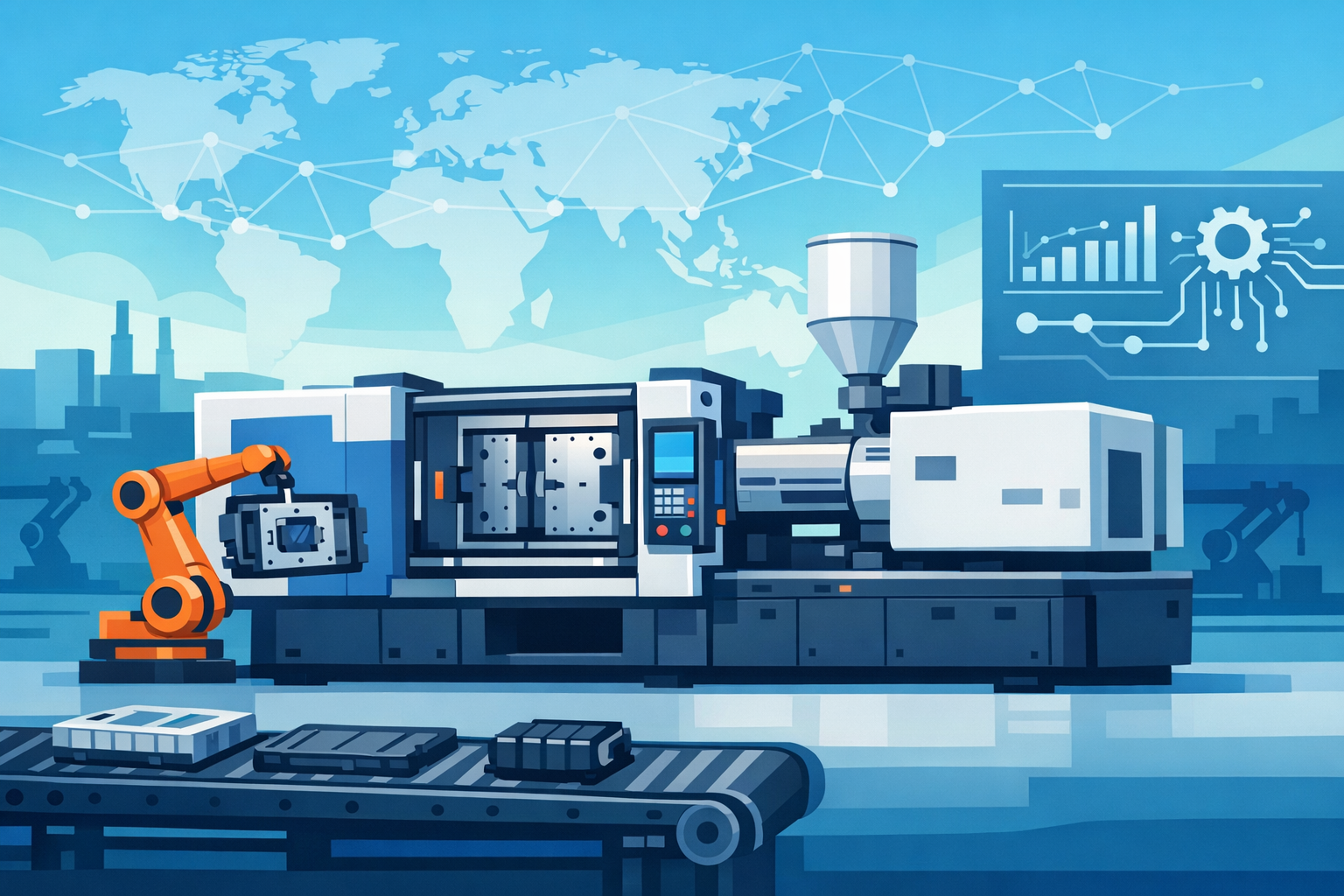
- Modern installations increasingly feature integrated robots, conveyors, and vision systems as standard components, not post-install add-ons.
IoT-enabled molding cells have demonstrated that real-time monitoring of cycle data, shot quality, energy usage, and downtime can raise OEE by double-digit percentages and cut unplanned stoppages, especially with automated material and mold changeovers.
AI-Enhanced Process Control and Predictive Maintenance
AI and machine learning now address process stability under variable material conditions and compensate for shortages in expert technicians.
Advances include:
- Smart viscosity correction and closed-loop control:
- Machines detect melt viscosity changes-driven by batch differences or recycled content-and adjust speed, pressure, and hold time accordingly.
- Industry benchmarking shows adaptive control can cut scrap rates by up to 40% when processing recycled or regrind materials, compared to static settings.
- Edge AI for quality inspection:
- Explainable AI models are being used to classify product quality from in-cycle sensor data, reducing offline inspection needs.
- Predictive maintenance for critical components:
- Embedded sensors monitor vibration, lubrication, and wear, enabling algorithms to forecast maintenance needs and prevent unexpected failures.
AI-driven optimization frameworks are also in development at the plant level. Deep-reinforcement learning (DRL) models are being piloted to adjust process parameters across molds and machines for quality and efficiency, factoring in real-time energy prices and scrap rates.
China+1 and the New Geography of Injection Molding Capacity
Supply Chain Decoupling as a Demand Driver for Machines
The outlook for US$14.28 billion by 2035 is linked to supply chain diversification and China+1 strategies.
- OEMs are implementing the China+1 approach-diversifying production from China to other locations such as India, Vietnam, Thailand, and Mexico-to mitigate geopolitical risk and tariffs and shorten lead times.
- Chinese and Western machinery OEMs are expanding assembly and application support in Southeast Asia, Mexico, and Europe.
Emerging Hubs: Southeast Asia, India, and Mexico
Cost and geography are influencing machine and tooling installations:
- Southeast Asia (SEA):
- Analyses estimate manufacturing labor costs in SEA at 50-60% of Chinese levels, aided by a strong network of free trade agreements.
- The region is taking a larger share of relocated injection molding for consumer, electronics, and automotive parts.
- Mexico and North America:
- Nearshoring reports show Mexican industrial labor costs at about 40% of U.S. equivalents, with transit to U.S. plants measured in days.
- The USMCA and EV content rules are spurring new investments for battery, interior, and charging parts.
A simplified comparison of sourcing strategies:
| Model | Typical regions | Lead time to OEM plant | Tariff / trade exposure | Primary rationale |
|---|---|---|---|---|
| China-centric | Coastal China | 4-6 weeks (ocean) | Higher tariffs in U.S./EU risk | Lowest unit cost, dense supplier base |
| China+1 (Asia diversified) | China + SEA/India | 2-4 weeks | Spread across regimes | Risk diversification, labor cost arbitrage |
| Nearshore to Mexico/EU | Mexico / CEE / Turkey | 2-5 days (truck/train) | Preferential under USMCA/EU FTAs | Lead time, responsiveness, logistics savings |
For EV programs with varied ramp profiles and tooling content, the ability to adapt production rapidly often outweighs unit cost differences, bolstering the shift to multi-hub models.
Constraints: Resins, Energy, and Skills
Several constraints may limit market growth despite favorable demand.
High-Performance Resin Availability
EV components rely on high-performance polymers:
- Flame-retardant, glass-fiber-reinforced PP and PA for battery housings.
- High-temperature resins (PEEK, PEI, PPS) for electronics and motors.
Studies identify limited high-performance resin availability and price volatility as a significant challenge for injection molding's expansion into advanced EV and electronics applications. Production capacity for these materials is lagging demand from EVs, electronics, and aerospace.
Energy Cost Volatility
Rising energy costs, especially in Europe, directly impact the economics of high-tonnage presses.
- Supplier and trade association data indicate post-2024 electricity price hikes of 10-15% in parts of Europe have accelerated adoption of energy-efficient servo-hydraulic and all-electric machines.
- Plants with older machines are under pressure to upgrade or replace equipment where retrofit ROI cannot be demonstrated.
Workforce and Skills Gap
A skills shortage is creating additional challenges.
- Analysts note a significant gap as experienced "master molders" retire. Some North American reshoring efforts report technician shortages of about 20%, delaying cell launches.
- Investment in user-friendly interfaces, recipe-based setups, automated start-up, and AI troubleshooting is increasing in response.
Automation and digitalization thus address both productivity and workforce constraints.
Strategic Implications for OEMs and Tier Suppliers
Machine Portfolio Strategy
Current trends suggest key approaches:
- High-tonnage: Plants serving EVs are structured around few very large, two-platen or tie-bar-less machines with turnkey automation and robust tooling.
- Precision clusters: Electronics and connector manufacturing shifts to clusters of medium-clamp all-electric machines with unified MES and quality analytics.
- Hybrid fleets: Many sites deploy mixed fleets-standard hydraulics for non-critical parts, hybrids for packaging or mid-size parts, and all-electrics for high-precision, cleanroom work.
Automation and Data Roadmaps
Facilities are advancing digital integration in stages:
- Connectivity and visibility: Integrate machines with MES, OEE, and energy dashboards.
- Closed-loop quality: Implement cavity pressure monitoring, in-mold sensors, and vision systems linked to automatic adjustments or part rejections.
- Predictive optimization: Apply AI models and digital twins for parameter management across molds, materials, and shifts.
For EV molding, traceability systems for safety-critical parts are now standard, not optional.
Supply Chain and Footprint Decisions
China+1 and nearshoring trends alter strategic questions on machinery and tooling:
- Where to locate large-tonnage presses for optimal logistics, duty exposure, and service support.
- Whether to maintain mold-building in China or shift capacities to India, SEA, Mexico, or CEE.
- How to standardize machinery specs, controls, and data protocols across regions.
Actionable Conclusions and Next Steps
Key recommendations for automotive plastics, composites, and EV stakeholders:
- The injection molding machines market's projected growth to about US$14.28 billion by 2035 depends on sustained EV demand, supply chain diversification, and wider automation.
- Plan high-tonnage capacity and multi-component tooling for battery enclosures, underbody structures, and advanced electronic modules.
- All-electric and efficient hybrid machines offer competitive TCO in regions with high power costs or stringent sustainability goals.
- Plants that systematically capture process data will realize the value of AI-driven process control and predictive maintenance as these tools mature.
- China+1 strategies require standardized approaches to machinery, tooling, and data to prevent operational fragmentation.
Indicative next steps:
- Reassess installed clamp-force profiles against long-term EV program forecasts.
- Prioritize replacement of high-energy, high-maintenance presses.
- Develop OPC UA/Euromap connectivity and MES integration standards for new equipment.
- Quantify cost and risk of China-based, China+1, and nearshore sourcing for molds and parts.
- Form cross-functional teams to pilot and evaluate AI and analytics solutions before large-scale deployment.
Frequently Asked Questions
What is driving the forecast to US$14.28 billion for plastic injection molding machines by 2035?
The projection to around US$14.28 billion is driven by global EV adoption, increased demand for advanced and automated machinery, and supply chain diversification. Automotive EV, medical, and packaging programs require higher-spec equipment, while China+1 and reshoring add capacity in new regions.
How is EV manufacturing changing typical clamp-force requirements in injection molding?
EV manufacturing increases demand for presses above 2,000 tons for large structural parts and for medium-tonnage all-electric machines for electrical components, while the 200-500 ton segment continues to serve interiors and conventional parts. The share of >500-ton machines specified for EV programs is rising.
Where does automation and AI deliver the fastest ROI in injection molding plants?
The most rapid returns appear in automated part handling for high-volume tools, closed-loop process control that reduces scrap rates (especially with recycled materials), and predictive maintenance to minimize downtime on critical equipment. Plants with robust process data achieve quicker paybacks from AI-based optimization tools.
How does the China+1 strategy affect decisions on equipment purchases?
China+1 often results in parallel machinery investments across regions, emphasizing standardized control systems and data protocols. Many companies specify consistent machine models and automation in China, SEA, India, and Mexico, adapting tonnage and automation depth to local needs.
What should OEMs and tier suppliers prioritize when planning new EV-focused molding capacity?
Priorities include aligning clamp-force and platen sizes to EV requirements, specifying open-standard data interfaces for MES and quality systems, and designing cells for flexibility with new materials and products. Energy efficiency, recyclate compatibility, and AI-readiness are becoming key selection criteria alongside cycle time and tooling considerations.