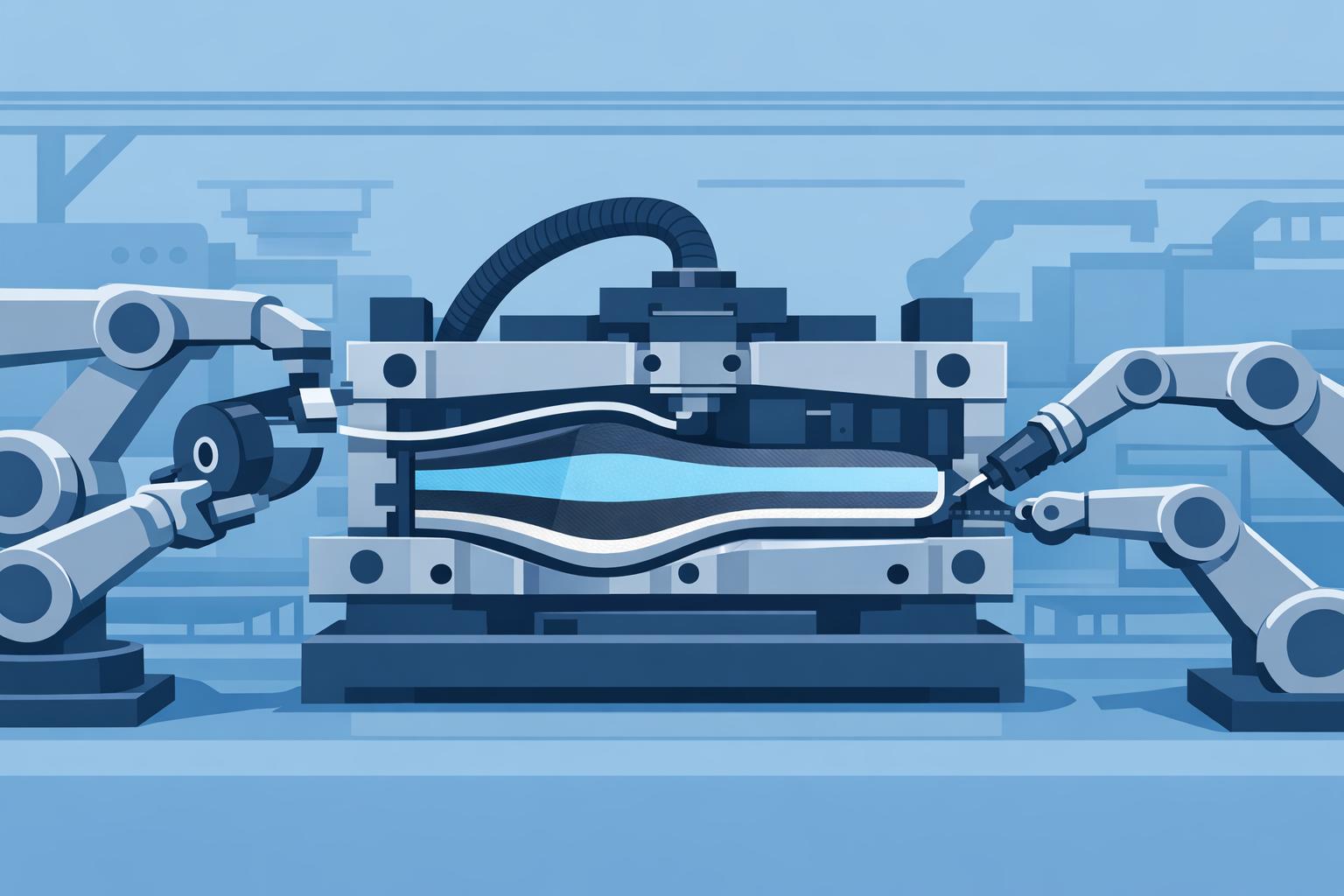
ENGEL unveiled a fully automated thermoplastic composite rotor blade manufacturing process for drones at JEC World 2026 in Paris. The system integrates reinforcement placement, foamed-core injection molding, and recyclability in a scalable sequence. Known as "tape-sandwich injection molding," the process uses carbon-fiber-reinforced thermoplastic tapes, precisely positioned by vacuum, combined with an injected short-fiber thermoplastic core. Chemical foaming reduces weight, and all steps occur within a continuous automated cycle using a tie-bar-less ENGEL victory 120 press and an easix six-axis robot. ENGEL reports cycle times of under 60 seconds per part, integrated noise-reducing serrated trailing edges, and enhanced sustainability through recyclability and reduced CO₂ footprint.
Background
ENGEL's automation builds on its established high-volume injection molding expertise for lightweight composites, applying these principles to thermoplastic structures. The tape-sandwich molding concept consolidates reinforcement layup, core injection, feature integration, and trimming into one streamlined process. This approach enables near-net-shape parts with minimal post-processing. It reflects industry trends toward scalable, sustainable manufacturing and closed-loop material cycles.
Details
The demonstration setup featured carbon-fiber-reinforced thermoplastic tapes, aligned along precise load paths and held by vacuum in the mold, concentrating material use only where structurally required. A short-fiber thermoplastic core was injected between the tapes, bonding to form a lightweight sandwich structure. Chemical foaming further reduced weight while preserving mechanical properties. Following trimming, the rotor blade was ready for deployment. Sub-60-second cycle times were achieved through the tie-bar-less design, allowing full automation of feeding, handling, and part removal. ENGEL also displayed integrated acoustic features, such as serrated trailing edges, enabled by interchangeable mold inserts.
The rotor blade project forms part of ENGEL's NeoBlade research initiative, a collaboration with ALPEX Technologies, JKU Linz's Energy Institute, FACC Operations, Plastic Innovation, and TU Wien's Aircraft Systems Research Group. The consortium explored various thermoplastic systems-including high-temperature, cost-efficient options, and recycled carbon fiber compounds. Life-cycle assessments showed a significant CO₂ footprint reduction compared to traditional thermoset processes. The recyclability of thermoplastics facilitates the reuse of production scrap and end-of-life parts.
Additionally, ENGEL showcased a full-scale thermoplastic high-voltage battery cover (1.3 × 1.8 m), produced using the same sandwich injection molding method. As a JEC World Innovation Awards 2026 finalist, this part underscored the method's scalability, demonstrating suitability from small rotor blades to large structural applications. Integrated features such as spacers and fastening points and complete recyclability were also presented.
Outlook
ENGEL's demonstration suggests rapid industrial scalability for automated thermoplastic composite production in drone, automotive, and aerospace structural uses. As the NeoBlade initiative and related projects progress, the process could enable cost-efficient, high-rate, environmentally responsible manufacturing of lightweight structural components.